Showing posts with label data and trends. Show all posts

Dec 6, 2009

Facebook: What's The Point?

2 comments
Three cute little kids playing soccerIt's time for end of year rankings. This week the top fifty brands on Facebook were identified.
...a ranking of the brands that are currently making the best use of Facebook. Various metrics—including fan numbers, page growth, frequency of updates, creativity as determined by a panel of judges, and fan engagement—were factored into each page’s score and ultimate rank on the list.--More from The Big Money.
The list included beverage companies Dr. Pepper, Coke and Mountain Dew to food companies Crispy Creme, Ben & Jerry's and Taco Bell to lifestyle brands like Louis Vuitton, Audi and Victoria's Secret.

These companies made the list--with very few exceptions--for the lamest of reasons. And without a discernible formula for success.
  • Two companies with millions of fans have "impressive fan base even though it rarely updates its page." Does this mean that you shouldn't interact with your fans?
  • One company was cited as a success because it posts frequently for fan engagement. Another was successful because it posts infrequently--their fans don't like to hear from them. Some companies post fan pictures or videos on their corporate pages. Does this mean you should interact with your fans? Or not?
  • A number of companies proved that buying ads on Facebook led to more fans. Well, duh! But what happens after the ad buy? What do these fans do? How does having fans help reach organizational goals?
  • A few other organizations found out that when they gave things away--hamburgers or danishes--people become fans. Again, after the promo was over, fan growth rate slowed. And it's unclear what the fans will do--buy another danish?
  • And, to great fanfare, a few media companies get "many" people to "like" their Facebook entries. How many of these fans who "like" a post actually click through and read the entire article? Is there a small core of people who click "like"? Do they share the link? Do their friends click through, increasing traffic? Why is "liking" important to an organization?
I am not saying that growing a fan list on Facebook is unimportant. I am wondering, however, why these companies are doing it. The raw number measures are not very meaningful. I would like to know
  • Do more people use free danish coupons in the Sunday paper? How do those customers compare with Facebook "fans?" Are they the same?
  • What does it mean if someone "likes" a page? Are people who "like" pages more likely to partake in another valued activity?
  • How do you find out how many fans are blocking your organization from their news feeds--basically hiding your messages? What is the percentage? Is there a natural falloff?
  • There are 350 million people on Facebook. What's the big win if 8,000 (2%) of your fans--a grossly insignificant number of Facebook users--vote in your contest? How do you grow that into something? What would success look like?
One bright light, Audi is using it's Facebook fan page to ask people to fill out a survey to tell the car company how they would like to interact. Not so lame.

Bottom line, it's not U-6 soccer, where everyone gets a trophy for showing up. It's past time where showing up is good enough.

A while back, I reminded government to be careful in believing its own hype. It all comes down to measures that mean something. Let's show that we take engagement seriously and create goals and measures for social media--otherwise we will not know if it's "working."

It's time for the big leagues, with stats collected and analyzed for each game, pubic win/loss records and accountability.

Dec 1, 2009

3 Reasons To Get With The Program Already

5 comments
Old-fashioned Underwood brand manual typewriterFirst, the change has already happened. It's done.

What has changed is the way people communicate and interact--with each other, with companies, with government. We don't yet know what that means. We can try and predict, but the main outcomes of these predictions is fodder for future laughs.

Now to you naysayers who say that not everyone is plugged in, not everyone uses social media or the Internet or even e-mail, I say, "So? You don't have to drive to know that cars changed the way we live, where we live, how we shop, where we go."

And, to you near-term nostalgics, the people who think that texting, tweeting, friending and gaming are stupid, who prefer a stamp to online banking, I say, "it's okay for you to feel that way, just realize that the rest of the world is embracing new channels."

Second, your brand has changed. "Brand" is not a visual representation of your organization. It is the experiences that people have with your organization and the sharing of these experiences within their networks. Brand doesn't belong to your agency, it belongs to people who interact with your agency.
For example, 65% of U.S. consumers report a digital experience changing their perception about a brand (either positively or negatively) and 97% of that group report that the same experience ultimately influenced whether or not they went on to purchase a product from that brand. In a nutshell, experience matters. A lot.

...That's why Amazon continues to pour money into improving its customer service rather than run traditional advertising or marketing campaigns. As Amazon CEO Jeff Bezos has said, "We are not great advertisers. So we start with customers, figure out what they want, and figure out how to get it to them."--
See more at AdAge.com
This matters a lot to government--at least it should. People expect that their tax dollars pay for the same types of experiences that they have in the private sector. When we disappoint, we fail. Government needs to better engage with citizens and provide services that people seek--less time broadcasting/marketing our messages and more time building good experiences. Better experiences will translate into better confidence in government.

Third, you simply disappear if you are not present. People are watching TV on their cell phones at their convenience. The entire country does not sit down at 6 p.m. to watch the evening news on traditional broadcast channels.
This is why monitoring, establishing and cultivating a strategic presence and inspiring meaningful engagement is so critical in social media. It impacts the bottom line. If we are not present within the attention dashboards of our existing customers and prospects, we intentionally remove ourselves from their decision-making funnel. Consumers are among the new influencers as they now have access to the same tools and channels that reach peers and shape their impressions.--[emphasis mine] More from digital marketing expert Brian Solis


Government frequently suffers from disproportionate emphasis on traditional communications channels. The story in the NY Times, the interview on CNN will remain important, but not the most important. The results from search engines that lead to content on web sites or engaging applications that are passed around and shared among friends on social networks are equally valuable. We have the skills to get traditional news stories, it's time to build skills to bring information directly to citizens.

Wake up! The world has already changed! But we still have time to shape what it will be and what government can do to better serve our citizens.

Oct 26, 2009

Shorts: Twitter Grows, Report Cards, Drupal and Memos

1 comments
Twitter grows. Pew released some data last week about growth in Twitter use--from 11% of Internet users to 19% in just six-months. Other findings? Three groups of internet users are mainly responsible for driving the growth of this activity, social network users, people who are using mobile and folks under age 44. See more at the Pew Internet Project.

White Paper Report Card. Candi Harrison asks, "Web Manager Council’s White Paper – Is There Progress A Year Later?" In her post she recaps the goals of easily identifiable, relevant, accurate, and up-to-date information that is easy to understand, addresses citizen tasks, is consistent across channels, provides feedback channels and is accessible across reading, ability and language barriers. She gave government a mixed review. See more here.

White House goes Drupal. And TechPresident swoons as they announced that whitehouse.gov has moved to Open Source Software and dropped their proprietary system. I am not sure that this is a great advance for democracy--bottom line is that there will be a custom (read proprietary) system built on the open source platform. But it is good for open source. See more at TechPresident.

Finally, NextGov reports, no movement from White House on the issuing of the Open Government memo that the President announced January 21. See Next Gov.

Oct 4, 2009

Hey dot-gov! Don't Believe Your Hype

5 comments
Pink Floyd's Dark Side of the Moon album cover.Success! Popularity! Fans! Page views! I win! Seems everybody wants to be Internet-important. Not to bust anybody's bubble, but government success and engagement numbers benefit from some perspective.

For starters, Federal Computer Week listed the "Top Ten Agencies with The Most Facebook Fans." Tops is White House's Facebook page with (now) 375,000 fans. That's a respectable number that continues to grow. But for comparison, the Facebook page for Nutella--that chocolate hazelnut spread--has 3.3 million fans. Plus there are two other Nutella fan pages with 977,000 and 750,000 fans each.

NASA, government's popular space agency, is pulling closer to 10,000 fans of it's Facebook page. Pink Floyd--a band that released it's last album the day that Netscape was founded and who created one of the best rock albums of all time Dark Side of the Moon (released in 1973 the same year that NASA's space station Skylab was launched)--has 1.6 million fans. [See also Mark Drapeau's post on this topic.]

Second, there are the arguments I hear about the important power of government content and presence on the Internet. Overall, this is true. According to comScore data* all dot-gov traffic combined puts government among the top 10 online properties.

Top websites by unique visitors, Google, Yahoo!, Microsoft, AOL, Facebook. ALL of Dot-Gov, Fox Interactive, Ask Network, Ebay, AmazonLooking closer at the numbers is more sobering. Because government sites are fragmented they are less trafficked than the aggregated numbers show.

For example, the online classified site craigslist.org has three-fifths (60%) the traffic of the entire government. Comparing the State Department--despite high traffic for passport and travel information, the sports-entertainment site ESPN has ten times more visitors. Commerce.gov--whose data includes hurricane and storm tracking from noaa.gov, weather.gov, time.gov--has less than one-sixth the traffic of the popular Weather Channel. And, the transaction heavy Social Security Administration has 10% of the visitors that Wal-Mart does.


Government websites and social media efforts exist in a broader ecosystem. Yes, let's celebrate success, but let's first define and refine what that means. The tough news? Looking at numbers without context can lead to believing that you are more important than you really are. The good news? The fact that you are less important than you think doesn't mean that you aren't important at all.

* The comScore data on government sites July 09 and regarding other media sites Aug 09.

Sep 8, 2009

Shorts: Wiki Strategy Tool, NonProfits Blog, Cultural Divide

1 comments
Smithsonian sharing their social media strategy development via wiki. Check out the process and get some tips on developing your own new media plan on this wiki. The plans are to feed the web and new media strategy into the Smithsonian's comprehensive strategic plan. Look and learn on the wiki.

Nonprofits lead way in social media adoption. The Society of New Communications Research looked at the 200 largest U.S. charities and found nonprofits outpaced corporations and academic institutions in their adoption of social media. 57% of charities have blogs compared with 18% of the Fortune 500. See more on BizGtowthNews.

The great gov 2.0 cultural divide. On his GovFresh blog, Luke Fretwell uses this week's Gov 2.0 summit and events as a backdrop to smartly talk about bridging the gap between Washington and West Coast tech-entrepreneurs. He says "Washington, D.C., needs to understand Silicon Valley entrepreneurs are no different than GSA Schedule government contractors or corporate-funded trade associations, all seeking to profit on an industry that will never file for bankruptcy and can always print more money." Read more on GovFresh.

Aug 23, 2009

To the Data User: Caveat Emptor

0 comments
Last week a few reports were released that can help shed some light on teen Twitter behavior.

[begin rant] You likely heard about the Morgan Stanley [rubbish] "report" written by a precocious fifteen-year-old intern from their London office. It's been stuck in my craw since it's post-release media flurry. No disrespect to the young man who solidly reported the experiences of he and his mates, but the ah-ha frenzy of corporate boardrooms and media belies that every observant parent of teens already knew what their kids do. [end rant]

Anyway, among the "findings" in the report--and one I have been arguing about--is that teens don't use Twitter because they are limited by limited cell phone use and texting.

Last week, Pew released a study on teens and cellphone use.
  • 71% of the people between 12-17 have cell phones. The percentage jumps to 85% for 16 and 17 year-olds.
  • Use is up from 63% in 2006 and almost catches teens up to the 77% of adults with cell phones.
  • Almost 40% send text messages DAILY.
  • Three-quarters of the 18-29 year olds text daily. (Pew Wireless Internet Use)
So, looking at the data, it doesn't seem that there is a huge lack of access to cell phones or text messaging that would limit the use of Twitter for teens.

THEN, there is the idea that it's important to tweet from your cell phone.

Read Write Web reported, also last week, that Twitter users are most likely to use the Web, not a cell phone, to share their tweets.
[U]pdating your status online via Twitter.com is still the dominant way that most people use Twitter, with 65% of tweets attributed to this method....Besides the web, which accounts for nearly two-thirds of Twitter updates, the second most popular way to update Twitter.com is via text message. However, with 6% of tweets sent, this method only accounts for 1/10th as many tweets.--Read more on Read Write Web.
Data shows that text messaging from phones is not preferred by Twitter users, period. Since more than 90% of all 12-17 year olds are online, more than any other age group, teens have at least the same access to the Twitter web interface as any other Twitter users.

So, the data does not support that dismal teen tweeting is "caused" by the lack of access to technology. It's more likely that they simply are not interested in Twitter

"So," you ask, "why did you go here? Taking us on this trail for a little tidbit of clarification on a fairly small topic?"

Two reasons. First, it's critical that folks working on innovation and technology make decisions based on data, not just fashion. And, second, it's imperative to take a hard look at the data sources. We need to carefully look at the data and assumptions and get past the hype, whenever we can. And not pass on the hype.

[Okay, and thirdly, because I was right and now there's nothing stuck in my U-Mich SRC craw. The benefits of being the blog owner.]

Aug 18, 2009

Research on Privacy Perceptions

0 comments
The White House is reviewing the federal government's cookie policy. Abridged version, it's been a 9-year rejection of the use of what many see as a benign tool and others see as government invading citizen privacy.

Part of this discussion has included what privacy means to people using online tools in 2009. Some think that people don't care about privacy, some that folks have no (or should have no) expectations of privacy, and others think that people care very much about their online privacy.

Fortunately, to help us learn more about just what privacy means, Patricia Abril and Avner Levin published a paper in the Vanderbilt Journal of Entertainment & Technology Law on privacy perceptions in online social networks. The team surveyed 2,500 young adults between the ages of 18 and 24 about the personal information they post online, what they do to protect their information, and any concerns regarding their personal information.

They reported that sharing information on social networks, and allowing other to share information about you, creates vulnerabilities, and that people know that they are potentially vulnerable.
  • 72% have adjusted privacy settings to restrict some groups of people from accessing their profiles.
  • More than 60% believe that they have taken sufficient steps to protect themselves.
  • 42% said they have read social networking sites' privacy policies.
  • Only 22% were not concerned that information about them (photos, videos, comments by others about them) could be created and posted by others.
  • 67% said that they were were most concerned about potential harm to their image or reputation.
  • 54.3% agreed with the statement, “Work life is completely separate from personal life, and what you do in one should not affect the other.”
  • 82% said that it would be inappropriate for employers to require them to "friend" a manager.
This young cohort appears to be both careful and realistic about their privacy. They are most worried about privacy lapses that could affect their reputations. And they want to keep some sort of firewall between their social selves and their work selves.

Based on their research, Abril and Levin created a concept of "network privacy."
We call this notion network privacy. According to network privacy, information is considered by online socializers to be private as long as it is not disclosed outside of the network to which they initially disclosed it, if it originates with them, or as long as it does not affect their established online personae, if it originates with others. [online social network]s, as businesses profiting from socializing online, are best positioned to offer online socializers, often the young and vulnerable, effective protection in accordance with their notion of network privacy above and beyond regular measures of personal information control, and they should be required to do so.--Read "Two Notions of Privacy Online."
Moving forward toward a meaningful, twenty-first century privacy policy, we will need to recognize the conflict between the desire and need to share information within networks and the difficulty in regulating networks with loose barriers.

Translating this to the cookies' debate, it seems that people may be less concerned with the mechanics of being "tracked" except when any "tracking" would reflect poorly on them.

Aug 2, 2009

If You Build It, NOT: 4 Pointers for Search Optimization

5 comments
The field of dreams baseball players appearing out of the magic corn field walking on to the magic baseball fieldIt's a MYTH! A MYTH! A MYTH I TELL YOU!

Just because you build it, nobody will come. Sure, you announce to your friends and stakeholders, but then what? There will be no miles long trail of cars snaking through cornfields to experience your vision. It's a movie. And a myth.

Yes, viral is important, but you can't manufacture true viral. It just happens.

I have been calling out this myth for 12 years. And, in this time of fractured media and spliced attentions, it is critical to be level-headed and recognize that there is effort involved in driving traffic. Launching your website or application is not the end. You need to help folks find it.
Eighty percent of all online sessions begin with search. Google alone has a 63.7 percent share of all searches. Some quick math tells me that this means that just over half of the time someone starts an online session, they open to Google and begin to search. Bottom line: Most of the time people go online, they start with a search -- and don't type in your URL.

Instead of typing in your URL and ending up on your site, people are using search engines to find what they are looking for. The question is: Will they find you? You might not like the answer.

It turns out that the top three listings on a search engine results page account for approximately 63 percent of all clicks. That is, about two-thirds of the time, people look no further than the first three listings before clicking. So, clearly that's the place to be. --See
more from Jonathan Richman at I Media Connection
There are many books, blogs, websites and experts on helping people find you (also known as search engine optimization). My purpose today is to start you thinking about making your content more accessible to search engines. Here are four starting pointers.

1. Don't be cute. Search engines look for clues on your pages to let them know what the page is about. They usually think that titles and headings provide pointers to what is important. So, every time you create a cute name for your page and use teaser language for your headers instead of clearly telling and leading readers (and search engines) about your purpose, you are turning them away.

2. Use normal words. Speaking of not knowing, search engines can't translate your arcane, governmentese into something findable. Especially when you are using your own special language. You may love your acronyms, but the uninitiated will not have a clue. No clue means they can't find you.

3. Seek out resources. You can learn about words people use to describe your services. Your site search should report the words that people are searching on. If they are looking for "green card" and you only use the official name "LPR," you are turning them away. And away means to another source. Also, visit the Google Keyword Tool to learn related words and phrases. Incorporate these words into your pages.

4. Select some pages and make changes. Identify a few terms and their pages you want to drive people to. Update the page title, headers and copy with the normal words. Check your progress by searching on these terms on Google, Bing, YAHOO, Ask. The results are easy to see. Also see MarketLeap.com for quick keyword verification across multiple search engines.

Now go do some more research, you might want to start with Search Engine Watch. And feel free to share your own resources and tips in the comments below.

Jul 30, 2009

Pulling the Plug on Underperforming IT Projects

2 comments
The Department of Veterans Affairs pulled the plug on 45 problem IT projects, pending further evaluation to see if they should continue.
In preparing data for the so-called IT Dashboard, a site that offers a window into the complex and costly process of procuring government IT services, VA officials discovered problems with some of the agency's IT projects. For example, while sifting through the data, VA Secretary Eric K. Shinseki and CIO Roger Baker learned that a scheduling project was running 17 months behind schedule, Kundra said.

Shinseki and Baker announced on Friday that they temporarily stopped development of 45 projects that are either behind schedule or over budget to determine if they should be canceled or salvaged.--Read more on NextGov.
The IT Dashboard allows users to learn more about information technology projects, like the VA's Health Data Repository, a $28 million project that is way behind schedule.


In addition to cost and schedule information, you can easily learn the purpose of the project and review other official documentation. And, very importantly, you can provide your thoughts to the CIO on specific projects.

This project is a tough one for agency CIO's. They are required to very publicly report and evaluate their projects. Many of them are responsible for projects that they didn't approve and in some cases went sour before their arrival. But it's important to begin to get an honest handle on IT projects and expenditures. And it's even more important to do something about them.<

Bravo to the VA, and bravo for this new transparency resource.

Jul 12, 2009

Numbers and Darn Numbers

0 comments
A few quick resources to look at the state of the interwebs and to help you measure your own state of being.

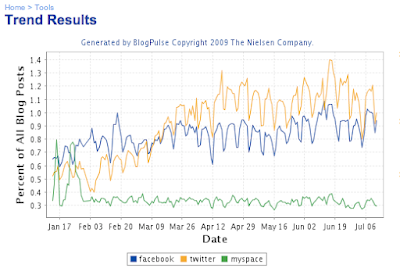
First, check out what's hot in the blogosphere. Nielsen data shows that Twitter is gaining mentions and MySpace is flatlining.
Graph of mentions Twitter Facebook MySpace. Twtitter trending up, Myspace flat and low, Facebook holding it's own[my apologies to the Tweep who sent me this way. I searched and couldn't find you. So an annon h/t. So sorry!]

Second trend, Nielsen Global Online Consumer Survey shows that personal recommendations and online opinions are the most influential.

Government is not listed in the mix, but depending on how you cut it, government sites are most like "brand" websites, which have a respectable 70% positive trust level.

The important piece for government, though, is to make content more sharable. If a friend sends an email, or shares a page on Facebook or tweets a link, 90% of the people will trust the information. Helping people to share government content looks like a big win.

Third, since Twitter is so hot, here are some numbers to give flavor to the "Twittershpere" via a report by Internet marketing company Hubspot. Among Twitter users
  • 55.50% are not following anyone
  • 54.88% have never tweeted
  • 52.71% have no followers
Looking closer at what this means, only 9% of the Twitter users meet all three criteria (less than 10 in each category). For example the State Department travel alerts follows only 15 but is followed by 6,215 and have updated with 175 alerts. And then there's Oprah, with her nearly 2 million followers, who only follows 14 people with a paltry 50 tweets.

People who have never tweeted may be using Twitter as a news aggregator, taking in information and choosing to share nothing. They are still involved by reading messages and are available. The people with few followers may follow many, follow a few people with whom they have a close exchange, or perhaps simply never got the Twitter bug. You can read the entire State of the Twittersphere (download PDF) report, here.

Jul 6, 2009

Where You Are Matters: MySpace and Facebook

0 comments
Picture of a racially diverse group of VERY cute kidsHad an amazing time at the Personal Democracy Forum in NYC last week. More than once I felt my head exploding with new thoughts. In this program full of great thinking and new ideas, danah boyd's talk on "The Not-So-Hidden Politics of Class Online" was probably the most referenced, and one that struck a nerve.

boyd began with questioning the hype that Facebook was hot and that MySpace was not. Now that Facebook has caught up, traffic-wise, with rival MySpace, many think it's over for MySpace. But with 70 million visitors on MySpace, how does it not continue to be important?

She then discussed her research and the growing race, class and education divide between the two networks and what she calls a modern day, digital "white flight" from MySpace to Facebook.
All this said, people are already divided and we accept that people from different backgrounds inhabit different environments. We cannot expect technology to automatically integrate people and generate cultural harmony. Although most of you call these sites "social networking sites," there's almost no networking going on. People use these sites to connect to the people they know....

But here's the main issue with social divisions. We can accept when people choose to connect to people who are like them and not friend different others. But can we accept when institutions and services only support a portion of the network? When politicians only address half of their constituency? When educators and policy makers engage with people only through the tools of the privileged? When we start leveraging technology to meet specific goals, we may reinforce the divisions that we're trying to address.

boyd summarized her thinking and research about social networks and the impact of institutions selecting specific venues for outreach.
1) Social stratification is pervasive in American society (and around the globe). Social media does not magically eradicate inequality. Rather, it mirrors what is happening in everyday life and makes social divisions visible.

2) There is no universal public online. What we see as user "choice" in social media often has to do with structural forces like homophily in people's social networks. People connect to people who think like them and they think like the people with whom they are connected.

3) If you are trying to connect with the public, where you go online matters. The key to developing a social media strategy is to understand who you're reaching and who you're not and make certain that your perspective is accounting for said choices.

4) The Internet has enabled many new voices to enter the political fray, but not everyone is sitting at the table.--read the entire talk on danah.org [emphasis mine]
So, as government agencies develop a social network strategy--and even as they are dipping their toes into the social media waters--the decisions agencies are making about resources and resourcing need to be informed by facts and not hype.

If government wants to reach people where they are, it needs to understand not only where "people are," but also who uses which tools and how different audiences expect to interact and consume information.

My excerpts and overview do not give boyd's ideas their due. Please read more here and think about how you might use her analysis as you develop your social media strategy.

May 15, 2009

Shorts: Flickr License, Chu Vents, CDC Web Stats

0 comments
Flickr Creates New License for White House Photos. The White House had been posting pics to Flickr under the Creative Commons Attribution license that lets people reuse, reprint and remix the photos just as long as they credit the original photographers--but since government works can’t be copyrighted that was a fail. Over the weekend, though, the licenses changed, and now the photos are labeled “United States Government Work” and link to an explanation on copyright.gov.  The change marks a first for Flickr, which did not have a license for government works, other than a “No Known Copyright Restriction” license. Read the post on Wired.

Energy Secretary Steven Chu Vents About IT Bureaucracy and provides Quote of the Day: "They (DoE's infosec people) forgot the Department of Energy has a job, and it’s not to protect the Department of Energy. It’s to get something done...(Risk) has to be balanced against the mission of the Department and so this is something that I feel very strongly about." Can I get an AMEN?  From Personal Democracy Forum.

Centers for Disease Control and Prevention (CDC) Posts Data on Web Experience. Being perfectly transparent about what people are looking for and how happy they are, CDC is posting quarterly numbers on visits,visitor satisfaction, what they look for on the site, and top pages. The quarter they are reporting includes heavy traffic from the peanut recall and H1N1 (nee swine) flu.  See the data dashboard on CDC.GOV.

May 7, 2009

Metrics That Matter, Some That Don't

0 comments
Good article on ClickZ recommending that we update our assumption about important metrics. Augustine Fou writes
Time on Site Is a Bad Metric. Time on site is still often referred to as if it's a useful metric of a program's success. However, this metric is quite possibly one of the worst indicators of "engagement" because so many factors can increase or decrease it without having anything to do with a user's interest.

For example, if someone opens a page in a Web browser, then takes a 30-minute phone call before coming back to the page, that "time on site" is artificially higher. Or if someone can't find something and spends some frustrating minutes looking around on the site, the extra time spent doesn't indicate greater interest. In fact, the person may get increasingly annoyed at the site and never come back.
Other factors decrease time on site artificially -- for example, the person found what they were looking for immediately through site search. The person was very satisfied and left the site after completing a mission.

Takeaway: there are no benchmarks for this metric. Drop it entirely as a success metric.--Read more on ClickZ.
So, what should you measure? Fou suggests new metrics that indicate user interest and intent like
  • On-site search. Are your visitors looking for something specific on your site?
  • Time they spend with a piece of content -- not just on the site in general. Are they spending time with a specific piece of content?
  • Site bounce rate (lower is better). Are people on your site finding that they were looking for?
  • Percentage of repeat visits. Do users find your site useful or valuable enough for them to come back?--Again, read the whole thing on ClickZ.
Take a look at what you are measuring, and make sure that it makes sense.

May 4, 2009

Who Controls Language on the Interwebs?

1 comments
A rose by any new name may be unfindable.

Last week, official Washington began calling the artist formerly known as "swine flu" the "H1N1 flu," as did the World Health Organization. There are very good reasons for this--the virus isn't transmitted by eating pork products, it is hurting the economy, the relationship between pigs and the virus is debatable, it is more accurate to call it by it's scientific name and the government response is based on science, etc. 

That said, people are looking for information on "swine flu" and people are talking about "swine flu." From BlogPulse:

NielsenBlogPulse view of the terms swine flu vs. H1N1, swine is much more popular.The blue line is the trend for the use of the term "swine flu" in blogs, and the orange trends "H1N1." 

Looking at Google Trends, we see that the change in terminology from "swine flu" to H1N1 was picked up and acknowledged in the news (lower graph), but is not having much impact in general web searches (upper graph). This data is for U.S. searches only.


CDC has said that they were going to work on transitioning their online information to H1N1 from swine. That sounds like a good idea, since we wouldn't want a choice of words interrupting people's ability to find critical health information. 

Takeaway? Use data and trends to find out what people are looking for and build web sites and tools according to data. Help people learn the new terms, but remember that once a meme has legs, it's ingrained in the collective and will not be replaced easily.

In the meantime, wash your hands!, and see CDC for up-to-date information on the H1N1 (swine) flu. 

If you want to track what is happening in the blogosphere the Nielsen BlogPulse is a great resource. Book mark it! Also, Google Trends for what people are looking for. Great FREE sources.

May 3, 2009

Social Media Opportunity & Vulnerabilities

0 comments
Open window.The Social Media Academy released a report reviewing the "social media status" of six global enterprises including Dow Chemical, John Deere, NetApp, New York Life, Toyota, and Vodafone.
We had a pretty good understanding about the estimated outcome –yet it was shocking to realize how vulnerable businesses are that stay away from social media. The present case demonstrates how a small group of social media savvy consultants can compromise a global enterprise based on publicly available data.

We used only publicly available data by dissecting the social web. The data was aggregated from over one million people who publicly expressed their opinions and emotions in social networks, groups, communities, forums, blogs, and other social media related places. The “Mind Share Report” demonstrates not only that social media is heavily used by businesses across all industries but also that it poses a significant threat to companies who do not understand how publicly available information can be used by their competitors to create devastating effects.--
Read more on customerthink.com
The full study is available for $195, but you can glean some very good insights from the free 30-page executive summary, especially as a blueprint for using social networks to find out more about your audience/stakeholders and what they think about your organization and issues. 

What you see in the corporate world are fan pages set up in Facebook, reviews of services in Yelp!, LinkedIn profiles of employees and groups related to their organizations, Twitter streams about organizations and from organizations, videos both for and against on YouTube. These same outlets are used by citizens to share things that they like about government and things that they don't like about government. Social media is the world's largest, ongoing focus group.

Take a look at the report and start searching networks for your agency and issues that you touch. Learn and engage. You can read the free 30-page executive summary (in PDF) here.

Apr 23, 2009

Trends: Online Video UP, Channels Down

0 comments
an old TVAs agencies look to add more video to their content mix, it's important to keep an eye on current video and TV habits. 
[T]elevision viewership is quickly splintering across a number of platforms like computers, phones, and set-top boxes. But in spite of this trend, viewership on all platforms (including the good old boob tube) is actually up. Online video hubs like YouTube and Hulu have also grown in appeal, as 74 percent of the study’s 14,000 respondents said they would enjoy watching TV via the computer. This increase not only represents a 13 percent bump year-over-year, but also the growth potential of the platform. As more and more video hubs net premium content deals, it seems likely that consumer interest in online viewing will continue to rise.

Surprisingly, Accenture’s respondents also expressed a lack of loyalty towards branded channels. Put simply, this means viewers were fiercely loyal to their favorite shows, but less loyal towards a show’s parent channel. Given the plethora of viewing outlets available to consumers (broadcast, online, mobile, cable provided on-demand, etc), and the myriad pay options available for these services (subscription, ad-supported, pay-to-play) this actually makes sense. As video distribution outlets pop up left and right, there’s basically a non-broadcast option available for everyone. --Read the whole post on Venture Beat.
Two trends I wanted to track here. First, it is critical to recognize the different ways that people are consuming video. TV is still popular, but there is no longer a common time that people watch a TV show--save popular sporting events. People watch a show when and where they want, sometimes with complete ads, sometimes with no ads, sometimes skipping ads. People don't rush home for their favorite shows. They can watch when it's convenient--after the kids are in bed or after studying on a less busy night.

Second, this cornucopia of viewing choice allows people to connect to the content itself--not who created it. The drive is to get the shows from their preferred outlet whether it's broadcast, digital video recorder (like TiVO), over the internet online to a TV or computer, downloaded to a personal device like an IPOD. The particular broadcast channel is unimportant. Again, the video consumer is taking more control.

While there has been a fair amount of attention--and plenty of concern--on the effects of the Internet on newspapers, it's important to also track the disruption in traditional television viewing. 

Apr 21, 2009

Shorts: Stats, DC's Digital Public Square, Good Looking data.gov

0 comments
red soccer shorts with number 12The Web in Numbers--The Rise in Social Media includes stats on YouTube--100 million monthly viewers in the US and 6.3 billion videos viewed; Facebook--grew from 100 million to 200 million users in less than 8 months, if it were a country, it would be bigger than Brazil; and, Twitter with 7 million unique monthly visitors and a growth rate that will have it at 100 million visitors this time next year. Other important statistic? Social media beats e-mail for top web activity! First time anything beats e-mail. Read the post from Mashable.

Digital Public Square in D.C. The Office of the Chief Technology Officer has launched the District of Columbia’s Digital Public Square which puts the citizen in the driver’s seat to discover how District agencies work, participate in the democratic process and connect with your government. This will be the portal for future mashups and data. See dps.dc.gov.

Image of data dot gov web siteSunlight Labs takes on Redesigning the Government: Data.gov. As part of their series redesigning government websites, Sunlight designers/developers prospectively create a design and architecture for data.gov (which today has a "coming soon" sign). They say, "Providing access to government data is one of the clearest ways to be more transparent— and it is our hope that Kundra and team nail this with Data.gov. In order to do so, we’re looking for these things: Bulk access to data, Accountability for Data Quality, Clear and understandable language, Service and developer friendly file formats, and Comprehensiveness." Read all about it at Sunlight.

Apr 9, 2009

Digital Kids = Digital Future

2 comments
Adults of tomorrow, also known as my two boys.Over the past few days I have observed discussions on the value of new media tools and whether it makes sense for government to jump in. It's true that we are still struggling with Web 1.0. Some think we should get that right before moving on. But these discussions were about today. Not about tomorrow. 

Chris Brogan blogged on Envisioning Digital Kids. He said that the adults of tomorrow now live in a world where
  • The Web is always on.
  • The Web is mobile.
  • Google has always been around, and is the core source of search information.
  • Cell phones are the default phone.
  • Apple TV, Netflix, and the Web are where shows and movies come from.
  • iPods are where music comes from.
  • Everything is play-on-demand. Nothing is appointment-based.
  • Most all software is web-based.
  • We share pictures and movies with relatives always.
  • We never get lost (GPS).
  • We buy what we want (Amazon).
  • We learn things from our friends (news via social networks). --Read the entire post.
Yes, there are people who don't have broadband or even Internet. Yes, there are people who don't use email and prefer paper and stamps for communications. Yes, some folks want to pick up a phone and ask questions. And, yes, dot-gov is still working on getting Web 1.0 right.

But it will soon be too late to engage with the next group of adults. The digital natives in my house ALWAYS have more computing power and instant access to information in their hands (cellphones) than we could have imagined five years ago. Some thirteen year olds will be voting in the next presidential election. 

How do we make government a relevant information provider? a relevant employer? a relevant part of society for the adults of tomorrow? 

For starters government leaders and technologists need to look ahead and get out of the muck of current barriers and old ways of thinking. Take a look at Brogran's list above and think how your programs are relevant to tomorrow's adults.

Dot-gov needs to aim to an unknown point in the future and not shoot ourselves in our static foot. 

Apr 7, 2009

Making National Tools Local

2 comments
Gov 2.0 Camp was a blast! I am so sorry that I only made it to Happy Hour and the afternoon sessions on Saturday. But there are great summaries, impressions, resources and play by plays available here, here, here, and, of course, here. 

For the session "Ask the President," Macon Phillips, White House New Media Director, and Bev Godwin, usa.gov guru currently detailed to WH new media team, wanted to learn how to improve the question and answer. First, a quick overview from Newsweek
The President held his first "Open for Questions" event in the East Room of the White House. Basically the White House invited people to submit questions for POTUS odnline. People could then vote for the questions they'd most like to hear him answer. The whole event streamed live on whitehouse.gov, and around 100 regular folks where invited to the East Room to watch. Over 90,000 people submitted questions and 3.6 million votes were cast.--Read the rest.
Overall, folks felt the Q&A was successful. The nagging question remained, though, that this type of forum is vulnerable to special interests drowning out more organic issues.  For example, Politico noted that pot, once again, was a top question/question vote-getter, likely via a push by NORML, the National Organization for the Reform of Marijuana Laws.

The President addressed the drug question head on, but from a participation and technology point of view, the issue of manipulating results remains. 

The White House used Google Moderator, a simple tool that helps groups determine which questions should be asked at all hands meetings, conferences, Q&A sessions (see TechCrunch). Moderator, as designed was  intended to be used locally. Pete Peterson very smartly writes in Tech President that it's hard to make policy on a national scale.
[Can government] focus its online engagement efforts at the local level. In a sense this means using tools like Moderator as they were originally intended. The advantage of this strategy is that the content and political decision-making process involved in localized issues tend to be less complex than at the national level. Participants can more readily see the impact they will have on a community concern than a national one. This does not mean the subject of the engagement is not Federal in nature. Many Federal agencies from the EPA to Homeland Security are tasked with conforming policies to cities and regions throughout the country. Answering the “how” question of policy – specifically, “how does that rule fit here?” – can be supported legitimately by online tools. --Tech President
If all politics are local, could Moderator function locally and roll up to a national agenda? The tool could ask for users' zip code or Congressional District and questions or priorities voted on locally. This would distribute the special interests geographically. 

People could begin by discussing and voting up questions in their locality and then popular questions could "advance" to a regional and then national level.  A bonus to this system, if by Congressional District, is that members of the House could also have access to the data from their districts, helping to inform their deliberations and decisions. If the tool was used for local politics, too, it would become even more valuable. 

This isn't a time to throw out the baby with the bathwater, but to take a closer look at what actually happens when new tools are introduced. The WH New Media team is anxious to refine and enhance participation tools and are looking at each foray into new territory as a learning experience. And that's something that we can all take back to our agencies. 

Mar 25, 2009

Mobile Is the Elite Internet User Differentiator

2 comments
Pew Internet and the American Life Project has developed a new typology for internet users based on mobile internet use--phones. Their previous typology [pdf] was based on broadband and gadget adoption, but current findings of what makes a technology user elite is mobile internet use.
For 39% of the adult population, mobile and wireline access tools have a symbiotic relationship. Mobile users typically have ready access to high-speed connections at home, which likely pushes them toward deeper home high-speed use; the digital content found on the mobile device may prompt more activity on their broadband-enabled big screen at home. At the same time, the desktop internet experience migrates to “on the go” as the handheld becomes a complementary access point to connect with people and digital content wherever a wireless network reaches. --Read more on Pew Internet. 
Pew found that younger people were more likely to be among the mobile elite, but one-fourth of the people 50+ join them. 

The categories of information and communication technology users that Pew defines is below. [I hate the term information and communication technology users. Can't we call them Internet users and just expand the definition to mobile??] 

Where do you fit in? Where do your users fit? What are their expectations and what will be their expectations in the future. Are your websites and applications "mobile ready?"

Motivated by Mobility (39% of the population)


Stationary Media Majority (61% of the population)

Read the entire study at Pew Internet & American Life Project. Kudos to Pew for making the entire report available online--without having to download a PDF. Nice!