Showing posts with label engagement. Show all posts

Jan 2, 2011

Doing Gov 2.0 Backwards in High Heels

2 comments
Ginger Rogers dancing with Fred Astaire backwards and in high heelsI was reading the awesomely comprehensive 2010 roundup of Gov 2.0 by Alex Howard and stumbled into a little Twitter dust-up between Alex and one of his readers, Microsoft's public sector evangelist, Mark Drapeau.

The twit-for-tat was around Mark's criticism that Gov 2.0 activities were focused on "govies, policies, and techies, and little citizens, services, engagement." He's right. There continues to be a lot of foundation-level work going on--like writing policies, creating governance, training, upgrading systems, cleaning up and making available data, etc. It makes it hard to see how this is having an impact on citizens and the public.

Then, Alex referenced Gov 2.0 impact on citizens
As the new year beckons, there are more ways for the citizens of the United States to provide feedback to their federal government than perhaps there ever have been in its history. In 2011, the open question is whether "We the people" will use these new participatory platforms to help government work better. The evolution of these kinds of platforms aren't U.S.-centric, either. Ushahidi, for example, started in Africa and has been deployed worldwide. The crowd matters more now in every sense: crowdfunding, crowdsourcing, crowdmapping, collective intelligence, group translation, and human sensor networks--O'Reilly Radar
Alex is finding some Gov 2.0 activity that is actually touching people. A good start, but how does this play for my sister in Indiana?

But, as Mark went on,
twitter image from Drapeau, Well @digiphile, government exists to serve all its citizens. Thusfar Government 2.0 mainly exists to serve wonks and geeks.
he and I part ways.

The heady newness of the Open Government Directive and the first forays into social media are over. We look back wistfully, like on the faded blush of a new romance. That was fun! But now we are left to work in the trenches to realize the promise. Much less sexy, but critical to success.

This year has included some very important new guidance--for example on surveys (Paperwork Reduction Act), privacy (including cookies and participating in 3rd party networks), plain language and prize authority to name a few--that agencies are trying to apply. And there is increasing scrutiny, oversight, and evaluation from both within and outside of agencies.

It seems that nothing breeds slowdowns like success. The layer of people who like things "the way they are" are not excited about new ways of interaction. And some are pulling the many levers at their disposal to doubly ensure that all T's are crossed and I's dotted.

Then, there are many early evangelists who are practicing what they were preaching. Being change agents in their agencies mean that they are less available to take to the pulpits of conferences and blog posts to proselytize across agencies.

I am neither a wonk nor a geek. I am a citizen, though. I am a citizen who works in government. And I am a citizen who works in a government built on--and sustained by--a massive command and control bureaucracy from a pre-Internet and social networking era. I am a citizen who works in this slow-moving behemoth and trying to make change for my fellow citizens, not to serve wonks and geeks.

Folks working in the trenches welcome the thoughtful criticism of outsiders. We don't have all the answers and have plenty of blind spots. Keep our feet to the fire, help us make change, and keep caring! But, I gotta tell you, from an insider's perspective, this is harder than it looks.

Jul 19, 2010

4 Lessons For Gov Via The @OldSpice Guy

2 comments
Should i start with a melodic, "Hellooo Ladies?"

Not one to let a hot meme slip by, and vacation prone to hearing the oceans in a shell and seeing signs in billowing clouds, here's my resounding YES to finding lessons for dot-gov in this past week's Internet phenom: that most awesome 180 videos in 3 days, multi-channel, rock-hard abs Old Spice campaign.

But I am not going to write about the brilliant social media campaign--others are doing that. Instead, I want to talk about four lessons we can take from @OldSpice Guy to better our dot-gov projects.

Number one: Speed
This is 2010, and if you haven't got it yet, we stopped waiting. The Old Spice team created video responses in real time. Someone--sometimes famous and sometimes not--would tweet and in minutes there was a response. And it was good. We hadn't seen this level of realtime before, but we like it.

Government needs to get with the program and escape from the time warps of never-ending requirements gathering, ad nauseam reporting, acquisition merry-go-rounds, and TAA (total risk aversion). I was on a panel a few weeks ago when someone asked how was it acceptable for government to take 3 months to implement open government initiatives. My response? that I would love for a project to come in under six. Sigh.

Our citizens expect immediate results. We need to make it so.

Number two: Planning
How do you make 180 videos, have them distributed across multiple networks and garner 11 million views in 3 days? Very carefully. This was a well-designed and executed plan. And, like any well-executed plan, it looked easy. But the handsome man already had a fan base, the social media team knew where to reach out, all the resources for the rapid research, writing, producing and editing were on site, and sign-offs were established.

I don't want to miss any chance to hammer home the strategy message. You, too, are building toward a goal. You have to lay the groundwork, do your research and pull together the team.  You also need to be open to opportunities.

For example, we learned that you can't put a new capability in place during a disaster (duh, you say, but there is an expectation that technology can solve problems "magically"). That's why it's important for people drill and for organizations to run simulations and exercises. That's why your IT and new media teams need to participate. Setting up a Twitter account days into a crisis is much less effective than building a follower base and expertise to broadcast information that scales.

Is having a web infrastructure that can easily output RSS something you will need? Don't have the infrastructure you want, but can begin collecting data for the next gen? Do it now. In 2006, we tested third party tools for a blog, because, even though we had no nibbles from the front office, we knew that we would keep pushing to blog. When the formerly reluctant boss hit "go," many months later, we were ready with tested technology and policy. We went from go to live in 5 weeks without breaking a sweat.

See where you want to be. Build toward that state.

Number three: Talent
No doubt that the Old Spicers had a corral full of talent. From the guy in front of camera to the professional broadcast quality output to the hysterically funny writers to the social media experts who brilliantly got it and executed on key to the crazy creatives that put the whole scheme in motion, this was high-quality work.

Who do you have in your stable? Is your organization built for mules who keep their heads down and plod along on the well-worn path? Or do you nurture thoroughbreds and give them room to run? Do you hire or contact with superstars only to to keep pulling up the reins and push them to follow that old path? Does your staff look at the Old Spice campaign and wish they could do something like that?

You want high quality output? Find and nurture the folks who can do that work. And give them the space.

Which leads to...

Number four: Trust
There would be no speed from this well-planned caper if there wasn't an extraordinary level of trust in the superstar team.  The ad company had worked with the client at length and pitched a process that skipped traditional sign-offs from legal, et.al. And the client agreed.

This is an interesting element. It's critical to understand that while trust is imperative, it's not automatic. Trust needs to be earned, every day. It's unreasonable--and dangerous--for executives to bet on a project or team simply because trust is a success factor. It's up to the folks in dot-gov to build the trust and to show the judgement necessary to take on risk. You create trust by building relationships, by showing success on smaller projects, by understanding the needs of the organization and developing programs to meet mission goals, by creating strong implementation and risk management plans, and by communicating clearly both up and down.

Trust, like Rome, isn't built in a day.

So that's it, speed, planning, talent and trust or SPTT! I think I need a vowel for that. Hey, look, a fish just fell in my arms. Then it turned into diamonds. I'm on a horse.

And, in case you missed it, here's my personal favorite of the Old Spice rapid ads--to the actor's daughter.


EAVB_OPOUDEQSUI

Jan 3, 2010

7 Social Media Takeaways for Dot-gov

4 comments
Seven of hearts playing cardAs we traverse to a new decade, here are seven takeaways to help small, medium and large agencies use social media to be more transparent, participatory and collaborative. Take what you can use.
  1. Community without guilt. There are many "experts" will tell you that there is one right way to "do" social media. They are wrong. There are tons of ways to use new communications tools and channels. Want to engage with your fans, followers, friends? Great! Want to use social tools to rebroadcast your message? That's okay. Just want to see what people are saying about you? That's fine, too. Most important, make sure you have a strategy together before jumping in. You can always adjust later.
  2. Social media is "plumbing." Don't adopt tool angst. While you need to know how different tools work (blogs, Twitter, Facebook, Wikipedia, social voting), these tools are conduits to communicating and, hopefully, engaging with your audience. The key is to figure out what you are trying to accomplish (again!), and use the best tools to reach out and meet your goals.
  3. All you can eat doesn't mean that you don't HAVE to eat it all. People get overwhelmed with the variety and scope of engagement opportunities. It's better to choose fewer, strategic projects and do them well than to spread yourself too thin. I predict that there will be as many abandoned government Twitter and Facebook accounts as there will be new ones in 2010. Prove me wrong!
  4. Friction free. One of the reasons that Twitter is so popular is that it's friction free--in other words, EASY. It's super easy to sign up for Twitter, same with Facebook, LinkedIn, etc. This is the expectation that citizens now have for government services. Government needs to review our gateways to try and make it easier to use our services than to NOT use us.
  5. Listening is important. Don't overestimate the importance of re-broadcasting your same tired messages in new venues. The real value comes from listening--from finding out what people are saying about your agency, where you succeed as well as where you are failing. My favorite saying is "Everybody has a point," even when their delivery makes it hard to hear. If you are listening, though, you have the opportunity to learn, see trends, and improve.
  6. Communicate with economy and precision. One of the best things about Twitter is that it forces communications into 140 characters. This forces us to eliminate all the extra, flowery, self aggrandizing government language. It behooves us to do this not only when tweeting, but in our blogs, websites, manuals, letters, instructions, well, you get the picture.
  7. Wisdom of the crowds can be time and volume based. Twitter helps define what is important, according to Clay Shirky, by “algorithmic authority." The idea is that if "all kinds of people are pointing at the same thing at the same instant, it must be a pretty big deal." Looking at trends in Twitter, Google, and your own search terms on your site can give you insight about what people think is important, NOW. What can you feature on the homepage of your website? Can you tweet a link to a resource? Clear up a misconception?
Bottom line, it's the same formula: What are you trying to accomplish? Who is your audience? How do new media channels help you meet your goals? Measure all your efforts against these questions.

This post is inspired by David Carr's very good post in the NYTimes on Why Twitter Will Endure. Read that, too!

Dec 22, 2009

21st Century Snow Removal

1 comments
A nice boy shoveling his neighbors' walk.Snaps to the Mayor and to the terrific folks at D.C. Public Works. After 20 inches of snow fell for 26 hours through Saturday night, the street in front of my house--a side street no less--was plowed before 5 a.m. Sunday morning. (Maybe even earlier. No neighbors were awake to verify.)

This was very different from twenty inches of snow that fell on Washington in 1987. An absent Mayor and a bumbling snow removal process lives large in Washingtonians' memories as a symbol of political incompetence.

It's also a reminder that people care about things that affect them personally. As Tip O'Neill famously said, "all politics is local." This translates into helping people and providing services that have an immediate and personal impact. Sure, it's great if it helps "everyone," but what about ME?

Last week, the President announced the winner of the SAVE Award, Nancy Fichtner. Fichtner's idea was to allow patients discharged from VA hospitals to take home leftover medications, rather than throwing them out. Often, patients turned around to get the same prescription filled at the local pharmacy--the government paying twice. Fichtner's is a great suggestion, not only because it saves money, but because it also touches people directly.

Tucked into the President's remarks on the Save Award were other plans to make government more efficient, including information about a tech forum,
That’s why we’re holding a forum at the White House next month to seek more ideas from the private sector, specifically about how we can better use technology to reform our government for the 21st century.--President Obama
This is an opportunity to take another look at the services that government offers to citizens--especially the mundane transactions like filling out financial aid forms, paying taxes, getting passports, updating W-2 forms, signing up for health programs, disaster assistance, etc.--and making these transactions more efficient and friendly.

Treating people like valued customers--think Zappos or Amazon. Simplifying government transactions to save citizen time--think how easy it is to sign up for Netflix or build your network on Facebook. Helping people get to where they need to be--think Google.

Putting citizens first, making information easy to find, relevant, accurate and understandable; ensuring that common tasks can be easily completed online; being consistent across all channels, online and offline; opening up venues to receive and act on citizen feedback; and being accessible whether someone has a disability or isn't proficient in English--these are the opportunities to make technology work better. And, not just work better for government, but for the citizens, too. (These recommendations are from the Federal Web Managers white paper to the transition team from last year.)

Just a reminder to get down to brass tacks. We care about getting our snow removed. Like NOW!

Dec 13, 2009

Open Government Needs Data (not just provide it)

3 comments
Flickr network universe 2005Last week was a "Big One" in dot-gov. The much anticipated Open Government Directive was announced. Peter Orszag, the Director of the White House Office of Management and Budget, summed it up.
The directive, sent to the head of every federal department and agency today, instructs the agencies to take specific actions to open their operations to the public. The three principles of transparency, participation, and collaboration are at the heart of this directive. Transparency promotes accountability. Participation allows members of the public to contribute ideas and expertise to government initiatives. Collaboration improves the effectiveness of government by encouraging partnerships and cooperation within the federal government, across levels of government, and between the government and private institutions.--Read more at the Open Government Blog
Out of the box, much of the specifics in the Directive was focused on transparency and the opening of public data sets. For example, in 45 days, three heretofore unreleased high value data sets need to be available on data.gov. [Sunlight Foundation parsed the directive and published a timeline for agency requirements.]

Requirements for collaboration and participation are less specific. [See Nancy Scola's very good summary and analysis on the Directive content on Tech President.]

Getting ready for collaboration and participation is what I wanted to talk about.

There's been plenty of work on engaging with the public--from the March Open for Questions exchange fueled by people submitting questions and voting for the ones they wanted the President to answer to the development of the Directive itself.

Chris Brogan is a well-known new media marketing guy. He suggests that people try and think like "-ologists" and learn from -ologists (anthropologists, sociologists, psychologists) in their outreach. Check out his 45 second video.


It's critical for government to take a broad look at how we interact, how people interact, and what it might mean. Taking a structured analytical approach--dare I say scientific--becomes critical. Open government efforts need to be structured to include measurement and evaluation. Best practices can't be defined without understanding the variables and the inputs. Did we get a good result because we were lucky? Did we get a good result because we think we did? Or, did we get a bad result that we believe is good? Did we get a good result because we went into the experiment as an -ologist?

This post was inspired by a reference in my Sunday paper to "Web-Based Experiments for the Study of Collective Social Dynamics in Cultural Markets" (PDF). The authors, sociologists Salganik and Watts, provide some perspective on how the idea of popularity can influence what is popular. The researchers found that there is randomness in the creation of popularity within a network. A song, for example, becomes more popular as other people in the network show interest. In another network, a different song could be the winner. That's why it's hard to predict the next hot song, band, movie or toy. It's somewhat random and unpredictable.

The got me thinking about how important network dynamics are to spreading ideas, forming consensus and developing meaningful interactions. Meaningful for citizens as well as government. And, it got me thinking that people are already studying these patterns in other venues.

This isn't getting any easier.

Dec 1, 2009

3 Reasons To Get With The Program Already

5 comments
Old-fashioned Underwood brand manual typewriterFirst, the change has already happened. It's done.

What has changed is the way people communicate and interact--with each other, with companies, with government. We don't yet know what that means. We can try and predict, but the main outcomes of these predictions is fodder for future laughs.

Now to you naysayers who say that not everyone is plugged in, not everyone uses social media or the Internet or even e-mail, I say, "So? You don't have to drive to know that cars changed the way we live, where we live, how we shop, where we go."

And, to you near-term nostalgics, the people who think that texting, tweeting, friending and gaming are stupid, who prefer a stamp to online banking, I say, "it's okay for you to feel that way, just realize that the rest of the world is embracing new channels."

Second, your brand has changed. "Brand" is not a visual representation of your organization. It is the experiences that people have with your organization and the sharing of these experiences within their networks. Brand doesn't belong to your agency, it belongs to people who interact with your agency.
For example, 65% of U.S. consumers report a digital experience changing their perception about a brand (either positively or negatively) and 97% of that group report that the same experience ultimately influenced whether or not they went on to purchase a product from that brand. In a nutshell, experience matters. A lot.

...That's why Amazon continues to pour money into improving its customer service rather than run traditional advertising or marketing campaigns. As Amazon CEO Jeff Bezos has said, "We are not great advertisers. So we start with customers, figure out what they want, and figure out how to get it to them."--
See more at AdAge.com
This matters a lot to government--at least it should. People expect that their tax dollars pay for the same types of experiences that they have in the private sector. When we disappoint, we fail. Government needs to better engage with citizens and provide services that people seek--less time broadcasting/marketing our messages and more time building good experiences. Better experiences will translate into better confidence in government.

Third, you simply disappear if you are not present. People are watching TV on their cell phones at their convenience. The entire country does not sit down at 6 p.m. to watch the evening news on traditional broadcast channels.
This is why monitoring, establishing and cultivating a strategic presence and inspiring meaningful engagement is so critical in social media. It impacts the bottom line. If we are not present within the attention dashboards of our existing customers and prospects, we intentionally remove ourselves from their decision-making funnel. Consumers are among the new influencers as they now have access to the same tools and channels that reach peers and shape their impressions.--[emphasis mine] More from digital marketing expert Brian Solis


Government frequently suffers from disproportionate emphasis on traditional communications channels. The story in the NY Times, the interview on CNN will remain important, but not the most important. The results from search engines that lead to content on web sites or engaging applications that are passed around and shared among friends on social networks are equally valuable. We have the skills to get traditional news stories, it's time to build skills to bring information directly to citizens.

Wake up! The world has already changed! But we still have time to shape what it will be and what government can do to better serve our citizens.

Nov 21, 2009

YouTube Captioning Makes Video More Accessible for All

2 comments


Dear Google/YouTube,
We want it. We want it NOW!
xoxo,
Your Dot-gov Buddies


Johnny's hearing aids. Johnny is  my son.A big barrier to making video content available to people who can't hear is creating captions for the audio--like the closed captioning you see on TV. This is especially important to government because we are required-- by law and by mission--to make content available to all people, regardless of their abilities. So, the dot-gov space was a-flutter [I almost said a-twitter, and that was true too] when Google announced two new features to make videos on YouTube accessible to the deaf and hearing impaired.

First, and available to EVERYONE now, YouTube account holders can upload a transcript with a video and YouTube will be automatically generate, time stamp, and incorporate captions into your video.

What does this mean? Well, in order for captions to make sense, they need to be coded to match up with the audio on the video. Bottom line, using current technologies, it takes more than a few painstaking staff hours to time code a 15 minute video. This delays posting the video--or fosters a reluctance to create video content or, even worse, encourages posting video that people who are deaf can't access. This is a huge problem for time sensitive, safety messages.

Why is this extra cool? The generated YouTube caption file can be downloaded from YouTube and used in other versions of the video. Most federal agencies post their video on a dot-gov site in addition to posting on YouTube. This will turn around processes and let us create the timestamp file on YouTube to post with our videos. Yay! I know at least one hard working captioner who will be ecstatic to turn her attention to more video production and less caption production. Breaking news: IT WORKS!!

Second,
[Google has] combined Google's automatic speech recognition (ASR) technology with the YouTube caption system to offer automatic captions, or auto-caps for short. Auto-caps use the same voice recognition algorithms in Google Voice to automatically generate captions for video. The captions will not always be perfect, but even when they're off, they can still be helpful—and the technology will continue to improve with time. --Read more on the Google Blog.
Auto-caps is being piloted withUC Berkeley, Stanford, MIT, Yale, UCLA, Duke, UCTV, Columbia, PBS, National Geographic, Demand Media, UNSW and most Google & YouTube channels.

This is pure awesomeness--despite any imperfections in machine generated captions--because unscripted events require a transcriptionist at cost of time and money. If the captioner is also transcribing it can take an hour to get a minute or two of captioning done. Google's auto-caps is a game changer with the potential to make more video more accessible to everyone.

Let's let Google explain the service:


This is great news for people who are deaf or hearing impaired. This is great news for government agencies that struggle with the cost and expertise required to make video accessible to everyone. This is great news because government can't be transparent for most of the people--open government is only meaningful when it's available to all.

Dear Google/YouTube,
Thanks for this new service! We are happy to help beta test your auto-captioning feature. Give us a call!
xoxo,
Your Dot-gov Buddies

Oct 18, 2009

Talk Talk vs. Do Do

11 comments
Hot air balloonJust what we need to move the policy discussion forward, another conference?

Back in March, Mark Drapeau from National Defense University wrote about the mid-life crisis of gov 2.0.
Government 2.0 has reached its midlife crisis. Despite some leadership from influential individuals on using social software in government, there is still in many cases a disconnect between authorities issuing directives and ground troops carrying them out...Resistant to change and adhering strictly to doctrine even when nonsensical, people in the clay layer can halt progress. Despite their intentions and being in a strategic position, they often stop the progress being called for.-- Read more on ReadWriteWeb
The solution? A conference. The wonderful Government 2.0 Camp in March attracted a huge number of government (federal, state and local as well as some international) and private sector attendees to talk about government 2.0 and learn from each other.

In July, Jaimie Maynard, a federal staffer, blogged about her post-conference low after the Open Government and Innovations Conference.
All web 2.0 conferences are all starting to look exactly the same. Many speakers come from agencies that are boldly using social media in a new and exciting ways, and many more "believers," who are not allowed to use those same technologies, come to hear about it. But the status quo remains the same...DoD, NASA, The White House are getting things done, but as a method to further collaboration and expand the use of social media, [the conference] failed. We need specifics: case studies, business case strategies that succeeded to support any/all of these tools, etc.
So, now it's October and there is another lament that Government 2.0 is failing or flailing. The Gov 2.0 conferences of the fall--O'Reilly's Expo and Summit--felt like just alot of talk by the same people about the same things.

Brian Drake from Deloitte blogs,
How we can get more people, enthusiasm, and get some tough issues on the table. The one group we continue to not hear from are the detractors or skeptics of social software...In addition to the slim number of public, cogent arguments against Government 2.0, our own discussions about failures are truncated. I’m noticing our Government 2.0 conferences either trumpet the achievements of the few or recast a failure as a success.--Read more on Brian's blog.
So the wrong people are coming to the conference. The solution? Another conference. This one to focus on the "Shortfalls of Gov 2.0" and attract people who aren't coming.

Steve Radick, from Booz Allen and a member of the "Goverati," offers a three part solution.
  1. Realize that not all is perfect in the land of Gov 2.0
  2. Identify the skeptics and open up a dialogue with them
  3. Hear the war stories of the people who have gone before us --Read more from Steve's blog.
And, a conference about Government 2.0 Shortfalls.

Underlying this most recent discussion is the idea that people are unaware of the barriers, arguments against, downsides to Government 2.0. I want to clarify that assumption.

People who actually work in government are well aware of the barriers and arguments against Government 2.0.

Yes, we already know. We don't need to talk about it at another conference. We need to fix it. The problems and issues have been defined and discussed since last year. A few quick examples,
  • In December 2008, the Federal Web Managers' Council published, "Social Media and the Federal Government: Perceived and Real Barriers and Potential Solutions" (pdf) This paper identified challenges with strategy, access, legal, privacy, advertising, ethics, accessibility, and the Paperwork Reduction Act. The paper also offered concrete recommendations to overcome these barriers.
  • In June, the Office of the Chief Privacy Officer at the Department of Homeland Security held a two-day workshop to explore best practices to implement the President’s January 2009, Transparency and Open Government Memorandum. In addition to Gov 2.0 advocates, panelists included a variety of viewpoints including privacy advocates, civil liberties organizations, security professionals, and differing legal opinions.
  • Last month, the Federal CIO Council security workgroup published Guidelines for Secure Use of Social Media by Federal Departments and Agencies identifying issues and recommendations to address security issues in social media.
While government 2.0 is bigger than social media much of the privacy, security, procurement, ethics, and laws and regulations issues are the same.

AND, many of us in government also know that there are some "successes" that have leap-frogged some hurdles and were implemented because leadership demanded that something be stood up. Agencies are playing catch up.

Gartner's Andrea DeMaio blogs very thoughtfully on government and technology changes. He recently said,
I am still amazed to see how little employee-centricity there is in today’s government 2.0 conferences, debates, positions and articles. It is as if employees were considered legacy, just part of an organization that will be transformed, and not the real fuel and soul of those organizations.

Until when their role will be given equal dignity as “citizens”, government 2.0 will remain an interesting subject for discussion, will marginally contribute to service improvement, but won’t realize a fraction of its potential.--More on Andrea's blog
I think that Brian and Steve make excellent points in their posts. I am not opposed to a conference to discuss the shortfalls of Government 2.0, but I am unsure about the payoff. What do we gain? How does it affect the policy? That's where the rubber meets the road. When will we have guidance on records? Can we make better sense out of the limits on advertising? Why does each agency need to do a privacy impact assessment on YouTube or FaceBook? Are the issues the same across government? How can we move the incentives (i.e. money) to reward cross-agency efforts? To gain efficiencies and reduce redundancies? To break down silos? To improve innovation?

Here's the challenge, because if we aren't getting to these solutions, it's just more hot air.

Sep 13, 2009

Searching for My Inner Craig

1 comments
Topic One at the big Government 2.0 Summit here in Washington last week was "What is Gov 2.0, and how do we get there?"

This isn't a new question. Twenty-seven months after HHS launched the first Cabinet-level public discussion via a blog, we are still trying to define both the destination and the journey.

My own embrace of a new, open, transparent, participatory and collaborative era of government is shackled by the fact that I am an implementer. I don't get to sit on the sidelines and make smack-talk. I have to figure out how to make this work operationally, legally, and effectively for a federal agency. And, I would be a big, fat liar if I didn't admit that it is harder than it looks and more than a little scary [insert your favorite "not safe for work" link here].

This is where my unknowing mentor Craig comes in. Craig, the man who put the Craig in Craigslist, has been successfully herding cats--by not trying to herd them--on the humongous, world-wide online classified ad site and community he founded in 1995. He's also an active advocate of improving government services.

I've been studying Craig's zen-like approach to service and communities as a model to help me with Gov 2.0. In searching for my inner-Craig I've begun to identify some "truths" to help in actualizing open, transparent, participatory and collaborative government.

Truth 1 Trust. Craig says, "Most people are trustworthy and good and want to treat other people like they want to be treated." While this seems easy, in a bureaucratic, conservative command and control organization--like the government--it's easy to get stuck on the word "most." Since not everyone is a good guy, risk-averse organizations develop structures and policies to treat all comers as if they were "bad." Michele Weslander Quaid, CTO for the Office of the Director of National Intelligence, said that ODNI hired a risk manager to help make decisions based on risk/reward. By identifying potential risks and the chance the event will occur, government can develop policies that make sense. Working from fact, not fear, lets us trust people to do the right thing--even when it's something we didn't expect--and get out of their way.

Truth 2 Patience. Government social media and transparency efforts are in their infancy. We need to take the time to build out a process. It won't happen overnight. Craigslist grew organically in the Bay Area for years. There were trials and lessons learned to apply to new cities as it gradually expanded over a decade. This isn't to say that we need to slow down efforts, but that there will be successes and failures. We need to learn from both. It's like a three act play. After the heady first act of new blogs, video sharing and wikis, we are now in the long second act where the heroes are tested and do battle, make mistakes and learn how this works. We are still a ways from the climax and dénouement of Act III. We can't rush the story.

Truth 3 Customer service is public service. It's easier to have all the answers than to spend time listening to your audience. It's also not a successful strategy. For government, our audience--our customers--are the American people. We don't make government for the sake of government. We make government on behalf of, and in service of the people. So, its up to us to get out of our cubbies, our jargon, and our assumptions and get out of the way of the information and services people need. Behind Craigslist is the philosophy that people are basically good and their needs fairly simple (see trust above) so a minimal structure led by user needs will let people work things out by themselves. Government should not direct the user, the user directs the government to meet their needs.

Danielle Blumenthal is getting at this in her recent blog post.
Silence is not the answer. Jargon is not the answer. Long sentences and self promotion are not the answer. Let's stop talking to ourselves in a haze of groupthink and fear and start having real conversations about who the customer is (the public) what they want and need to hear (the truth) and how we need to say it so that they really get the message (any method of communication that works).--More from Branding and Social Media.
Knowing the truths is not the same as truly incorporating the truths. I am not all the way there, but I have a path. And I am working on it.

Thanks Master Craig, from Grasshopper Gwynne.

[For more on Craig, check out his blog or the recent Wired Magazine feature on him. ]

Sep 1, 2009

4 Lessons for Dot-gov: What Makes a "Top" Website?

2 comments
The number 4Last week, Time published its Top 50 Websites for 2009, and there was nary a government site on the list.

The closest dot-gov came was #39, BabyNameWizard.com's NameVoyage, which uses Social Security Administration data to help parents find popular--and not so popular--names across the ages. But ssa.gov didn't make the list.

Looking at the sites that did "make it," Time's criteria for selecting Top Sites are clear. There are four main themes shared by Top Sites, and four lessons for government site owners who want to meet citizen and stakeholder needs.

1. Do something. Pretty much every Top Site had a task for people to complete. From searching for something on Google to selecting the best name for their baby to booking cheap travel on Kayak, Top Sites are where people go to accomplish something. Can people accomplish something on your site? Is your offer worth their time?

2. Focus. Most Top Sites have a clear single purpose. You use Netflix to find and rent movies. You go to OpenTable to make restaurant reservations. Fonolo helps you skip a corporate phone tree and get to a live person. Pretty direct. Many government sites, on the other hand, are multi-purpose. This makes search and navigation especially important to help people. How does your site help your visitors get someplace? Are you setting up a clear hierarchy with your users' top tasks up front?

3. Engage. This is a corollary to doing something. One of the somethings that Internet uses want to do is to participate. Many Top Sites, for example, Yelp and Amazon, let users have a say--rating movies, music, restaurants, services and products. Others, like Facebook and social networking sites, encourage friends to take silly polls and forward links. Once people have engaged, they are more likely to come back. Does your site allow feedback? Voting? Tagging? Can people see what others' have said? Do you make it easy for someone to send a link from your site? Do you talk back to them?

4. Share. Different from engaging, sharing lets site visitors collaborate in content creation. This can be Flickr (#1 on the List) which lets users upload photos for people to view, comment and reuse. Or Wikipedia, where you can share your expertise in a wildly popular public encyclopedia. Or buy joining a microfinance group via Kiva to invest in developing countries. Are you inviting people to share in their government? Are you inviting their creativity and smarts?

Whether you think Time's criteria is fair, the traffic behind many of these sites show that Internet users value them, too. Might be time to review what makes e-gov tick. Maybe we'll make the 2010 list.

Aug 7, 2009

Rapunzel Was a Baby-Mama

0 comments
Very cool wordle of the Rapunzel story, from Kindlerama CreativeCommons License This past week had a few stories from the Department of Defense and the defense against the dark arts of social media.

Last week, DOD launched the DoD Web 2.0 Guidance Forum, a new dialogue initiative. They said
We are using this blog as an approach to engage the public in Department of Defense (DoD) considerations of web 2.0 capabilities, and are excited to participate in this new facet to the President’s openness and transparency efforts.-Read more on the Forum.
In what seemed like only a few hours later, Wired reported that DOD was considering banning social networking sites like Twitter and Facebook because they cause security "headaches."
[T]his fresh ban stems from fears that Facebook and the like make it far too easy for hackers and cybercrooks to gain access to the military’s networks.

Last week, U.S. Strategic Command issued a “warning order” to the rest of the military, asking for feedback on a social media ban on the NIPRNet, the Defense’s Department’s unclassified network. (Naturally, access is already denied on the secret and top secret nets.)

“The mechanisms for social networking were never designed for security and filtering. They make it way too easy for people with bad intentions to push malicious code to unsuspecting users. It’s just a fact of life,” says a source at Stratcom, which is responsible for securing the military’s “global information grid.”--
Read the rest in Wired's DangerRoom.
Seemed like a pretty quick assessment of the public sentiment. [Seriously, the dialogue is open through the end of August, so please participate.]

On Monday, the Marines announced an IMMEDIATE BAN OF INTERNET SOCIAL NETWORKING SITES (SNS) ON MARINE CORPS ENTERPRISE NETWORK (MCEN) NIPRNET.
The U.S. Marine Corps on Monday issued a directive banning access to Internet social networking sites on the Marine Corps Enterprise Network because such sites represent a security risk.
Marine administrative message 458/09 says that social networking sites like Facebook, MySpace, and Twitter "are a proven haven for malicious actors and content and are particularly high risk due to information exposure, user generated content and targeting by adversaries."
Social networking sites create vulnerabilities that can be exploited and may expose unnecessary information to adversaries, putting military personnel at increased risk of compromise, the directive says.--Read more on InformationWeek.
"What's going on?," you may ask. Hasn't DOD been at the forefront of social media engagement?

The questions being asked by some worried brass and the edicts and bans being handed down are a reflection of the reality that there is a conflict between legitimate security issues and the reality of this very open, very participatory new world.

But, I would like to offer a Grimm Fairy Tale.

"Rapunzel, Rapunzel let down your hair." And with that quick phrase, the prince was inside the fortress and "married" the fair maiden.

Bottom line, while you can set up multiple, extraordinary, and high-hurdle defenses, the desires and needs to extend beyond the "impregnable" fortresses may make them insufficient.

Better said by Talking Salmons.
Social media is how I communicate...It is the evolution of communication. Faster, fitter, more productive, free, easy and beneficial. Policy makers who ban social media because of the threat of viruses make no sense to me. Are we still in the era of burning towns to stop the plague? Do we ban cars when a teenager drives drunk? Do we ban computers when someone writes a computer virus?--Read the entire excellent post on Talking Salmons.
I am sounding a bit redundant, but, once again, this is stuff that we are figuring out. So, I would like to leave this post in the able tweet of Admiral Mike Mullen, chair of the Joint Chiefs.

Tweet by Adm Mullen of Joint Chiefs, Obviously we need to find right balance between security and transparency. We are working on that. But am I still going to tweet? You bet.

Jul 25, 2009

Choir Boys and Rebels

0 comments
Old picture of two choir boys in robesThe government meets web 2.0 conference circuit is getting tired.
All web 2.0 conferences are all starting to look exactly the same. Many speakers come from agencies that are boldly using social media in a new and exciting ways, and many more "believers," who are not allowed to use those same technologies, come to hear about it. But the status quo remains the same. NASA and DoD get to successfully use social media, and the rest of us, for the most part, don't. This is the divide that needs to be overcome. I understand that agencies like the IRS and SSA have intensely sensitive data and need to be extremely cautious. But there are a great many agencies that do not fall into this category that are prevented from using these technologies, despite any prior approval GSA may have gotten. My agency isn't even officially allowed to use Twitter yet...One panelist at a breakout session described how DoD is using "other transactions" to quickly fund new ideas to address current problems. While very interesting, this was less than helpful since DoD is the only agency that I know of with this kind of authority - everyone else has to use the traditional and time-consuming procurement system. For an expo, these are excellent speakers. DoD, NASA, The White House are getting things done, but as a method to further collaboration and expand the use of social media, it failed. We need specifics: case studies, business case strategies that succeeded to support any/all of these tools, etc. [emphasis mine]--More from Jaime Maynard on her GovLoop* blog.
The robust discussion that followed Jamie's post included more than a few frustrated voices lamenting the lack of process and policy that can allow and encourage the use of social media tools in government agencies. Bottom line, it's not fun to see what everyone is doing if there appears to be no light at the end of your own tunnel.

So, tunnel!

Here's the thing. We are just at the beginning of a social information revolution. The roads are more like ruts in the ground. There are no traffic signals. And, yes, in many cases, it's the blind leading the blind.

But, it's not just government. The private sector--outside of the social technology companies themselves--is also wrestling with the upheaval that social media brings.

The ultimate issue is, How do hierarchical, risk adverse and change-fearing organizations incorporate tools that are anti-hierarchy, risky, game-changers?

Funny thing, these conferences that are causing frustrations--what with all the preaching to the choir--are the venues to create and build the networks and common language that choir members take back to their day jobs. And, the rebellious choir members are singing to colleagues, bosses, and compliance professionals from this same hymnal. And, some of the people who hear the music feel the joy and join the choir, too. This process repeats.

This is a sea change that is disrupting the basic structures of our systems, from contracting and buying services to shining bright lights on moldy laws to upending command and control structures. These institutions--acquisitions, legal, management--are meant to withstand fads and the winds of change. But the change is happening from within.

Craig Newmark, founder of Craigslist, blogged on this earlier in the week.
We’re seeing movement from mere words to reality, and by bearing witness to that progress, I hope to help accelerate that progress, with actual results. Our goal involves:
  • Increasing government accountability
  • Everyday engagement between government workers and the public for customer service
  • Everyday engagement between the public and their representatives regarding ongoing government policy
As a nation, we’re already heading to our shared goals, mostly via many grassroots, spontaneous efforts, often involving informal collaborations between the citizens and government workers. --[emphasis mine] Read more on FedScoop.
So, take heart and channel any impatience towards improving your own knowledge and networking with other choir members. See, for example, the terrific follow-on post by Jeffrey Levy with practical suggestions to build the community and help usher in the change.

Raise your voices. This is a choir like none we've seen in a very long time.

[* If you're not a member of GovLoop you can't see Jaimies post. So join GovLoop, it's a great social network tool connecting the government (local, state, fed, contractor) community.]

Jul 17, 2009

What Is the Most Important Thing?

4 comments
My desk phone rang at 7:00 p.m. "Go Home!" said the caller.

Of course, he was glad to have caught me, and we had a quick confab about social media. And the arrows all pointed at the disruptive communications technologies that are social media.

The early days of ignorance and bliss are gone. The days when government staffers innocently clicked the button that said, "I agree," and opened up the Pandora's box of Facebook, YouTube, AddThis, Feedburner, MySpace, and Twitter.

Those few days when the Internet was free and open--a new, more transparent, collaborative and participatory way--for government to communicate and interact with her citizens. The days before the inevitable crush of rules and regulations, of some CFR thingie and the threat of potential hearings, made us grow up and take notice of what we had unleashed.

So today's discussion with my friend was about one of the regulatory tigers [link to pdf]. It doesn't matter which one because they are all important. Could be security. Could be privacy. Could be protecting the record of how a decision is made. Could be ethics. Could be cramming the Internet pipes of an agency with who knows what. Could be the sovereignty of the United States of America, for goodness' sake!

They are all important. And so is embracing the uncertainty and risk of this new more transparent, collaborative and participatory way for government to communicate and interact with her citizens.

Amazing photo of traffic circle by Nikolas R. Schiller, Los Angeles, Calif April 2008
We are now standing in the middle of an incredibly busy intersection of dozens of important interests. Working through the interests, it sometimes seems that these important interests don't know or recognize that they are all part of the same ecosystem. An ecosystem that is not yet in any balance. And, as each of the interests advocate vociferously for their needs, the shape of the discussion distorts.

My friend @bashley said, "We'll know #gov20 has come of age once it's cross-examined as if a defendant before a magistrate, awaiting sentence."

We are trying to build the perfect traffic circle. A circle in which all the interests enter into the traffic flow--the flow of this new more transparent, collaborative and participatory way for government to communicate and interact with her citizens--without colliding, without impeding the stream and without giving too much favor to any one interest.

Jul 12, 2009

Numbers and Darn Numbers

0 comments
A few quick resources to look at the state of the interwebs and to help you measure your own state of being.

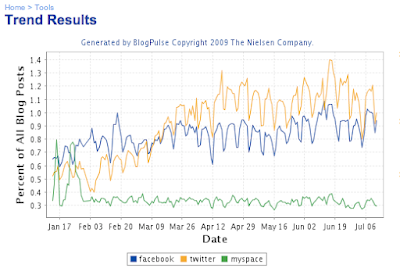
First, check out what's hot in the blogosphere. Nielsen data shows that Twitter is gaining mentions and MySpace is flatlining.
Graph of mentions Twitter Facebook MySpace. Twtitter trending up, Myspace flat and low, Facebook holding it's own[my apologies to the Tweep who sent me this way. I searched and couldn't find you. So an annon h/t. So sorry!]

Second trend, Nielsen Global Online Consumer Survey shows that personal recommendations and online opinions are the most influential.

Government is not listed in the mix, but depending on how you cut it, government sites are most like "brand" websites, which have a respectable 70% positive trust level.

The important piece for government, though, is to make content more sharable. If a friend sends an email, or shares a page on Facebook or tweets a link, 90% of the people will trust the information. Helping people to share government content looks like a big win.

Third, since Twitter is so hot, here are some numbers to give flavor to the "Twittershpere" via a report by Internet marketing company Hubspot. Among Twitter users
  • 55.50% are not following anyone
  • 54.88% have never tweeted
  • 52.71% have no followers
Looking closer at what this means, only 9% of the Twitter users meet all three criteria (less than 10 in each category). For example the State Department travel alerts follows only 15 but is followed by 6,215 and have updated with 175 alerts. And then there's Oprah, with her nearly 2 million followers, who only follows 14 people with a paltry 50 tweets.

People who have never tweeted may be using Twitter as a news aggregator, taking in information and choosing to share nothing. They are still involved by reading messages and are available. The people with few followers may follow many, follow a few people with whom they have a close exchange, or perhaps simply never got the Twitter bug. You can read the entire State of the Twittersphere (download PDF) report, here.

Jul 8, 2009

If Social Media is the New Punk, Who Are You?

2 comments

This is a fun video. And whether you do or don't like punk, you must admit that it influenced the music following. So, for fun, if gov-social media is to punk rock, where do you fit?

Ramones. Raw, stripped down and honest. Listen to Blitzkrieg Bop. Let's face it, not many in gov have the guts or the ability to be leaders in this space. But NGOs can.

Take a look at the innovative, crowd-sourced and brave efforts of the JumpStart Mapping Initiative. This program aims "to produce complete, free, and open public-domain street maps in developing countries." Volunteers are being trained in GIS surveying and cartography and walk the streets to produce a data set for a street map of the West Bank using web-based open source software to get to
  • better transparency in government planning for civil services
  • better relief and reporting for humanitarian efforts
  • better fluidity in private markets
  • the potential to generate job opportunities that enable businesses to enhance their services
See also the slides from Mikel Miron's program from Crisis Camp Ignite. This is one of the most amazing projects I have seen.

Another Ramone's era example is the useful, cool and edgy mashup created with official D.C. government data. Stumble Safely is a mobile application that helps people "find the best bars and a safe path to stumble home on." It uses uses data about D.C. crime, streets, liquor licenses, parks, and subway stations to build a safe route home as well as awareness information to let you know club hotspots. This is what happens when government takes the chance of opening up it's data stores-an application that gets people's attention and fills a niche need (or maybe desire). Watch the local government space for more Ramones-like applications.

The Clash: Punk from across the pond, The Clash took raw energy and politics and recognized that production values count with some added polish. Try Train in Vain. Still crazy innovative, they brought the in-your-face punk to a wider audience with the best LP of the 80's.

We are starting to see examples of Clash-level work, like the TSA Blog which brings a bite not normally seen in government discourse with an openness, and, yes, sometimes even in-your-face-ness that others have yet to emulate.

Another example, less edgy and more harmonic, is the Centers for Disease Control and Prevention (CDC) and their e-marketing social media efforts. Their steps into interaction in virtual worlds reaches new audiences (kids and their grandparents) to change people's behavior, like getting a flu vaccine. CDC is also using widgets to encourage people who care--not everyone--pass on public health information to their friends.

Much to come in this category.

U2: Still with a distinct sound, this Irish band has defined rock and roll for 25 years. From Two Hearts to Beautiful Day to a turn at the inauguration, they are definitely mainstream, but with an edge. They ask us to participate and to collaborate with them and with each other.

We are too soon for any U2-style examples as we're at the beginning of the trek (at this stage I see more examples like this).

We must continue to evolve, experiment and take risks. There would be no U2 without the Clash and no Clash without the Ramones. Punk evolves to mainstream, but a bit of the anarchy remains (did you hear what Bono said about int'l relations at the Inaugural concert?).

It's up to the folks who want more than a controlled, conservative approach to government "interaction" to step up to be dot-gov rockstars, the next Bono.

Hey, ho, let's GO!

Jul 6, 2009

Where You Are Matters: MySpace and Facebook

0 comments
Picture of a racially diverse group of VERY cute kidsHad an amazing time at the Personal Democracy Forum in NYC last week. More than once I felt my head exploding with new thoughts. In this program full of great thinking and new ideas, danah boyd's talk on "The Not-So-Hidden Politics of Class Online" was probably the most referenced, and one that struck a nerve.

boyd began with questioning the hype that Facebook was hot and that MySpace was not. Now that Facebook has caught up, traffic-wise, with rival MySpace, many think it's over for MySpace. But with 70 million visitors on MySpace, how does it not continue to be important?

She then discussed her research and the growing race, class and education divide between the two networks and what she calls a modern day, digital "white flight" from MySpace to Facebook.
All this said, people are already divided and we accept that people from different backgrounds inhabit different environments. We cannot expect technology to automatically integrate people and generate cultural harmony. Although most of you call these sites "social networking sites," there's almost no networking going on. People use these sites to connect to the people they know....

But here's the main issue with social divisions. We can accept when people choose to connect to people who are like them and not friend different others. But can we accept when institutions and services only support a portion of the network? When politicians only address half of their constituency? When educators and policy makers engage with people only through the tools of the privileged? When we start leveraging technology to meet specific goals, we may reinforce the divisions that we're trying to address.

boyd summarized her thinking and research about social networks and the impact of institutions selecting specific venues for outreach.
1) Social stratification is pervasive in American society (and around the globe). Social media does not magically eradicate inequality. Rather, it mirrors what is happening in everyday life and makes social divisions visible.

2) There is no universal public online. What we see as user "choice" in social media often has to do with structural forces like homophily in people's social networks. People connect to people who think like them and they think like the people with whom they are connected.

3) If you are trying to connect with the public, where you go online matters. The key to developing a social media strategy is to understand who you're reaching and who you're not and make certain that your perspective is accounting for said choices.

4) The Internet has enabled many new voices to enter the political fray, but not everyone is sitting at the table.--read the entire talk on danah.org [emphasis mine]
So, as government agencies develop a social network strategy--and even as they are dipping their toes into the social media waters--the decisions agencies are making about resources and resourcing need to be informed by facts and not hype.

If government wants to reach people where they are, it needs to understand not only where "people are," but also who uses which tools and how different audiences expect to interact and consume information.

My excerpts and overview do not give boyd's ideas their due. Please read more here and think about how you might use her analysis as you develop your social media strategy.

Jul 3, 2009

Smithsonian Seeding Staff New Media Innovation

2 comments
The Smithsonian Castle on the National Mall, Washington DCSmithsonian Secretary Wayne Clough announced a new project and fund to encourage staff at the world's largest museum complex and research organization to explore and launch ways to "use digital technology and new media" to advance the Smithsonian's work.

From Secretary Clough's announcement to staff
The Smithsonian 2.0 Fund offers internal grants to staff for varied and diverse attempts to use interactive web methods and digital technology in a creative way so as to engage members of the public or particular constituencies in the collections, research, exhibitions, or programs of the Smithsonian. Grant awards will typically be in the $10,000 to $30,000 range; they are intended to provide seed money for projects likely to turn into larger initiatives.

All Smithsonian staff and units are eligible to submit projects for funding. Proposed projects must be led by a Smithsonian staff person, though they may involve more than one SI unit as well as outside partners.

In light of our very successful Smithsonian 2.0 conference and subsequent debates and discussions, I am confident that we have a large number of good ideas for moving ahead in the digital arena. I fully expect numerous staff to submit fine proposals for the benefit of the Smithsonian, the public, and our various constituencies.--from email to staff
This project begins to answer one of the challenges raised in their debates:
Knowledge is increasing at such a rapid pace that keeping web-delivered content up to date is an extremely challenging and expensive task, perhaps too much so...If the pace of knowledge development is driven by the collaboration and sharing of expertise via the Internet, should we be looking at a similar model to get the word out about the breakthroughs and new developments we are part of?--see more on the Smithsonian 2.0 blog.
What a terrific effort to tap the collective knowledge and creativity of the people who directly know the collections and the audience, AND, to acknowledge that the knowledge and creativity of staff as a valued resource.

The effort is funded by gifts from the Smithsonian National Board. Great job putting your money where your mouth is, Smithsonian.

Jun 28, 2009

Phase III of Open Government Initiative Extended

0 comments
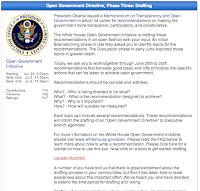
Open Government Initiative web sitePlease put on your to-do list and PARTICIPATE in this effort.

From the Open Government Blog at the White House
SAT, JUNE 27, 7:17 PM EST Extension of Phase III: Drafting of Open Government Recommendations
As of Friday, June 26th, there were well over 100 drafts of open government recommendations that you, the public, had written in Phase III of the public consultation process. The community of contributors grows by the hour, as word of this collaborative effort spreads.

A number of you have told us that there is great excitement about the drafting process in your communities, but that it has taken time to raise awareness about this important effort. We’ve heard you and have decided to extend the time period for drafting and voting.

Drafting of recommendations will now continue through 11:59pm Eastern Friday, July 3rd. Voting will stay open through the holiday weekend, until 11:59pm Eastern Monday, July 6th.

Spread the word and join the movement to help make government more transparent, participatory, and collaborative. Write, read, and rate recommendations at http://www.mixedink.com/opengov/ --Read the post on the White House blog.
The topics so far are
  • Transparency- including defining transparency, institutionalizing transparency, operations, more data online, improving access
  • Participation- including creating new opportunities to engage citizens, training people to participate, new media, agency e-rulemaking
  • Collaboration- including inter-governmental collaboration, public-private partnerships, online dispute resolution.
Don't see what you think is important? Jump in.

The White House is using a tool called Mixed Ink for the collaboration. It's a hybrid wiki that lets multiple authors update and comment, and also enables voting on changes for what they call "more consensual collaboration."

Don't be daunted by the tool. Poke around. Vote. Then go ahead and make some changes or add a section. Especially if this is what you have been asking for, and, let others know about this opportunity. This will be as good as we make it.

Now go! Do it!

Jun 25, 2009

7 Listening Tools: Getting from Asking to Listening

2 comments
T-shirt that says, WARNING I am not listening P&G and Nielsen are trying to understand how learning gleaned from “listening” to online consumer conversations compares to survey-based findings (”asking”).
What we learned was surprising and important. Findings from “listening” and “asking” were largely consistent. Most importantly, in every case, “listening” added to our understanding in important ways, meaningfully enhancing insights, and sometimes suggesting a different course of action. For example, a survey on cloth diapering identified cost savings and sustainability as key reasons for using cloth diapers. Listening took this further, revealing the passion cloth-diapering moms have for “CD’ing,” and connecting it to core values around parenting. This led to a fundamentally different, more holistic understanding of cloth diapering than was available from survey results alone.

Listening consistently provided valuable depth and context … adding listening to the picture was a little like going from an X-ray to a CAT scan. Furthermore, listening revealed the level of consumer passion or intensity associated with a specific topic. Understanding “intensity” can be just as important to winning in the marketplace as understanding size or “magnitude,” suggesting the need to pursue survey-based and listening-based approaches (or hybrid methods) going forward.--More on the Nielsen Online Analyst Blog
It's clear that asking is important. But, information from listening added to information from surveys (asking) gives a more nuanced and more complete picture of what's going on.

For government, it means looking for ways to listen. Here are 7 easy--and available--listening tools.
  1. If you survey, be sure to leave space for free response. Yes, it's harder to quantify, but it's the best way to get to what your users/visitors really mean.
  2. Regularly review the emails sent to the generic webmaster address. You will learn what people are looking for, what makes them unhappy, and potential gaps in content or services.
  3. Review weblogs for search terms. These are the words and phrases that people are using to get to your site. Take the most popular terms and run the search yourself. What are the results? Is it what a user might expect?
  4. Review your internal search logs to find out what people are looking for once they're on your site. Quarterly, look at all the search terms and group them by "like." When you group them you might see a different trend. Also, your users will tell you what they call your content (you say "lawful permanent residence" and they say "green card").
  5. Check out what people are looking for on Google. There is a suite of free query tools that can give you insights into the people who may or may not visit your site. Start at What is the Google zeitgeist? and work your way through the search and comparison tools.
  6. Take the terms people relate to you (in 3 and 4) and use twitter search. You will get folks' raw opinion. Some good, some bad. Save the search as an RSS feed for regular access. Look for other twitter monitoring tools.
  7. Sign up for Google Alerts. Enter the terms to track and find out what bloggers, news sources and others are saying.
Got a good tool that you use? Put it in the comments and help a guy out.

BTW, Nielsen and P+G are doing a webinar to discuss their findings on Friday at 2 pm. You can register here.