Federal agencies are blogging, tweeting, sharing photos and videos, publishing data, running online public dialogues, texting, fanning and friending. Here's a great list in case you need to catch up.
Good news is that many of the policy barriers have been overcome and agencies are regularly using social media to communicate and, in some cases, serve the public. The complicating news is that the mainstreaming of social media has brought new eyes and challenges to light.
This manifests itself practically in an office saying they won't allow use of Twitter since it hasn't been accredited in accordance with NIST SP 800-37 "Guide for the Security Certification and Accreditation of Federal Information Systems." Hunh? Or another office saying that there will be no comments, or that comments will be ignored(!), on their Facebook wall because to interact would create a government record. Whaa? Big barriers to participation, no?
I wonder. Do people who comment on government pages and channels expect that they are entering data into the federal record? Or are they thinking it's like a town hall or letter to the editor in a newspaper? Or more likely something for their other friends to see?
I wonder. Are agencies barred from using public social networks unless these private networks follow government security requirements? [And would they turn over security documentation for the public record?] Or are theses public commons in which the government engages, like the President giving a speech at a school or addressing the public as a guest on a cable TV show?
I wonder. Does government own or control third-party, private social media networks like Facebook, Twitter, and YouTube? Or is government a participant--like everyone else--in these communities.
Not one to let a hot meme slip by, and vacation prone to hearing the oceans in a shell and seeing signs in billowing clouds, here's my resounding YES to finding lessons for dot-gov in this past week's Internet phenom: that most awesome 180 videos in 3 days, multi-channel, rock-hard abs Old Spice campaign.
But I am not going to write about the brilliant social media campaign--others are doing that. Instead, I want to talk about four lessons we can take from @OldSpice Guy to better our dot-gov projects.
Number one: Speed
This is 2010, and if you haven't got it yet, we stopped waiting. The Old Spice team created video responses in real time. Someone--sometimes famous and sometimes not--would tweet and in minutes there was a response. And it was good. We hadn't seen this level of realtime before, but we like it.
Government needs to get with the program and escape from the time warps of never-ending requirements gathering, ad nauseam reporting, acquisition merry-go-rounds, and TAA (total risk aversion). I was on a panel a few weeks ago when someone asked how was it acceptable for government to take 3 months to implement open government initiatives. My response? that I would love for a project to come in under six. Sigh.
Our citizens expect immediate results. We need to make it so.
Number two: Planning
How do you make 180 videos, have them distributed across multiple networks and garner 11 million views in 3 days? Very carefully. This was a well-designed and executed plan. And, like any well-executed plan, it looked easy. But the handsome man already had a fan base, the social media team knew where to reach out, all the resources for the rapid research, writing, producing and editing were on site, and sign-offs were established.
I don't want to miss any chance to hammer home the strategy message. You, too, are building toward a goal. You have to lay the groundwork, do your research and pull together the team. You also need to be open to opportunities.
For example, we learned that you can't put a new capability in place during a disaster (duh, you say, but there is an expectation that technology can solve problems "magically"). That's why it's important for people drill and for organizations to run simulations and exercises. That's why your IT and new media teams need to participate. Setting up a Twitter account days into a crisis is much less effective than building a follower base and expertise to broadcast information that scales.
Is having a web infrastructure that can easily output RSS something you will need? Don't have the infrastructure you want, but can begin collecting data for the next gen? Do it now. In 2006, we tested third party tools for a blog, because, even though we had no nibbles from the front office, we knew that we would keep pushing to blog. When the formerly reluctant boss hit "go," many months later, we were ready with tested technology and policy. We went from go to live in 5 weeks without breaking a sweat.
See where you want to be. Build toward that state.
Number three: Talent
No doubt that the Old Spicers had a corral full of talent. From the guy in front of camera to the professional broadcast quality output to the hysterically funny writers to the social media experts who brilliantly got it and executed on key to the crazy creatives that put the whole scheme in motion, this was high-quality work.
Who do you have in your stable? Is your organization built for mules who keep their heads down and plod along on the well-worn path? Or do you nurture thoroughbreds and give them room to run? Do you hire or contact with superstars only to to keep pulling up the reins and push them to follow that old path? Does your staff look at the Old Spice campaign and wish they could do something like that?
You want high quality output? Find and nurture the folks who can do that work. And give them the space.
Which leads to...
Number four: Trust
There would be no speed from this well-planned caper if there wasn't an extraordinary level of trust in the superstar team. The ad company had worked with the client at length and pitched a process that skipped traditional sign-offs from legal, et.al. And the client agreed.
This is an interesting element. It's critical to understand that while trust is imperative, it's not automatic. Trust needs to be earned, every day. It's unreasonable--and dangerous--for executives to bet on a project or team simply because trust is a success factor. It's up to the folks in dot-gov to build the trust and to show the judgement necessary to take on risk. You create trust by building relationships, by showing success on smaller projects, by understanding the needs of the organization and developing programs to meet mission goals, by creating strong implementation and risk management plans, and by communicating clearly both up and down.
Trust, like Rome, isn't built in a day.
So that's it, speed, planning, talent and trust or SPTT! I think I need a vowel for that. Hey, look, a fish just fell in my arms. Then it turned into diamonds. I'm on a horse.
And, in case you missed it, here's my personal favorite of the Old Spice rapid ads--to the actor's daughter.
Twitter grows. Pew released some data last week about growth in Twitter use--from 11% of Internet users to 19% in just six-months. Other findings? Three groups of internet users are mainly responsible for driving the growth of this activity, social network users, people who are using mobile and folks under age 44. See more at the Pew Internet Project.
White Paper Report Card. Candi Harrison asks, "Web Manager Council’s White Paper – Is There Progress A Year Later?" In her post she recaps the goals of easily identifiable, relevant, accurate, and up-to-date information that is easy to understand, addresses citizen tasks, is consistent across channels, provides feedback channels and is accessible across reading, ability and language barriers. She gave government a mixed review. See more here.
White House goes Drupal. And TechPresident swoons as they announced that whitehouse.gov has moved to Open Source Software and dropped their proprietary system. I am not sure that this is a great advance for democracy--bottom line is that there will be a custom (read proprietary) system built on the open source platform. But it is good for open source. See more at TechPresident.
Finally, NextGov reports, no movement from White House on the issuing of the Open Government memo that the President announced January 21. See Next Gov.
Last week a few reports were released that can help shed some light on teen Twitter behavior.
[begin rant] You likely heard about the Morgan Stanley [rubbish] "report" written by a precocious fifteen-year-old intern from their London office. It's been stuck in my craw since it's post-release media flurry. No disrespect to the young man who solidly reported the experiences of he and his mates, but the ah-ha frenzy of corporate boardrooms and media belies that every observant parent of teens already knew what their kids do. [end rant]
Anyway, among the "findings" in the report--and one I have been arguing about--is that teens don't use Twitter because they are limited by limited cell phone use and texting.
So, looking at the data, it doesn't seem that there is a huge lack of access to cell phones or text messaging that would limit the use of Twitter for teens.
THEN, there is the idea that it's important to tweet from your cell phone.
Read Write Web reported, also last week, that Twitter users are most likely to use the Web, not a cell phone, to share their tweets.
[U]pdating your status online via Twitter.com is still the dominant way that most people use Twitter, with 65% of tweets attributed to this method....Besides the web, which accounts for nearly two-thirds of Twitter updates, the second most popular way to update Twitter.com is via text message. However, with 6% of tweets sent, this method only accounts for 1/10th as many tweets.--Read more on Read Write Web.
Data shows that text messaging from phones is not preferred by Twitter users, period. Since more than 90% of all 12-17 year olds are online, more than any other age group, teens have at least the same access to the Twitter web interface as any other Twitter users.
So, the data does not support that dismal teen tweeting is "caused" by the lack of access to technology. It's more likely that they simply are not interested in Twitter
"So," you ask, "why did you go here? Taking us on this trail for a little tidbit of clarification on a fairly small topic?"
Two reasons. First, it's critical that folks working on innovation and technology make decisions based on data, not just fashion. And, second, it's imperative to take a hard look at the data sources. We need to carefully look at the data and assumptions and get past the hype, whenever we can. And not pass on the hype.
[Okay, and thirdly, because I was right and now there's nothing stuck in my U-Mich SRC craw. The benefits of being the blog owner.]
A few quick resources to look at the state of the interwebs and to help you measure your own state of being.
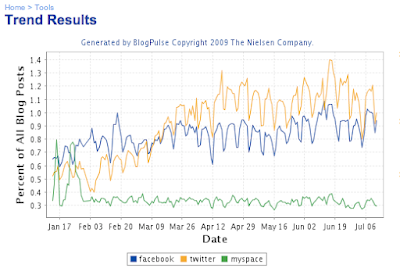
First, check out what's hot in the blogosphere. Nielsen data shows that Twitter is gaining mentions and MySpace is flatlining. [my apologies to the Tweep who sent me this way. I searched and couldn't find you. So an annon h/t. So sorry!]
Second trend, Nielsen Global Online Consumer Survey shows that personal recommendations and online opinions are the most influential. Government is not listed in the mix, but depending on how you cut it, government sites are most like "brand" websites, which have a respectable 70% positive trust level.
The important piece for government, though, is to make content more sharable. If a friend sends an email, or shares a page on Facebook or tweets a link, 90% of the people will trust the information. Helping people to share government content looks like a big win.
Third, since Twitter is so hot, here are some numbers to give flavor to the "Twittershpere" via a report by Internet marketing company Hubspot. Among Twitter users
55.50% are not following anyone
54.88% have never tweeted
52.71% have no followers
Looking closer at what this means, only 9% of the Twitter users meet all three criteria (less than 10 in each category). For example the State Department travel alerts follows only 15 but is followed by 6,215 and have updated with 175 alerts. And then there's Oprah, with her nearly 2 million followers, who only follows 14 people with a paltry 50 tweets.
People who have never tweeted may be using Twitter as a news aggregator, taking in information and choosing to share nothing. They are still involved by reading messages and are available. The people with few followers may follow many, follow a few people with whom they have a close exchange, or perhaps simply never got the Twitter bug. You can read the entire State of the Twittersphere (download PDF) report, here.
P&G and Nielsen are trying to understand how learning gleaned from “listening” to online consumer conversations compares to survey-based findings (”asking”).
What we learned was surprising and important. Findings from “listening” and “asking” were largely consistent. Most importantly, in every case, “listening” added to our understanding in important ways, meaningfully enhancing insights, and sometimes suggesting a different course of action. For example, a survey on cloth diapering identified cost savings and sustainability as key reasons for using cloth diapers. Listening took this further, revealing the passion cloth-diapering moms have for “CD’ing,” and connecting it to core values around parenting. This led to a fundamentally different, more holistic understanding of cloth diapering than was available from survey results alone.
Listening consistently provided valuable depth and context … adding listening to the picture was a little like going from an X-ray to a CAT scan. Furthermore, listening revealed the level of consumer passion or intensity associated with a specific topic. Understanding “intensity” can be just as important to winning in the marketplace as understanding size or “magnitude,” suggesting the need to pursue survey-based and listening-based approaches (or hybrid methods) going forward.--More on the Nielsen Online Analyst Blog
It's clear that asking is important. But, information from listening added to information from surveys (asking) gives a more nuanced and more complete picture of what's going on.
For government, it means looking for ways to listen. Here are 7 easy--and available--listening tools.
If you survey, be sure to leave space for free response. Yes, it's harder to quantify, but it's the best way to get to what your users/visitors really mean.
Regularly review the emails sent to the generic webmaster address. You will learn what people are looking for, what makes them unhappy, and potential gaps in content or services.
Review weblogs for search terms. These are the words and phrases that people are using to get to your site. Take the most popular terms and run the search yourself. What are the results? Is it what a user might expect?
Review your internal search logs to find out what people are looking for once they're on your site. Quarterly, look at all the search terms and group them by "like." When you group them you might see a different trend. Also, your users will tell you what they call your content (you say "lawful permanent residence" and they say "green card").
Check out what people are looking for on Google. There is a suite of free query tools that can give you insights into the people who may or may not visit your site. Start at What is the Google zeitgeist? and work your way through the search and comparison tools.
Take the terms people relate to you (in 3 and 4) and use twitter search. You will get folks' raw opinion. Some good, some bad. Save the search as an RSS feed for regular access. Look for other twitter monitoring tools.
Sign up for Google Alerts. Enter the terms to track and find out what bloggers, news sources and others are saying.
Got a good tool that you use? Put it in the comments and help a guy out.
BTW, Nielsen and P+G are doing a webinar to discuss their findings on Friday at 2 pm. You can register here.
Andrew Sullivan blogging on Iranians using Twitter and social media as telephones and television communications were being shut down:
Mock not. As the regime shut down other forms of communication, Twitter survived. With some remarkable results. Those rooftop chants that were becoming deafening in Tehran? A few hours ago, this concept of resistance was spread by a twitter message.
That a new information technology could be improvised for this purpose so swiftly is a sign of the times. It reveals in Iran what the Obama campaign revealed in the United States. You cannot stop people any longer. You cannot control them any longer. They can bypass your established media; they can broadcast to one another; they can organize as never before.--Read the entire post at The Atlantic.
While it's too early to say what will happen, it's clear that people are using whatever conduits they find to communicate, especially during a crisis.
CrisisCamp DC started with one idea, "How can technology help people around the world during times and places of crisis?" Over the weekend about a hundred people got together to talk about how technology is or can be used for humanitarian relief. Industry, NGOs, responders, academics, public health, geek, non-geek and a few government joined to usher in a movement.
Where else can you find sessions like Flood, Earthquake, Pandemic, Twister, Dirty Bomb, Last Supper-Armageddon, or the use of zombies as an example to help people think in new ways?
Government limits were also in the mix. Government can be slow, not willing to trust citizens as adults, hobbled by privacy and potential corruption, and too top-down when crisis is definitely felt and fought from the ground up (see Camp tweets for fuller flavor). A big theme was emphasis on listening rather then telling, adapting rather than knowing, and sharing.
There has been discussion about authoritative sources for crisis information, and government is at the beginnings of understanding our role. We know what we know, but unofficial sources--real people--know what they are experiencing. Bringing these views and experiences together, with the help of smart smart people and technology, will define success and failure in future crisis. And, as everyone at Crisis Camp was well aware, on the ground this is real--survival and pace of recovery.
The Social Media Academy released a report reviewing the "social media status" of six global enterprises including Dow Chemical, John Deere, NetApp, New York Life, Toyota, and Vodafone.
We had a pretty good understanding about the estimated outcome –yet it was shocking to realize how vulnerable businesses are that stay away from social media. The present case demonstrates how a small group of social media savvy consultants can compromise a global enterprise based on publicly available data.
We used only publicly available data by dissecting the social web. The data was aggregated from over one million people who publicly expressed their opinions and emotions in social networks, groups, communities, forums, blogs, and other social media related places. The “Mind Share Report” demonstrates not only that social media is heavily used by businesses across all industries but also that it poses a significant threat to companies who do not understand how publicly available information can be used by their competitors to create devastating effects.--Read more on customerthink.com
The full study is available for $195, but you can glean some very good insights from the free 30-page executive summary, especially as a blueprint for using social networks to find out more about your audience/stakeholders and what they think about your organization and issues.
What you see in the corporate world are fan pages set up in Facebook, reviews of services in Yelp!, LinkedIn profiles of employees and groups related to their organizations, Twitter streams about organizations and from organizations, videos both for and against on YouTube. These same outlets are used by citizens to share things that they like about government and things that they don't like about government. Social media is the world's largest, ongoing focus group.
Twitter is a social networking and microblogging tool that lets people send short--only 140 characters--text messages to friends and on a massive public timeline. It is growing fast, 131% traffic increase in March to over 9 million visitors. It has grown because it is easy and conversational. People can learn about friends and even converse with celebrities. See what Shaquille O'Neal has to say at twitter.com/the_real_shaq.
See also twitter.com/nasa for an example of what a government Twitter stream looks like.
Nextgov looked at a random sample of 100 Twitter updates from ten different government organizations to find out what federal agencies were tweeting about. They generated lists of the 40 most-used words in each organization's Twitter feed.
It's very interesting to see the words that agencies use in their tweets. The larger the word, the more frequently it is used by the agency.
Twitter can be a broadcast channel, but many see Twitter as a tool to engage and converse with followers. In the case of government, followers are citizens, constituents, and other stakeholders.
In the Air Force example, they most frequently talk about themselves: air force, af, airmen and officer, official; they also talk about the media. Another big word, however, is THANKS, definitely a term of engagement.
The second example is from the Transportation Security Administration (TSA). Their Twitter stream is all about their blog, post, blogger, publish, less about the organization, tsa and dhs. One of the biggest word on the page, though, is YOU and your. Looks like the agency is getting outside of itself.
Twitter, Facebook not ready for Government 2.0? Bill Schrier, CIO for the City of Seattle and a creative adopter of technology, writes, "Amazingly enough, social networking tools may not be of much use to local government, unless there are significant improvements or new applications. How do social media companies and local governments need to change to really bring social networking "to the people"? " Schrier calls out issues with identity and relationships to government, challenges with volume and true one-one communications with officials, and the digital divide as issues that need to be thought through and addressed. Read his post.
Government 2.0 Meets Catch 22. NY Times blogger Saul Hansell writes, “Do I need to P.I.A. Facebook?” said the perplexed bureaucrat squished into a narrow basement hotel conference room in Washington DC. P.I.A. stands for Privacy Impact Assessment, a procedure that federal agencies must go through every time they create a new computer system. It was one of many questions about how the government can use the tools of Web 2.0 raised in a session of a privacy conference last week. Organizations of all sorts have been trying to figure out how they can adapt social networks, blogs, wiki’s and other Web tools to their traditional operating methods in order to connect to customers and partners." Really, who woulda thunk that a PIA would be mentioned in a NYT blog? Also, for the record the Dept of Homeland Security doesn't have a Facebook page per some misinformed "official" quoted in the blog.Read the entire post.
Analysis: Which URL Shortening Service Should You Use? Search Engine Land has a great primer and comparison for URL shorteners. "URL shortening services are experiencing a renaissance in the age of Twitter. When every character counts, these services reduce long URLs to tiny forms. But which is the best to use, when so many are offered and new ones seem to appear each day? Below, issues to consider and a breakdown of popular services, including recommendations and services to avoid (the new DiggBar being one of these)." Very practical read.
While not all dot-gov is about social media--despite heavy news and buzz coverage--it certainly is growing in importance.
Social media includes blogs, social networking sites like Facebook and MySpace, microblogging platforms like Twitter, social bookmarking like delicious, collaborative tools like Wikipedia, and more. These tools provide new avenues to deliver government services and communicate--two way!--with citizens.
Ten Common Objections to Social Media Adoption and How You Can Respond: From Read Write Web: An excellent article that list each of the top 10 common objections to new online tools and provides advice on what you can say in response to each of them. From I to I don’t have the time to contribute and moderate.
Top 10 Reasons Brands should Listen to Social Media: From Power Shift - Social Media Blog: There are a multitude of reasons for paying attention to what’s being said in social media. This article lists the top ten which include uncovering complaints so you can remedy them and identifying customers who praise your products so you can use these as testimonials.
21 Ways to Share the Social Media Love From Altitude Branding: The first step in convincing someone about social media is making sure they understand it. This article reviews 21 things to do share what you know about social media with others — business or individual. If you want to increase your own confidence in social media try our post 100+ Resources to Boost Your Social Media Savvy
Take a look at these even if you are not ready to convince your boss. You might be the one who needs convincing, and the time to research is now. If you liked the examples above, see more here.
The Department of Health and Human Services (HHS), the Centers for Disease Control and Prevention (CDC) and the Food and Drug Administration (FDA) have been doing some absolutely terrific work on using all the arrows in their quivers--nonstop social media and cross agency collaboration--to get out information on the salmonella-in-peanut-butter recall.
Federal health agencies have been experimenting with new Internet tools, dubbed Web 2.0, that make it easier to deliver information directly to the public. The "Health 2.0" movement got a big boost with the arrival of President Barack Obama, who is pushing federal agencies to use the tools to make the federal government more transparent and participatory.
When the source of the salmonella outbreak was identified in January, the FDA scampered to put a searchable database of recalled products on the Web. People have searched the database 19 million times in the past 10 days, Sanjay Koyani, the FDA's director of Web communications, told me yesterday. Outbreak updates are also available via blogs, widgets, and podcasts. The not-at-all-scary podcast aimed at kids explains that "icky bugs" could make them sick. You can even add a badge to your Facebook page saying: "I checked my cupboards for recalled products!"Read more on U.S. News "On Parenting"
HHS has been doing a great job keeping the focus on the health emergency on their homepage--with ample links to resources in their sibling sites. This is the level of content integration that is critical to the public, and in too many instances has been waylaid because of turf battles. Folks in government appreciate how important--and how challenging--this is. Kudos to the FDA, CDC and HHS web, new media and communications teams.
Please share the widget (below) and pass on the message!
One of the barriers to using social media is cultural/corporate. This means that decision makers and leaders may not share the zeal of the advocates. They may think that social media tools are used by a small niche of people, so why take the risk and adopt these crazy channels?
From a Ketchum Public Relations survey released two weeks ago:
Consumers are using a wider variety of channels than ever before. Newer channels, such as blogs and social networking sites, are gaining more and more traction. The survey found that 26% of consumers use social networking sites, compared to 17% in 2006. The usage of blogs nearly doubled (24% in 2008 compared to 13% in 2006).
This is especially true among influential consumers – the 10% to 15% of the population who initiate change in their communities – of which 43% read blogs by nonjournalists (compared to 16% of the general population) and 32% read blogs written by journalists (8% of the general population).
Conversely, the use of more established media channels continues to wane. The survey revealed that 65% of consumers use major network television news as a source of information (down from 71% in 2006). Local television news saw a sharper drop – 62% in 2008 compared to 74% in 2006. [Emphasis added by me]--From Media in the 21st Century. Read more.
So, traditional network news use is decreasing and the use of social media is increasing. While the overall numbers are still in favor of traditional media, the trends look like the balance will shift.
While this study was for traditional PR, we all know that a major focus of the government is to communicate--from peanut butter recalls to hurricane evacuation orders, from prescription drug benefits changes to the demise of analog TV signals, from immigration reform pros and cons to bank bailout pros and cons. Adding additional channels to your communications strategy is just plain good business. For government, that is.
Looks like there will be a few tweets from Chief Paulison to get started (signed -P) followed by a tweet exchange. The promise is to have staff answer any tweets that the Chief can't get to.
From Tech Crunch: Phishing attacks, which hit Twitter over the weekend, are a sign a service has arrived Facebook has the same problem). But someone hacking into Twitter’s internal admin tools and compromising 33 high profile accounts, including President Elect Barack Obama, has Twitter users freaking out about what to do.
Here is Twitter’s official explanation:
This morning we discovered 33 Twitter accounts had been “hacked” including prominent Twitter-ers like Rick Sanchez and Barack Obama (who has not been Twittering since becoming the president elect due to transition issues). We immediately locked down the accounts and investigated the issue. Rick, Barack, and others are now back in control of their accounts.
What Happened?
The issue with these 33 accounts is different from the Phishing scam aimed at Twitter users this weekend. These accounts were compromised by an individual who hacked into some of the tools our support team uses to help people do things like edit the email address associated with their Twitter account when they can’t remember or get stuck. We considered this a very serious breach of security and immediately took the support tools offline. We’ll put them back only when they’re safe and secure.
I got a suspect tweet yesterday. It came direct to my phone, so I knew something was wrong. Here is more from twitter on the scam they were caught in.
This is a reminder to all using social media--but more importantly for advocates of social media. It's critical that advocates keep up with the "news" and status of the new favorite tools. Early adopters need to be aware of the risks and be the ones to bring it up.