Showing posts with label blogs. Show all posts

Dec 29, 2009

Round Up for 2009

0 comments
Here are some of articles, papers, and videos that shaped my thinking this year.
  • Putting Government Data Online Tim Berners-Lee most excellent article challenging us to take the risk and be open before we know the results. My #1.
  • Newspapers and Thinking the Unthinkable Clay Shirky's view of journalism is an insight into the disruptive change we are living.
  • "The Not-So-Hidden Politics of Class Online" danah boyd's speech at June's Personal Democracy Forum forcing folks to sit up and think about how we use and think about online social networks.
  • Web Squared: Web 2.0 Five Years On (PDF) Tim O’Reilly and John Battelle's discussion on how the Web is learning, and maybe solving some of our data issues.
  • Is Twitter a Complex Adaptive System? Vanessa Miemis laces a number of disciplines together to build on structure and development of online social systems (not just Twitter).
  • Cultural Change is Free In this video, John Seddon talks about "systems thinking", as opposed to the top-down "management thinking" or "Command and Control" thinking. Or, the manifesto to letting it go. Watch the entire video, it's worth it.
What else should I be reading? I want to learn more--put your favs in the comments.

Next, here are the ten most popular posts from this blog in 2009.
  1. What Is the Most Important Thing?
  2. Transparency Requires Plain Language
  3. Yellow Brick Roadmap: Five Examples of Getting Gov 2.0 Done
  4. 5 Social Media Memes Changing Government
  5. Hey dot-gov! Don't Believe Your Hype
  6. Innovation Causes Failure
  7. New Utah Website Graded on Tasks
  8. Talk Talk vs. Do Do
  9. 7 Listening Tools: Getting from Asking to Listening
  10. Social Networking and National Security
Thanks for reading and egging me on.

And, last, here's to an exciting New Year! Can't wait to see what's next.

Jul 25, 2009

Choir Boys and Rebels

0 comments
Old picture of two choir boys in robesThe government meets web 2.0 conference circuit is getting tired.
All web 2.0 conferences are all starting to look exactly the same. Many speakers come from agencies that are boldly using social media in a new and exciting ways, and many more "believers," who are not allowed to use those same technologies, come to hear about it. But the status quo remains the same. NASA and DoD get to successfully use social media, and the rest of us, for the most part, don't. This is the divide that needs to be overcome. I understand that agencies like the IRS and SSA have intensely sensitive data and need to be extremely cautious. But there are a great many agencies that do not fall into this category that are prevented from using these technologies, despite any prior approval GSA may have gotten. My agency isn't even officially allowed to use Twitter yet...One panelist at a breakout session described how DoD is using "other transactions" to quickly fund new ideas to address current problems. While very interesting, this was less than helpful since DoD is the only agency that I know of with this kind of authority - everyone else has to use the traditional and time-consuming procurement system. For an expo, these are excellent speakers. DoD, NASA, The White House are getting things done, but as a method to further collaboration and expand the use of social media, it failed. We need specifics: case studies, business case strategies that succeeded to support any/all of these tools, etc. [emphasis mine]--More from Jaime Maynard on her GovLoop* blog.
The robust discussion that followed Jamie's post included more than a few frustrated voices lamenting the lack of process and policy that can allow and encourage the use of social media tools in government agencies. Bottom line, it's not fun to see what everyone is doing if there appears to be no light at the end of your own tunnel.

So, tunnel!

Here's the thing. We are just at the beginning of a social information revolution. The roads are more like ruts in the ground. There are no traffic signals. And, yes, in many cases, it's the blind leading the blind.

But, it's not just government. The private sector--outside of the social technology companies themselves--is also wrestling with the upheaval that social media brings.

The ultimate issue is, How do hierarchical, risk adverse and change-fearing organizations incorporate tools that are anti-hierarchy, risky, game-changers?

Funny thing, these conferences that are causing frustrations--what with all the preaching to the choir--are the venues to create and build the networks and common language that choir members take back to their day jobs. And, the rebellious choir members are singing to colleagues, bosses, and compliance professionals from this same hymnal. And, some of the people who hear the music feel the joy and join the choir, too. This process repeats.

This is a sea change that is disrupting the basic structures of our systems, from contracting and buying services to shining bright lights on moldy laws to upending command and control structures. These institutions--acquisitions, legal, management--are meant to withstand fads and the winds of change. But the change is happening from within.

Craig Newmark, founder of Craigslist, blogged on this earlier in the week.
We’re seeing movement from mere words to reality, and by bearing witness to that progress, I hope to help accelerate that progress, with actual results. Our goal involves:
  • Increasing government accountability
  • Everyday engagement between government workers and the public for customer service
  • Everyday engagement between the public and their representatives regarding ongoing government policy
As a nation, we’re already heading to our shared goals, mostly via many grassroots, spontaneous efforts, often involving informal collaborations between the citizens and government workers. --[emphasis mine] Read more on FedScoop.
So, take heart and channel any impatience towards improving your own knowledge and networking with other choir members. See, for example, the terrific follow-on post by Jeffrey Levy with practical suggestions to build the community and help usher in the change.

Raise your voices. This is a choir like none we've seen in a very long time.

[* If you're not a member of GovLoop you can't see Jaimies post. So join GovLoop, it's a great social network tool connecting the government (local, state, fed, contractor) community.]

Jun 11, 2009

Gov 2.0 Around the World

0 comments
Check out this dot-gov video from down-under--Australia. Matthew Hodgson's video on Gov 2.0 shows that the challenges are trans-hemispheric [okay, I likely made that word up].

From PDF's and static pages created by the "experts" behind the green shades talking about themselves in arcane governtmentese to a landscape full of choice, relationships, trust, and community.


Making government personal, real and relevant. Coming soon to a continent near you!

Apr 9, 2009

Digital Kids = Digital Future

2 comments
Adults of tomorrow, also known as my two boys.Over the past few days I have observed discussions on the value of new media tools and whether it makes sense for government to jump in. It's true that we are still struggling with Web 1.0. Some think we should get that right before moving on. But these discussions were about today. Not about tomorrow. 

Chris Brogan blogged on Envisioning Digital Kids. He said that the adults of tomorrow now live in a world where
  • The Web is always on.
  • The Web is mobile.
  • Google has always been around, and is the core source of search information.
  • Cell phones are the default phone.
  • Apple TV, Netflix, and the Web are where shows and movies come from.
  • iPods are where music comes from.
  • Everything is play-on-demand. Nothing is appointment-based.
  • Most all software is web-based.
  • We share pictures and movies with relatives always.
  • We never get lost (GPS).
  • We buy what we want (Amazon).
  • We learn things from our friends (news via social networks). --Read the entire post.
Yes, there are people who don't have broadband or even Internet. Yes, there are people who don't use email and prefer paper and stamps for communications. Yes, some folks want to pick up a phone and ask questions. And, yes, dot-gov is still working on getting Web 1.0 right.

But it will soon be too late to engage with the next group of adults. The digital natives in my house ALWAYS have more computing power and instant access to information in their hands (cellphones) than we could have imagined five years ago. Some thirteen year olds will be voting in the next presidential election. 

How do we make government a relevant information provider? a relevant employer? a relevant part of society for the adults of tomorrow? 

For starters government leaders and technologists need to look ahead and get out of the muck of current barriers and old ways of thinking. Take a look at Brogran's list above and think how your programs are relevant to tomorrow's adults.

Dot-gov needs to aim to an unknown point in the future and not shoot ourselves in our static foot. 

Apr 7, 2009

Making National Tools Local

2 comments
Gov 2.0 Camp was a blast! I am so sorry that I only made it to Happy Hour and the afternoon sessions on Saturday. But there are great summaries, impressions, resources and play by plays available here, here, here, and, of course, here. 

For the session "Ask the President," Macon Phillips, White House New Media Director, and Bev Godwin, usa.gov guru currently detailed to WH new media team, wanted to learn how to improve the question and answer. First, a quick overview from Newsweek
The President held his first "Open for Questions" event in the East Room of the White House. Basically the White House invited people to submit questions for POTUS odnline. People could then vote for the questions they'd most like to hear him answer. The whole event streamed live on whitehouse.gov, and around 100 regular folks where invited to the East Room to watch. Over 90,000 people submitted questions and 3.6 million votes were cast.--Read the rest.
Overall, folks felt the Q&A was successful. The nagging question remained, though, that this type of forum is vulnerable to special interests drowning out more organic issues.  For example, Politico noted that pot, once again, was a top question/question vote-getter, likely via a push by NORML, the National Organization for the Reform of Marijuana Laws.

The President addressed the drug question head on, but from a participation and technology point of view, the issue of manipulating results remains. 

The White House used Google Moderator, a simple tool that helps groups determine which questions should be asked at all hands meetings, conferences, Q&A sessions (see TechCrunch). Moderator, as designed was  intended to be used locally. Pete Peterson very smartly writes in Tech President that it's hard to make policy on a national scale.
[Can government] focus its online engagement efforts at the local level. In a sense this means using tools like Moderator as they were originally intended. The advantage of this strategy is that the content and political decision-making process involved in localized issues tend to be less complex than at the national level. Participants can more readily see the impact they will have on a community concern than a national one. This does not mean the subject of the engagement is not Federal in nature. Many Federal agencies from the EPA to Homeland Security are tasked with conforming policies to cities and regions throughout the country. Answering the “how” question of policy – specifically, “how does that rule fit here?” – can be supported legitimately by online tools. --Tech President
If all politics are local, could Moderator function locally and roll up to a national agenda? The tool could ask for users' zip code or Congressional District and questions or priorities voted on locally. This would distribute the special interests geographically. 

People could begin by discussing and voting up questions in their locality and then popular questions could "advance" to a regional and then national level.  A bonus to this system, if by Congressional District, is that members of the House could also have access to the data from their districts, helping to inform their deliberations and decisions. If the tool was used for local politics, too, it would become even more valuable. 

This isn't a time to throw out the baby with the bathwater, but to take a closer look at what actually happens when new tools are introduced. The WH New Media team is anxious to refine and enhance participation tools and are looking at each foray into new territory as a learning experience. And that's something that we can all take back to our agencies. 

Apr 4, 2009

Shorts: Tools not Gov20 Ready, Catch-22 and URL Shorteners

0 comments
Khaki women's walking shorts.Twitter, Facebook not ready for Government 2.0? Bill Schrier, CIO for the City of Seattle and a creative adopter of technology, writes, "Amazingly enough, social networking tools may not be of much use to local government, unless there are significant improvements or new applications. How do social media companies and local governments need to change to really bring social networking "to the people"? " Schrier calls out issues with identity and relationships to government, challenges with volume and true one-one communications with officials, and the digital divide as issues that need to be thought through and addressed. Read his post.

Government 2.0 Meets Catch 22. NY Times blogger Saul Hansell writes, “Do I need to P.I.A. Facebook?” said the perplexed bureaucrat squished into a narrow basement hotel conference room in Washington DC. P.I.A. stands for Privacy Impact Assessment, a procedure that federal agencies must go through every time they create a new computer system. It was one of many questions about how the government can use the tools of Web 2.0 raised in a session of a privacy conference last week. Organizations of all sorts have been trying to figure out how they can adapt social networks, blogs, wiki’s and other Web tools to their traditional operating methods in order to connect to customers and partners." Really, who woulda thunk that a PIA would be mentioned in a NYT blog? Also, for the record the Dept of Homeland Security doesn't have a Facebook page per some misinformed "official" quoted in the blog. Read the entire post.

Analysis: Which URL Shortening Service Should You Use? Search Engine Land has a great primer and comparison for URL shorteners. "URL shortening services are experiencing a renaissance in the age of Twitter. When every character counts, these services reduce long URLs to tiny forms. But which is the best to use, when so many are offered and new ones seem to appear each day? Below, issues to consider and a breakdown of popular services, including recommendations and services to avoid (the new DiggBar being one of these)." Very practical read.

Apr 1, 2009

Twist on Citizen-Jounalist: The Fed-Journalist

0 comments
Sheila Campbell, former Peace Corps intranet manager and currently on staff at GSA as Manager of Webcontent.gov and Web Manager University AND co-chair of the Federal Web Managers Council, somehow has squeezed out some time to join the blogging team at Tech President.

She said
In full disclosure, you’ll see from my bio that I’m no professional writer or journalist like many of the other bloggers. I doubt you’ll be reading my posts because of my brilliant prose. But what I’m hoping I can offer—as co-chair of the Federal Web Managers Council—is an insider’s view of the government web manager community and the challenges and issues we face every day in trying to transform government websites to better serve the public. I want to share some observations from inside the trenches. And I want to get a dialogue going about how we can work together to effect meaningful, lasting change. Over the past year, I’ve seen too many conversations in the echo chamber, where government people just talk to government people or the “we-want-to-reform-government” folks only talk to other government reform folks. This blog is a small attempt to try to address that. --Read Sheila's entire inaugural post.
Sheila is among many in government who are working to bridge the gap between government and the rest-of-the-world. But she had some reservations that her bosses at the General Services Administration--the agency that oversees buildings and buying for the federal government--would not want her to blog.
But, in fact, they embraced it, as they have with other new media efforts. It was refreshing to hear them say, “it’s no different than other forms of public speaking or representation you would normally do. Just follow the same guidelines as you would otherwise. Then go for it.”
Lessons I am taking from the making of a new Fed-Journalist are, first, don't be afraid to ask permission. Times are changing and if you make a good case the answer may be "Yes!" Second, don't be afraid to be turned down. There is a growing number of examples throughout government. Use models that exist. And if someone says, "No!" you have at least tilled the soil for the next time.

Looking forward to Sheila's blog posts in the future. Go to Tech President and tell her, "hi!"

Mar 27, 2009

Shorts: Online POTUS Town Hall, Search & Better Websites

0 comments
purple camo shortsWhite House Using Google Moderator For Town Hall Meeting. And AppEngine. And YouTube. The White House is using Moderator, hosted on AppEngine, to determine which questions President Obama should answer at an online Town Hall meeting on Thursday. In just a few hours 6,932 people have submitted 7,037 questions and cast 236,048 votes on the site. Read more on TechCrunch.

And, Holy Cow, The White House Has a Digg Clone. The White House has launched a new web site where anyone can submit and vote up their most important questions for President Obama about the economy. That's right - the White House has a Digg clone! At least for the next two days. Activity on the site will culminate in Obama addressing the top questions on Thursday, March 26. Read more on ReadWriteWeb.

Transforming the Relationship Between Citizens and Government: Making Content Findable Online. [T]o truly make content available, it has to appear on the first page of search results for relevant queries on major search engines. What can government web sites do to be more findable? Findability is an in-depth process that involves both technical site architecture (ensuring search engines can crawl the pages) and content (ensuring the text is in the language of the searcher). As Kundra acknowledged, "“A two-way interaction between the government and its citizens,” he said, “will require a massive transformation by the government, on the back end, to ensure the government can deal with this new reality.”. But while a long-term plan to make government content findable in search engines is necessary, there are some basic steps that government sites can take to make content more visible in the short term. Read more from Vanessa Fox on O'Rielly blog.

Fed Web Managers Featured on Radio. Did you hear Fed 100 Winner Sheila Campbell on Federal News Radio? Sheila talks about helping citizens complete their top tasks and the Federal Web Managers Council. Also, the April Government Web Managers Conference. Listen here. Get information about the Conference in D.C., here.

Mar 24, 2009

Update on Recovery.gov

1 comments
Greg Elin from Sunlight Foundation (and who has been doing some great work helping move the recovery.gov technology solutions forward) writes
In the short 30 days since the President signed the Recovery Act (aka Stimulus Bill) into law and Recovery.gov launched:
  • 26 of 28 federal agencies currently handling stimulus dollars have launched websites at identical “/recovery” URLs (example: http://hhs.gov/recovery)
  • 83 identically formatted .xls weekly reports were filed by agencies and are downloadable by reporting agency (generally 3 per agency)
  • 42 states have launched their own recovery-related web sites with several adopting the “/recovery” meme (for example: http://www.maine.gov/recovery)
  • 3,900 hits-per-second loads have been reported for Recovery.gov
So, when I finally started to explore the Recovery sites, I grew fond of the incompleteness found in OMB’s 62 page detailed guidance memo to agencies. Inside the typical Washington-ese of the memo was a basic message that came from the Recovery Act and OMB amplified. That message was: “Use the Web, stupid.” Stating this in 2009 is very different that stating in 2004 or even 2006 (when Sunlight Foundation launched). In the post-USASpending.gov, post Obama-campaign 2009 world, all the young professionals grew up on the web. The web-requirements of the Obama administration and it’s new, back-on-the-job CIO Vivek Kundra (a 30-something year old himself) essentially unleashed the web talent inside government agencies that had been shackled by the chains of the way things were always done. Voilà! In 30 days since the Act became law, more than 70 government web “sites” have been launched. (And a lot of non-government recovery sites, too, which I’m not mentioning). Where do we ever see things happen that quickly…except on the web?" --
More on the Sunlight Blog
I especially like his statement that this is evidence of  "unleashed web talent inside government agencies that had been shackled by the way things were always done." Yes we can! And I am going to take him at face value when he call out us "young" professionals who grew up on the web. 

I will also give credit to the Federal Web Managers Council and Web Managers Forum for the ease of implementation of the "/recovery" address. A common subdirectory was first used by all agencies a few years back to help people find and link to Hurricane Katrina resources. This has since become a model for interagency web linking.

In the past few weeks, I was at more than one meeting that included a significant amount of stress--if not quite dismay--at the enormity of the Recovery.gov reporting task. And while there is still much work to be done [I am still waiting for that xml schema--I mean, come on, break it up, the schema for major comms is an easy lift and a quick success], the high expectations set from the start is translating into getting the work done. 

Mar 18, 2009

Data About Twitter

4 comments
Read Write Web talks about data from Hitwise about where Twitter leads people
According to the latest data from Hitwise, Twitter sends most of its traffic to Google, Facebook, TwitPic, and MySpace. Overall, Twitter sends about 1 in 5 users to social networks and another 1 in 5 to entertainment sites like Twitpic, YouTube, or Flickr. Even though some people think that Twitter is just a 'poor man's email system,' Twitter's clickstream profile is very different from that of most email services.

There are a number of interesting results in Hitwise's study. Among others, Hitwise notes that a higher share of downstream clicks from Twitter.com go to blogs and personal websites than from search sites, social networks, or email services. A larger number of Twitter users are also being sent to news and media sites, which points towards Twitter's growing role as a medium for sharing and breaking news stories. --More from Read Write Web.
Twitter is a great place for folks to share links to resources. Makes sense to get gov links on Twitter.

An easy way to use Twitter is to automatically send your agency RSS blog or newsroom feed to Twitter by Twitterfeed. Not the sexiest use of Twitter, but one that doesn't have much lift and can help broadcast information. See, for example, the Department of Labor twitter account.

Mar 16, 2009

Thinking the Unthinkable in Gov?

5 comments
Guttenberg Press, clipart courtesy of FCITClay Shirky's latest blog post, Newspapers and Thinking the Unthinkable, has got me thinking and thinking, some of it may be unthinkable for dotgov.
Revolutions create a curious inversion of perception. In ordinary times, people who do no more than describe the world around them are seen as pragmatists, while those who imagine fabulous alternative futures are viewed as radicals. The last couple of decades haven’t been ordinary, however...

When reality is labeled unthinkable, it creates a kind of sickness in an industry. Leadership becomes faith-based, while employees who have the temerity to suggest that what seems to be happening is in fact happening are herded into Innovation Departments, where they can be ignored en masse. This shunting aside of the realists in favor of the fabulists has different effects on different industries at different times. One of the effects on the newspapers is that many of their most passionate defenders are unable, even now, to plan for a world in which the industry they knew is visibly going away.

While Shirky is talking directly about the newspaper industry, he is also talking about our current world and all our communications and interactions. Including those interactions that kept people at arms' length from government--finding the legislator, writing a letter, addressing and mailing the letter; or making appointments to stand in line at the DMV; or even knowing that there was a regulation that affected your neighborhood or industry that you might find, read, and write or fax a comment about--are falling around us.

The printing press didn't just give us books, it gave us literacy.

That is what real revolutions are like. The old stuff gets broken faster than the new stuff is put in its place. The importance of any given experiment isn’t apparent at the moment it appears; big changes stall, small changes spread. Even the revolutionaries can’t predict what will happen. Agreements on all sides that core institutions must be protected are rendered meaningless by the very people doing the agreeing. (Luther and the Church both insisted, for years, that whatever else happened, no one was talking about a schism.) Ancient social bargains, once disrupted, can neither be mended nor quickly replaced, since any such bargain takes decades to solidify.

And so it is today. When someone demands to know how we are going to replace newspapers, they are really demanding to be told that we are not living through a revolution. They are demanding to be told that old systems won’t break before new systems are in place. They are demanding to be told that ancient social bargains aren’t in peril, that core institutions will be spared, that new methods of spreading information will improve previous practice rather than upending it. They are demanding to be lied to.

So when you ask me what this means, I can't tell you. We are living it. And it is happening all around us. And someday we will know the results. Right now, though, citizens are demanding services to be delivered with an immediacy they expect from Amazon or Craig's List or Netflix or Hulu or Limewire.

People will ask, why are you making a four color tri-fold brochure? I just want the information on my cell phone. Why can't I access my student loan information online from my own bank? Why do you have a paperwork reduction act and then make me fill out a form in triplicate, asking me for the same information I gave you before? Why can't I look at a bill 5 days before the President signs it? And more importantly, why can't it be written in English? Can't we get the clever bloggers to rewrite it?

And many people serving in government will be confused. Some will resist. Some will be the experimenters. But no matter what, we are living in a time of great change.

So, what are the unthinkable thinkings for our government?

Read Shirky's entire post here.

Mar 13, 2009

Shorts: Navy and Web 2.0, CMS Hurdles, CIO New Job or New Title?

0 comments
Navy Considers Web 2.0 Tools. Navy officials want to adopt Web 2.0 tools such as Facebook and Wikipedia, but they will likely deploy their own versions of those technologies, said Robert Carey, the Navy Department’s chief information officer...."However, Web 2.0 technology is not designed for use in a strict command structure," Carey said. “It does flatten the organization, which makes us nervous because we’re not a flat organization, we are a rank organization,” he said. Read more on Federal Computer Week.

Obama Call for Citizen E-Participation Will Encounter Technical Hurdles. "Washington is abuzz about new possibilities for federal web publishing, but actually executing on a strategy of greater transparency combined with public participation will be difficult," notes CMS Watch founder Tony Byrne. "Web CMS vendors and Social Software suppliers can talk a good game about offering a unified solution to this challenge, but their architectures have not caught up with their marketing here." Byrne adds, "In particular, agencies will find that their existing Web CMS infrastructures are not up to the challenge of public participation." See more on CMSWatch.

Is CIO Gig New Position or New Title? [OMB] assured us that Kundra is, indeed, taking the Evans job, which since its creation in 2001 has sometimes been informally referred to as a "CIO" post. The e-Gov and IT chief is essentially responsible for coordinating government IT strategies across agencies, and chairs the federal CIO Council, comprising the CIOs of individual agencies. So is this just old wine in a new bottle—or at least a sexier label? Well, not exactly: apparently the CIO position is a distinct but "complementary" job within OMB, with a big-picturey mandate to transform the way government agencies use tech to interact with the public. In other words—or so it seems to me, anyway—it actually is the same job, but adding the CIO title reflects the broader scope and increased influence and prominence the administration expects Kundra to have, given that e-Gov head has traditionally been a fairly low-profile post. Read the entire post on ArsTechnia.

Mar 5, 2009

Making a Case for Social Media

0 comments
Bunch of logos from social media sites including Facebook, YouTube, Flickr, MySpace, deliciousWhile not all dot-gov is about social media--despite heavy news and buzz coverage--it certainly is growing in importance.

Social media includes blogs, social networking sites like Facebook and MySpace, microblogging platforms like Twitter, social bookmarking like delicious, collaborative tools like Wikipedia, and more. These tools provide new avenues to deliver government services and communicate--two way!--with citizens.

Even as the policy issues in using social media in government are being worked out, it's not too early to understand and figure out how to use these tools in your own agency.

An absolutely terrific resource is the extensive webliography (bibliography of web sources) from Robin Broitman, How to Sell Social Media to Cynics, Skeptics & Luddites. A few highlights
  • Ten Common Objections to Social Media Adoption and How You Can Respond: From Read Write Web: An excellent article that list each of the top 10 common objections to new online tools and provides advice on what you can say in response to each of them. From I to I don’t have the time to contribute and moderate.
  • Top 10 Reasons Brands should Listen to Social Media: From Power Shift - Social Media Blog: There are a multitude of reasons for paying attention to what’s being said in social media. This article lists the top ten which include uncovering complaints so you can remedy them and identifying customers who praise your products so you can use these as testimonials.
  • 21 Ways to Share the Social Media Love From Altitude Branding: The first step in convincing someone about social media is making sure they understand it. This article reviews 21 things to do share what you know about social media with others — business or individual. If you want to increase your own confidence in social media try our post 100+ Resources to Boost Your Social Media Savvy
Take a look at these even if you are not ready to convince your boss. You might be the one who needs convincing, and the time to research is now. If you liked the examples above, see more here.

Mar 2, 2009

Shorts: Obama Web Team, Pentagon Blogger

0 comments
Web-Savvy Obama Team Hits Unexpected Bumps: The team that ran the most technologically advanced presidential campaign in modern history is finding it difficult to adapt that model to government. WhiteHouse.gov has a blog and a YouTube channel, both firsts for a president. The online unit, which numbers at least seven, is larger than any White House has had, but it is not configured to replicate the campaign's work. New Media Director Macon Phillips said, "We're not running a campaign anymore. To us here, WhiteHouse.gov is not just a Web site. The new programs that we will roll out are more than just URLs. They are new ways to engage with citizens. Stay tuned." More on Washington Post.

Pentagon gets a blogger of its own: The Defense Department's in-house wire service, is taking a page from the bloggers and offering up a new new series of Internet reports from one of its own. Fred W. Baker III, who is currently on an extended assignment in Afghanistan, has a dedicated page on the Department of Defense website. It's a slick multimedia setup that combines video, photo essays and dispatches. More from Wired blog.

Feb 26, 2009

Social Media Science: A Periodic Table

0 comments
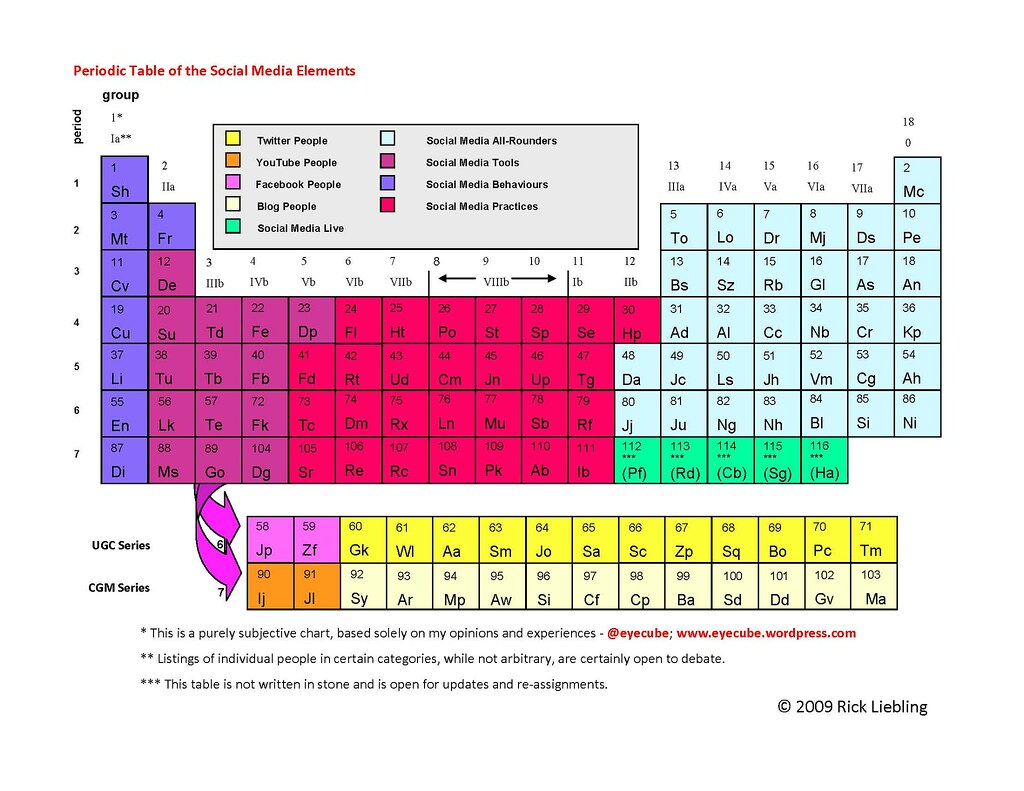
Rick Liebling put together a Periodic Table of Social Media Elements.
Periodic Table of Social Media
[click pic to enlarge]

This chart is interesting as much for the legend as the table itself. It's a road map to today's social media landscape with lists of influential bloggers, twitterers and experts; lists of terminology (we have all felt like we didn't know the secret handshake, this is so helpful); and a key to practices in social media (follow, hashtag, poke, status update).

I especially like the behaviors--what do people do within the social media space?
Social Media Behaviours: (These are the positive things you choose to do)
Sh = Share
Mt = Monitor
Fr = Friend
Cv = Converse
Cu = Customize
Li = Listen
En = Engage
Di = Dialogue
The idea is to mix up the different elements. I am not sure how that works, but this chart/legend is a great primer for people learning about social media and a great checklist for people who want to fill gaps in their social medial strategy.

Read Rick's post here.

Jan 24, 2009

Influence Ripples--Not A Straight Line

0 comments

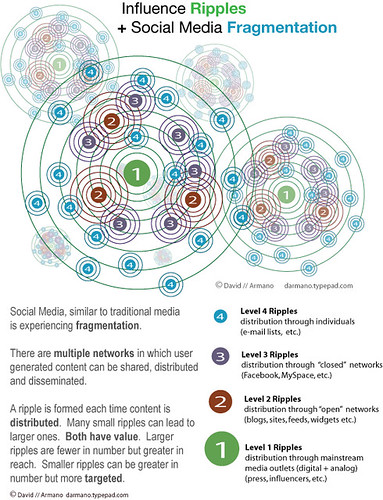
Influence Ripples, originally uploaded by David Armano.

Great visualization of the ripples of distribution and influence in social media. I like it especially because it represents the overlapping and interconnectedness of today's communications.

Communications is not one way, and it is definitely not linear. I am going to spend more time studying this image.

David Armano is the creator of this image graph. I got the reference for this from Shannon Paul's blog.

Today Shannon talks (very smartly) about why blogs matter for communicators. And let's face it, we are ALL communicators.

Whether anyone likes it or not, information no longer travels in a straight shot from company to journalist to public.

Instead, it bounces back and forth between all three. It’s just as possible for information to swell up from the public to the journalist to the company, or from the public to the company to the journalist. Or from the journalist to the company to the public and back again.

...More than three quarters of journalists see blogs as helpful in giving them story ideas, story angles, and insight into the tone of an issue, according to a study conducted last year by Brodeur, a unit of of Omnicom Group in conjunction with Marketwire. --Read the entire post.
Why is this important for government? It's more important to understand the communications ecosystem than to use the newest tools. Creating a myspace or Facebook page doesn't mean that you are succeeding in communicating. What are you trying to accomplish? How does this tool or technology fit your goals? Are you reaching your audience(s)? And the next important question, are you ready to let your audience reach you?

Jan 14, 2009

The Promise and Myth of Barack Obama’s Government 2.0

0 comments
See Gaurav Mishra's most excellent post, The Promise and Myth of Barack Obama’s Government 2.0. In addition to a great set of links and smart analysis, he provides a good structure to think about and talk about "government 2.0."
"It is obvious that different people associate different things with government 2.0. In essence, they are talking about five different level of government 2.0, which can be plotted on a scale of 1 to 5 where 5 is the most radical version of government 2.0 –

Level 1. Allowing government employees and elected officials at all levels to access and use social media tools like blogs, wikis and social networks to connect with their constituents.

Level 2. The strategic use of social media tools like blogs, wikis and social networks by government agencies to achieve their objectives and solicit citizen feedback to improve their processes.

Level 3. A participatory platform that engages citizens in policy debates and voluntary service at all levels of the government.

Level 4. Open availability of all non-sensitive and non-personal government data so that citizens can use it and third parties can build web 2.0 mashups on top of it.

Level 5. Crowd-sourcing the government, party by institutionalizing a process that directly uses the aforementioned participatory platform as an important input into government functions, including policy formation. --Read the entire post.
He goes on to give links to examples. Really, read it.

Jan 8, 2009

Army Reports Brass, Not Bloggers, Breach Security

0 comments
Fear of blogging? from Wired:
For years, the military has been warning that soldiers' blogs could pose a security threat by leaking sensitive wartime information. But a series of online audits, conducted by the Army, suggests that official Defense Department websites post material far more potentially harmful than anything found on a individual's blog.

The audits, performed by the Army Web Risk Assessment Cell between January 2006 and January 2007, found at least 1,813 violations of operational security policy on 878 official military websites. In contrast, the 10-man, Manassas, Virginia, unit discovered 28 breaches, at most, on 594 individual blogs during the same period. --Read the rest.

Can't really add much more to that.

Jan 2, 2009

The Air Force’s Rules of Engagement for Blogging

0 comments
Everyone is looking to figure out the best ways to engage with the blogs and bloggers. The Air Force has developed a guideline document that does a pretty nice job setting out a procedure.

Schematic of the US Air Force's Rules of Engagement for Blogging
See Joey Devilla's post on Global Nerdy for more. Nevermind the haters in the comments, this is a tool that I know many of us will be using.