Showing posts with label measurement. Show all posts

Dec 6, 2009

Facebook: What's The Point?

2 comments
Three cute little kids playing soccerIt's time for end of year rankings. This week the top fifty brands on Facebook were identified.
...a ranking of the brands that are currently making the best use of Facebook. Various metrics—including fan numbers, page growth, frequency of updates, creativity as determined by a panel of judges, and fan engagement—were factored into each page’s score and ultimate rank on the list.--More from The Big Money.
The list included beverage companies Dr. Pepper, Coke and Mountain Dew to food companies Crispy Creme, Ben & Jerry's and Taco Bell to lifestyle brands like Louis Vuitton, Audi and Victoria's Secret.

These companies made the list--with very few exceptions--for the lamest of reasons. And without a discernible formula for success.
  • Two companies with millions of fans have "impressive fan base even though it rarely updates its page." Does this mean that you shouldn't interact with your fans?
  • One company was cited as a success because it posts frequently for fan engagement. Another was successful because it posts infrequently--their fans don't like to hear from them. Some companies post fan pictures or videos on their corporate pages. Does this mean you should interact with your fans? Or not?
  • A number of companies proved that buying ads on Facebook led to more fans. Well, duh! But what happens after the ad buy? What do these fans do? How does having fans help reach organizational goals?
  • A few other organizations found out that when they gave things away--hamburgers or danishes--people become fans. Again, after the promo was over, fan growth rate slowed. And it's unclear what the fans will do--buy another danish?
  • And, to great fanfare, a few media companies get "many" people to "like" their Facebook entries. How many of these fans who "like" a post actually click through and read the entire article? Is there a small core of people who click "like"? Do they share the link? Do their friends click through, increasing traffic? Why is "liking" important to an organization?
I am not saying that growing a fan list on Facebook is unimportant. I am wondering, however, why these companies are doing it. The raw number measures are not very meaningful. I would like to know
  • Do more people use free danish coupons in the Sunday paper? How do those customers compare with Facebook "fans?" Are they the same?
  • What does it mean if someone "likes" a page? Are people who "like" pages more likely to partake in another valued activity?
  • How do you find out how many fans are blocking your organization from their news feeds--basically hiding your messages? What is the percentage? Is there a natural falloff?
  • There are 350 million people on Facebook. What's the big win if 8,000 (2%) of your fans--a grossly insignificant number of Facebook users--vote in your contest? How do you grow that into something? What would success look like?
One bright light, Audi is using it's Facebook fan page to ask people to fill out a survey to tell the car company how they would like to interact. Not so lame.

Bottom line, it's not U-6 soccer, where everyone gets a trophy for showing up. It's past time where showing up is good enough.

A while back, I reminded government to be careful in believing its own hype. It all comes down to measures that mean something. Let's show that we take engagement seriously and create goals and measures for social media--otherwise we will not know if it's "working."

It's time for the big leagues, with stats collected and analyzed for each game, pubic win/loss records and accountability.

Oct 4, 2009

Hey dot-gov! Don't Believe Your Hype

5 comments
Pink Floyd's Dark Side of the Moon album cover.Success! Popularity! Fans! Page views! I win! Seems everybody wants to be Internet-important. Not to bust anybody's bubble, but government success and engagement numbers benefit from some perspective.

For starters, Federal Computer Week listed the "Top Ten Agencies with The Most Facebook Fans." Tops is White House's Facebook page with (now) 375,000 fans. That's a respectable number that continues to grow. But for comparison, the Facebook page for Nutella--that chocolate hazelnut spread--has 3.3 million fans. Plus there are two other Nutella fan pages with 977,000 and 750,000 fans each.

NASA, government's popular space agency, is pulling closer to 10,000 fans of it's Facebook page. Pink Floyd--a band that released it's last album the day that Netscape was founded and who created one of the best rock albums of all time Dark Side of the Moon (released in 1973 the same year that NASA's space station Skylab was launched)--has 1.6 million fans. [See also Mark Drapeau's post on this topic.]

Second, there are the arguments I hear about the important power of government content and presence on the Internet. Overall, this is true. According to comScore data* all dot-gov traffic combined puts government among the top 10 online properties.

Top websites by unique visitors, Google, Yahoo!, Microsoft, AOL, Facebook. ALL of Dot-Gov, Fox Interactive, Ask Network, Ebay, AmazonLooking closer at the numbers is more sobering. Because government sites are fragmented they are less trafficked than the aggregated numbers show.

For example, the online classified site craigslist.org has three-fifths (60%) the traffic of the entire government. Comparing the State Department--despite high traffic for passport and travel information, the sports-entertainment site ESPN has ten times more visitors. Commerce.gov--whose data includes hurricane and storm tracking from noaa.gov, weather.gov, time.gov--has less than one-sixth the traffic of the popular Weather Channel. And, the transaction heavy Social Security Administration has 10% of the visitors that Wal-Mart does.


Government websites and social media efforts exist in a broader ecosystem. Yes, let's celebrate success, but let's first define and refine what that means. The tough news? Looking at numbers without context can lead to believing that you are more important than you really are. The good news? The fact that you are less important than you think doesn't mean that you aren't important at all.

* The comScore data on government sites July 09 and regarding other media sites Aug 09.

Sep 1, 2009

4 Lessons for Dot-gov: What Makes a "Top" Website?

2 comments
The number 4Last week, Time published its Top 50 Websites for 2009, and there was nary a government site on the list.

The closest dot-gov came was #39, BabyNameWizard.com's NameVoyage, which uses Social Security Administration data to help parents find popular--and not so popular--names across the ages. But ssa.gov didn't make the list.

Looking at the sites that did "make it," Time's criteria for selecting Top Sites are clear. There are four main themes shared by Top Sites, and four lessons for government site owners who want to meet citizen and stakeholder needs.

1. Do something. Pretty much every Top Site had a task for people to complete. From searching for something on Google to selecting the best name for their baby to booking cheap travel on Kayak, Top Sites are where people go to accomplish something. Can people accomplish something on your site? Is your offer worth their time?

2. Focus. Most Top Sites have a clear single purpose. You use Netflix to find and rent movies. You go to OpenTable to make restaurant reservations. Fonolo helps you skip a corporate phone tree and get to a live person. Pretty direct. Many government sites, on the other hand, are multi-purpose. This makes search and navigation especially important to help people. How does your site help your visitors get someplace? Are you setting up a clear hierarchy with your users' top tasks up front?

3. Engage. This is a corollary to doing something. One of the somethings that Internet uses want to do is to participate. Many Top Sites, for example, Yelp and Amazon, let users have a say--rating movies, music, restaurants, services and products. Others, like Facebook and social networking sites, encourage friends to take silly polls and forward links. Once people have engaged, they are more likely to come back. Does your site allow feedback? Voting? Tagging? Can people see what others' have said? Do you make it easy for someone to send a link from your site? Do you talk back to them?

4. Share. Different from engaging, sharing lets site visitors collaborate in content creation. This can be Flickr (#1 on the List) which lets users upload photos for people to view, comment and reuse. Or Wikipedia, where you can share your expertise in a wildly popular public encyclopedia. Or buy joining a microfinance group via Kiva to invest in developing countries. Are you inviting people to share in their government? Are you inviting their creativity and smarts?

Whether you think Time's criteria is fair, the traffic behind many of these sites show that Internet users value them, too. Might be time to review what makes e-gov tick. Maybe we'll make the 2010 list.

Aug 23, 2009

To the Data User: Caveat Emptor

0 comments
Last week a few reports were released that can help shed some light on teen Twitter behavior.

[begin rant] You likely heard about the Morgan Stanley [rubbish] "report" written by a precocious fifteen-year-old intern from their London office. It's been stuck in my craw since it's post-release media flurry. No disrespect to the young man who solidly reported the experiences of he and his mates, but the ah-ha frenzy of corporate boardrooms and media belies that every observant parent of teens already knew what their kids do. [end rant]

Anyway, among the "findings" in the report--and one I have been arguing about--is that teens don't use Twitter because they are limited by limited cell phone use and texting.

Last week, Pew released a study on teens and cellphone use.
  • 71% of the people between 12-17 have cell phones. The percentage jumps to 85% for 16 and 17 year-olds.
  • Use is up from 63% in 2006 and almost catches teens up to the 77% of adults with cell phones.
  • Almost 40% send text messages DAILY.
  • Three-quarters of the 18-29 year olds text daily. (Pew Wireless Internet Use)
So, looking at the data, it doesn't seem that there is a huge lack of access to cell phones or text messaging that would limit the use of Twitter for teens.

THEN, there is the idea that it's important to tweet from your cell phone.

Read Write Web reported, also last week, that Twitter users are most likely to use the Web, not a cell phone, to share their tweets.
[U]pdating your status online via Twitter.com is still the dominant way that most people use Twitter, with 65% of tweets attributed to this method....Besides the web, which accounts for nearly two-thirds of Twitter updates, the second most popular way to update Twitter.com is via text message. However, with 6% of tweets sent, this method only accounts for 1/10th as many tweets.--Read more on Read Write Web.
Data shows that text messaging from phones is not preferred by Twitter users, period. Since more than 90% of all 12-17 year olds are online, more than any other age group, teens have at least the same access to the Twitter web interface as any other Twitter users.

So, the data does not support that dismal teen tweeting is "caused" by the lack of access to technology. It's more likely that they simply are not interested in Twitter

"So," you ask, "why did you go here? Taking us on this trail for a little tidbit of clarification on a fairly small topic?"

Two reasons. First, it's critical that folks working on innovation and technology make decisions based on data, not just fashion. And, second, it's imperative to take a hard look at the data sources. We need to carefully look at the data and assumptions and get past the hype, whenever we can. And not pass on the hype.

[Okay, and thirdly, because I was right and now there's nothing stuck in my U-Mich SRC craw. The benefits of being the blog owner.]

Aug 18, 2009

Research on Privacy Perceptions

0 comments
The White House is reviewing the federal government's cookie policy. Abridged version, it's been a 9-year rejection of the use of what many see as a benign tool and others see as government invading citizen privacy.

Part of this discussion has included what privacy means to people using online tools in 2009. Some think that people don't care about privacy, some that folks have no (or should have no) expectations of privacy, and others think that people care very much about their online privacy.

Fortunately, to help us learn more about just what privacy means, Patricia Abril and Avner Levin published a paper in the Vanderbilt Journal of Entertainment & Technology Law on privacy perceptions in online social networks. The team surveyed 2,500 young adults between the ages of 18 and 24 about the personal information they post online, what they do to protect their information, and any concerns regarding their personal information.

They reported that sharing information on social networks, and allowing other to share information about you, creates vulnerabilities, and that people know that they are potentially vulnerable.
  • 72% have adjusted privacy settings to restrict some groups of people from accessing their profiles.
  • More than 60% believe that they have taken sufficient steps to protect themselves.
  • 42% said they have read social networking sites' privacy policies.
  • Only 22% were not concerned that information about them (photos, videos, comments by others about them) could be created and posted by others.
  • 67% said that they were were most concerned about potential harm to their image or reputation.
  • 54.3% agreed with the statement, “Work life is completely separate from personal life, and what you do in one should not affect the other.”
  • 82% said that it would be inappropriate for employers to require them to "friend" a manager.
This young cohort appears to be both careful and realistic about their privacy. They are most worried about privacy lapses that could affect their reputations. And they want to keep some sort of firewall between their social selves and their work selves.

Based on their research, Abril and Levin created a concept of "network privacy."
We call this notion network privacy. According to network privacy, information is considered by online socializers to be private as long as it is not disclosed outside of the network to which they initially disclosed it, if it originates with them, or as long as it does not affect their established online personae, if it originates with others. [online social network]s, as businesses profiting from socializing online, are best positioned to offer online socializers, often the young and vulnerable, effective protection in accordance with their notion of network privacy above and beyond regular measures of personal information control, and they should be required to do so.--Read "Two Notions of Privacy Online."
Moving forward toward a meaningful, twenty-first century privacy policy, we will need to recognize the conflict between the desire and need to share information within networks and the difficulty in regulating networks with loose barriers.

Translating this to the cookies' debate, it seems that people may be less concerned with the mechanics of being "tracked" except when any "tracking" would reflect poorly on them.

Aug 2, 2009

If You Build It, NOT: 4 Pointers for Search Optimization

5 comments
The field of dreams baseball players appearing out of the magic corn field walking on to the magic baseball fieldIt's a MYTH! A MYTH! A MYTH I TELL YOU!

Just because you build it, nobody will come. Sure, you announce to your friends and stakeholders, but then what? There will be no miles long trail of cars snaking through cornfields to experience your vision. It's a movie. And a myth.

Yes, viral is important, but you can't manufacture true viral. It just happens.

I have been calling out this myth for 12 years. And, in this time of fractured media and spliced attentions, it is critical to be level-headed and recognize that there is effort involved in driving traffic. Launching your website or application is not the end. You need to help folks find it.
Eighty percent of all online sessions begin with search. Google alone has a 63.7 percent share of all searches. Some quick math tells me that this means that just over half of the time someone starts an online session, they open to Google and begin to search. Bottom line: Most of the time people go online, they start with a search -- and don't type in your URL.

Instead of typing in your URL and ending up on your site, people are using search engines to find what they are looking for. The question is: Will they find you? You might not like the answer.

It turns out that the top three listings on a search engine results page account for approximately 63 percent of all clicks. That is, about two-thirds of the time, people look no further than the first three listings before clicking. So, clearly that's the place to be. --See
more from Jonathan Richman at I Media Connection
There are many books, blogs, websites and experts on helping people find you (also known as search engine optimization). My purpose today is to start you thinking about making your content more accessible to search engines. Here are four starting pointers.

1. Don't be cute. Search engines look for clues on your pages to let them know what the page is about. They usually think that titles and headings provide pointers to what is important. So, every time you create a cute name for your page and use teaser language for your headers instead of clearly telling and leading readers (and search engines) about your purpose, you are turning them away.

2. Use normal words. Speaking of not knowing, search engines can't translate your arcane, governmentese into something findable. Especially when you are using your own special language. You may love your acronyms, but the uninitiated will not have a clue. No clue means they can't find you.

3. Seek out resources. You can learn about words people use to describe your services. Your site search should report the words that people are searching on. If they are looking for "green card" and you only use the official name "LPR," you are turning them away. And away means to another source. Also, visit the Google Keyword Tool to learn related words and phrases. Incorporate these words into your pages.

4. Select some pages and make changes. Identify a few terms and their pages you want to drive people to. Update the page title, headers and copy with the normal words. Check your progress by searching on these terms on Google, Bing, YAHOO, Ask. The results are easy to see. Also see MarketLeap.com for quick keyword verification across multiple search engines.

Now go do some more research, you might want to start with Search Engine Watch. And feel free to share your own resources and tips in the comments below.

Jul 30, 2009

Pulling the Plug on Underperforming IT Projects

2 comments
The Department of Veterans Affairs pulled the plug on 45 problem IT projects, pending further evaluation to see if they should continue.
In preparing data for the so-called IT Dashboard, a site that offers a window into the complex and costly process of procuring government IT services, VA officials discovered problems with some of the agency's IT projects. For example, while sifting through the data, VA Secretary Eric K. Shinseki and CIO Roger Baker learned that a scheduling project was running 17 months behind schedule, Kundra said.

Shinseki and Baker announced on Friday that they temporarily stopped development of 45 projects that are either behind schedule or over budget to determine if they should be canceled or salvaged.--Read more on NextGov.
The IT Dashboard allows users to learn more about information technology projects, like the VA's Health Data Repository, a $28 million project that is way behind schedule.


In addition to cost and schedule information, you can easily learn the purpose of the project and review other official documentation. And, very importantly, you can provide your thoughts to the CIO on specific projects.

This project is a tough one for agency CIO's. They are required to very publicly report and evaluate their projects. Many of them are responsible for projects that they didn't approve and in some cases went sour before their arrival. But it's important to begin to get an honest handle on IT projects and expenditures. And it's even more important to do something about them.<

Bravo to the VA, and bravo for this new transparency resource.

Jul 22, 2009

Shorts: Second Life for White House, Participation, SocNet Policy

0 comments
Fairly ugly pair of yellow madras shortsObama Team Officially Gets a Second Life.When President Obama spoke to a live audience in Ghana, his address was streamed to audiences in the virtual worlds of Second Life and Metaplace. After the speech there was a virtual discussion, led by a panel with the former ambassador to Qatar and an African historian. This event was announced by CBS News and organized as an official White House event by the U.S. State Department. No one knows yet what the future holds for the Obama administration and virtual worlds, but what we are sure of, is that they are actively seeking out, researching, and testing these opportunities. Read more.

Measuring Effectiveness of Participation Projects. What is the return on the investment of the government's time, resources, and attention into cracking open the political sphere to citizen engagement? In other words, how do open government projects operating within the government bureaucracy justify their keep? That's the subtext to a new report out from New York Law School's Center for Patent Innovations, overseer of the Peer-to-Patent project. Peer-to-Patent broke new ground in participatory government and the Patent Office decided to assess whether it's worthwhile to continue the project as part of the standard practice of how the U.S. vets patents. In its two-year life thus far, 2,600 people registered on the site as patent reviewers. More than 180 applications were vetted. Read more from Nancy Scola on Tech President.

10 things you should cover in your social networking policy. When the social networking phenomenon began, many companies dealt with it by not dealing with it — they simply banned/blocked social networking sites on the company network. Now, as social media grows up, policy is starting to try to catch up to practice. Check out the suggestions from copyright to employee conduct on and off the job. More on the TechRepublic blog.

Jul 12, 2009

Numbers and Darn Numbers

0 comments
A few quick resources to look at the state of the interwebs and to help you measure your own state of being.

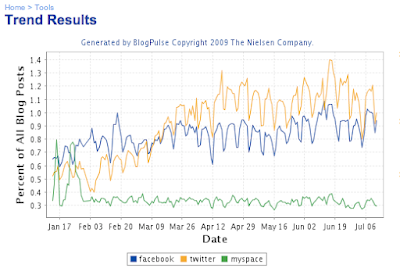
First, check out what's hot in the blogosphere. Nielsen data shows that Twitter is gaining mentions and MySpace is flatlining.
Graph of mentions Twitter Facebook MySpace. Twtitter trending up, Myspace flat and low, Facebook holding it's own[my apologies to the Tweep who sent me this way. I searched and couldn't find you. So an annon h/t. So sorry!]

Second trend, Nielsen Global Online Consumer Survey shows that personal recommendations and online opinions are the most influential.

Government is not listed in the mix, but depending on how you cut it, government sites are most like "brand" websites, which have a respectable 70% positive trust level.

The important piece for government, though, is to make content more sharable. If a friend sends an email, or shares a page on Facebook or tweets a link, 90% of the people will trust the information. Helping people to share government content looks like a big win.

Third, since Twitter is so hot, here are some numbers to give flavor to the "Twittershpere" via a report by Internet marketing company Hubspot. Among Twitter users
  • 55.50% are not following anyone
  • 54.88% have never tweeted
  • 52.71% have no followers
Looking closer at what this means, only 9% of the Twitter users meet all three criteria (less than 10 in each category). For example the State Department travel alerts follows only 15 but is followed by 6,215 and have updated with 175 alerts. And then there's Oprah, with her nearly 2 million followers, who only follows 14 people with a paltry 50 tweets.

People who have never tweeted may be using Twitter as a news aggregator, taking in information and choosing to share nothing. They are still involved by reading messages and are available. The people with few followers may follow many, follow a few people with whom they have a close exchange, or perhaps simply never got the Twitter bug. You can read the entire State of the Twittersphere (download PDF) report, here.

Jun 23, 2009

It's Okay Not to Know-But How Will This Work?

0 comments
Empty goal, photo by henning via FlickrNextGov reports that would-be Recovery.gov designers face a moving target,
Web-design firms bidding on a contract to revamp the official stimulus-tracking site Recovery.gov face the challenge of building a prototype that must comply with unpredictable content requirements, according to procurement specialists and information access academics.

In October, agencies will be required to start transmitting reports from stimulus fund recipients to Recovery.gov, which is maintained by the Recovery Accountability and Transparency Board. But the details of what will go into those reports and the technologies that will dispatch information have not been finalized.--Read more on NextGov
It's great that the Board at Recovery.Gov is not creating a multi-volume set of requirements. In addition to lacking the time, the tortured requirements process is not a clear path to application success.

But what is the path to success?

A challenge in a project like this--especially when establishing a new work relationship--is to have client and vendor share the same expectations.

I hope that the RFP includes clear and specific goals for the site. I hope that it defines what success is--for the END USER. This definition will provide the touchstone to develop and evaluate features, to set appropriate phases of implementation, and to pull the plug on efforts going astray.

I hope that the project includes government program staff who are well-versed in the technology and who have the time to participate as partners, rather than observers. I hope, too, that their bosses trust them to do the work and make the decisions they need to make.

I hope that the people working on the effort spend most time coding, iterating, sharing, fixing and coding, iterating, sharing, fixing and fewer resources on updating project management software.

I hope that there is the courage to honestly say what's working and what's not, and to be able to say when a timeline is flawed or to jettison some one's pet feature in order to make the deadline.

And, I hope that the project goals are reviewed in every meeting to keep everyone aligned with the big picture.

Did I say goals were critical to success? This is especially key when there are so many unknowns.

Good luck!

May 7, 2009

Metrics That Matter, Some That Don't

0 comments
Good article on ClickZ recommending that we update our assumption about important metrics. Augustine Fou writes
Time on Site Is a Bad Metric. Time on site is still often referred to as if it's a useful metric of a program's success. However, this metric is quite possibly one of the worst indicators of "engagement" because so many factors can increase or decrease it without having anything to do with a user's interest.

For example, if someone opens a page in a Web browser, then takes a 30-minute phone call before coming back to the page, that "time on site" is artificially higher. Or if someone can't find something and spends some frustrating minutes looking around on the site, the extra time spent doesn't indicate greater interest. In fact, the person may get increasingly annoyed at the site and never come back.
Other factors decrease time on site artificially -- for example, the person found what they were looking for immediately through site search. The person was very satisfied and left the site after completing a mission.

Takeaway: there are no benchmarks for this metric. Drop it entirely as a success metric.--Read more on ClickZ.
So, what should you measure? Fou suggests new metrics that indicate user interest and intent like
  • On-site search. Are your visitors looking for something specific on your site?
  • Time they spend with a piece of content -- not just on the site in general. Are they spending time with a specific piece of content?
  • Site bounce rate (lower is better). Are people on your site finding that they were looking for?
  • Percentage of repeat visits. Do users find your site useful or valuable enough for them to come back?--Again, read the whole thing on ClickZ.
Take a look at what you are measuring, and make sure that it makes sense.