Showing posts with label metrics. Show all posts

Dec 6, 2009

Facebook: What's The Point?

2 comments
Three cute little kids playing soccerIt's time for end of year rankings. This week the top fifty brands on Facebook were identified.
...a ranking of the brands that are currently making the best use of Facebook. Various metrics—including fan numbers, page growth, frequency of updates, creativity as determined by a panel of judges, and fan engagement—were factored into each page’s score and ultimate rank on the list.--More from The Big Money.
The list included beverage companies Dr. Pepper, Coke and Mountain Dew to food companies Crispy Creme, Ben & Jerry's and Taco Bell to lifestyle brands like Louis Vuitton, Audi and Victoria's Secret.

These companies made the list--with very few exceptions--for the lamest of reasons. And without a discernible formula for success.
  • Two companies with millions of fans have "impressive fan base even though it rarely updates its page." Does this mean that you shouldn't interact with your fans?
  • One company was cited as a success because it posts frequently for fan engagement. Another was successful because it posts infrequently--their fans don't like to hear from them. Some companies post fan pictures or videos on their corporate pages. Does this mean you should interact with your fans? Or not?
  • A number of companies proved that buying ads on Facebook led to more fans. Well, duh! But what happens after the ad buy? What do these fans do? How does having fans help reach organizational goals?
  • A few other organizations found out that when they gave things away--hamburgers or danishes--people become fans. Again, after the promo was over, fan growth rate slowed. And it's unclear what the fans will do--buy another danish?
  • And, to great fanfare, a few media companies get "many" people to "like" their Facebook entries. How many of these fans who "like" a post actually click through and read the entire article? Is there a small core of people who click "like"? Do they share the link? Do their friends click through, increasing traffic? Why is "liking" important to an organization?
I am not saying that growing a fan list on Facebook is unimportant. I am wondering, however, why these companies are doing it. The raw number measures are not very meaningful. I would like to know
  • Do more people use free danish coupons in the Sunday paper? How do those customers compare with Facebook "fans?" Are they the same?
  • What does it mean if someone "likes" a page? Are people who "like" pages more likely to partake in another valued activity?
  • How do you find out how many fans are blocking your organization from their news feeds--basically hiding your messages? What is the percentage? Is there a natural falloff?
  • There are 350 million people on Facebook. What's the big win if 8,000 (2%) of your fans--a grossly insignificant number of Facebook users--vote in your contest? How do you grow that into something? What would success look like?
One bright light, Audi is using it's Facebook fan page to ask people to fill out a survey to tell the car company how they would like to interact. Not so lame.

Bottom line, it's not U-6 soccer, where everyone gets a trophy for showing up. It's past time where showing up is good enough.

A while back, I reminded government to be careful in believing its own hype. It all comes down to measures that mean something. Let's show that we take engagement seriously and create goals and measures for social media--otherwise we will not know if it's "working."

It's time for the big leagues, with stats collected and analyzed for each game, pubic win/loss records and accountability.

Oct 4, 2009

Hey dot-gov! Don't Believe Your Hype

5 comments
Pink Floyd's Dark Side of the Moon album cover.Success! Popularity! Fans! Page views! I win! Seems everybody wants to be Internet-important. Not to bust anybody's bubble, but government success and engagement numbers benefit from some perspective.

For starters, Federal Computer Week listed the "Top Ten Agencies with The Most Facebook Fans." Tops is White House's Facebook page with (now) 375,000 fans. That's a respectable number that continues to grow. But for comparison, the Facebook page for Nutella--that chocolate hazelnut spread--has 3.3 million fans. Plus there are two other Nutella fan pages with 977,000 and 750,000 fans each.

NASA, government's popular space agency, is pulling closer to 10,000 fans of it's Facebook page. Pink Floyd--a band that released it's last album the day that Netscape was founded and who created one of the best rock albums of all time Dark Side of the Moon (released in 1973 the same year that NASA's space station Skylab was launched)--has 1.6 million fans. [See also Mark Drapeau's post on this topic.]

Second, there are the arguments I hear about the important power of government content and presence on the Internet. Overall, this is true. According to comScore data* all dot-gov traffic combined puts government among the top 10 online properties.

Top websites by unique visitors, Google, Yahoo!, Microsoft, AOL, Facebook. ALL of Dot-Gov, Fox Interactive, Ask Network, Ebay, AmazonLooking closer at the numbers is more sobering. Because government sites are fragmented they are less trafficked than the aggregated numbers show.

For example, the online classified site craigslist.org has three-fifths (60%) the traffic of the entire government. Comparing the State Department--despite high traffic for passport and travel information, the sports-entertainment site ESPN has ten times more visitors. Commerce.gov--whose data includes hurricane and storm tracking from noaa.gov, weather.gov, time.gov--has less than one-sixth the traffic of the popular Weather Channel. And, the transaction heavy Social Security Administration has 10% of the visitors that Wal-Mart does.


Government websites and social media efforts exist in a broader ecosystem. Yes, let's celebrate success, but let's first define and refine what that means. The tough news? Looking at numbers without context can lead to believing that you are more important than you really are. The good news? The fact that you are less important than you think doesn't mean that you aren't important at all.

* The comScore data on government sites July 09 and regarding other media sites Aug 09.

Aug 23, 2009

To the Data User: Caveat Emptor

0 comments
Last week a few reports were released that can help shed some light on teen Twitter behavior.

[begin rant] You likely heard about the Morgan Stanley [rubbish] "report" written by a precocious fifteen-year-old intern from their London office. It's been stuck in my craw since it's post-release media flurry. No disrespect to the young man who solidly reported the experiences of he and his mates, but the ah-ha frenzy of corporate boardrooms and media belies that every observant parent of teens already knew what their kids do. [end rant]

Anyway, among the "findings" in the report--and one I have been arguing about--is that teens don't use Twitter because they are limited by limited cell phone use and texting.

Last week, Pew released a study on teens and cellphone use.
  • 71% of the people between 12-17 have cell phones. The percentage jumps to 85% for 16 and 17 year-olds.
  • Use is up from 63% in 2006 and almost catches teens up to the 77% of adults with cell phones.
  • Almost 40% send text messages DAILY.
  • Three-quarters of the 18-29 year olds text daily. (Pew Wireless Internet Use)
So, looking at the data, it doesn't seem that there is a huge lack of access to cell phones or text messaging that would limit the use of Twitter for teens.

THEN, there is the idea that it's important to tweet from your cell phone.

Read Write Web reported, also last week, that Twitter users are most likely to use the Web, not a cell phone, to share their tweets.
[U]pdating your status online via Twitter.com is still the dominant way that most people use Twitter, with 65% of tweets attributed to this method....Besides the web, which accounts for nearly two-thirds of Twitter updates, the second most popular way to update Twitter.com is via text message. However, with 6% of tweets sent, this method only accounts for 1/10th as many tweets.--Read more on Read Write Web.
Data shows that text messaging from phones is not preferred by Twitter users, period. Since more than 90% of all 12-17 year olds are online, more than any other age group, teens have at least the same access to the Twitter web interface as any other Twitter users.

So, the data does not support that dismal teen tweeting is "caused" by the lack of access to technology. It's more likely that they simply are not interested in Twitter

"So," you ask, "why did you go here? Taking us on this trail for a little tidbit of clarification on a fairly small topic?"

Two reasons. First, it's critical that folks working on innovation and technology make decisions based on data, not just fashion. And, second, it's imperative to take a hard look at the data sources. We need to carefully look at the data and assumptions and get past the hype, whenever we can. And not pass on the hype.

[Okay, and thirdly, because I was right and now there's nothing stuck in my U-Mich SRC craw. The benefits of being the blog owner.]

Aug 18, 2009

Research on Privacy Perceptions

0 comments
The White House is reviewing the federal government's cookie policy. Abridged version, it's been a 9-year rejection of the use of what many see as a benign tool and others see as government invading citizen privacy.

Part of this discussion has included what privacy means to people using online tools in 2009. Some think that people don't care about privacy, some that folks have no (or should have no) expectations of privacy, and others think that people care very much about their online privacy.

Fortunately, to help us learn more about just what privacy means, Patricia Abril and Avner Levin published a paper in the Vanderbilt Journal of Entertainment & Technology Law on privacy perceptions in online social networks. The team surveyed 2,500 young adults between the ages of 18 and 24 about the personal information they post online, what they do to protect their information, and any concerns regarding their personal information.

They reported that sharing information on social networks, and allowing other to share information about you, creates vulnerabilities, and that people know that they are potentially vulnerable.
  • 72% have adjusted privacy settings to restrict some groups of people from accessing their profiles.
  • More than 60% believe that they have taken sufficient steps to protect themselves.
  • 42% said they have read social networking sites' privacy policies.
  • Only 22% were not concerned that information about them (photos, videos, comments by others about them) could be created and posted by others.
  • 67% said that they were were most concerned about potential harm to their image or reputation.
  • 54.3% agreed with the statement, “Work life is completely separate from personal life, and what you do in one should not affect the other.”
  • 82% said that it would be inappropriate for employers to require them to "friend" a manager.
This young cohort appears to be both careful and realistic about their privacy. They are most worried about privacy lapses that could affect their reputations. And they want to keep some sort of firewall between their social selves and their work selves.

Based on their research, Abril and Levin created a concept of "network privacy."
We call this notion network privacy. According to network privacy, information is considered by online socializers to be private as long as it is not disclosed outside of the network to which they initially disclosed it, if it originates with them, or as long as it does not affect their established online personae, if it originates with others. [online social network]s, as businesses profiting from socializing online, are best positioned to offer online socializers, often the young and vulnerable, effective protection in accordance with their notion of network privacy above and beyond regular measures of personal information control, and they should be required to do so.--Read "Two Notions of Privacy Online."
Moving forward toward a meaningful, twenty-first century privacy policy, we will need to recognize the conflict between the desire and need to share information within networks and the difficulty in regulating networks with loose barriers.

Translating this to the cookies' debate, it seems that people may be less concerned with the mechanics of being "tracked" except when any "tracking" would reflect poorly on them.

Jul 12, 2009

Numbers and Darn Numbers

0 comments
A few quick resources to look at the state of the interwebs and to help you measure your own state of being.

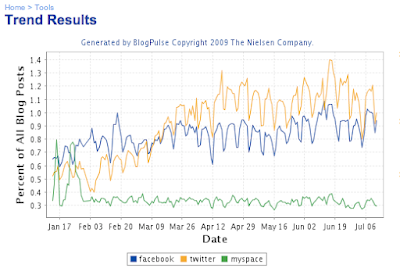
First, check out what's hot in the blogosphere. Nielsen data shows that Twitter is gaining mentions and MySpace is flatlining.
Graph of mentions Twitter Facebook MySpace. Twtitter trending up, Myspace flat and low, Facebook holding it's own[my apologies to the Tweep who sent me this way. I searched and couldn't find you. So an annon h/t. So sorry!]

Second trend, Nielsen Global Online Consumer Survey shows that personal recommendations and online opinions are the most influential.

Government is not listed in the mix, but depending on how you cut it, government sites are most like "brand" websites, which have a respectable 70% positive trust level.

The important piece for government, though, is to make content more sharable. If a friend sends an email, or shares a page on Facebook or tweets a link, 90% of the people will trust the information. Helping people to share government content looks like a big win.

Third, since Twitter is so hot, here are some numbers to give flavor to the "Twittershpere" via a report by Internet marketing company Hubspot. Among Twitter users
  • 55.50% are not following anyone
  • 54.88% have never tweeted
  • 52.71% have no followers
Looking closer at what this means, only 9% of the Twitter users meet all three criteria (less than 10 in each category). For example the State Department travel alerts follows only 15 but is followed by 6,215 and have updated with 175 alerts. And then there's Oprah, with her nearly 2 million followers, who only follows 14 people with a paltry 50 tweets.

People who have never tweeted may be using Twitter as a news aggregator, taking in information and choosing to share nothing. They are still involved by reading messages and are available. The people with few followers may follow many, follow a few people with whom they have a close exchange, or perhaps simply never got the Twitter bug. You can read the entire State of the Twittersphere (download PDF) report, here.

May 7, 2009

Metrics That Matter, Some That Don't

0 comments
Good article on ClickZ recommending that we update our assumption about important metrics. Augustine Fou writes
Time on Site Is a Bad Metric. Time on site is still often referred to as if it's a useful metric of a program's success. However, this metric is quite possibly one of the worst indicators of "engagement" because so many factors can increase or decrease it without having anything to do with a user's interest.

For example, if someone opens a page in a Web browser, then takes a 30-minute phone call before coming back to the page, that "time on site" is artificially higher. Or if someone can't find something and spends some frustrating minutes looking around on the site, the extra time spent doesn't indicate greater interest. In fact, the person may get increasingly annoyed at the site and never come back.
Other factors decrease time on site artificially -- for example, the person found what they were looking for immediately through site search. The person was very satisfied and left the site after completing a mission.

Takeaway: there are no benchmarks for this metric. Drop it entirely as a success metric.--Read more on ClickZ.
So, what should you measure? Fou suggests new metrics that indicate user interest and intent like
  • On-site search. Are your visitors looking for something specific on your site?
  • Time they spend with a piece of content -- not just on the site in general. Are they spending time with a specific piece of content?
  • Site bounce rate (lower is better). Are people on your site finding that they were looking for?
  • Percentage of repeat visits. Do users find your site useful or valuable enough for them to come back?--Again, read the whole thing on ClickZ.
Take a look at what you are measuring, and make sure that it makes sense.