Showing posts with label article. Show all posts

Jul 11, 2010

Watch Out for the Gov 2.0 Villains (FanGirl Version)

1 comments
First, go read Steve Radick's tragically funny post on the Six Villians of Gov 2.0. I laughed and I cried, especially since I know people in each category, I am sorry to say.

No great list goes without a tweak, and I want to add another villain to Steve's on target list. I'll wager that you have met him or her, too. It's The Man.

The Man is the one in charge, and with his extreme power he can immediately kill any innovative project--or green light it. The Man is driven by a desire to be young and modern. He is enamored with the cool, the perceived hip, the newfangled innerwebs things (in addition to other mid-life crisis baubles) that shows he still has "It."

The Man is especially susceptible to teaming with the Money Monger (this is the part where you really need to see Steve's list), who's promises of the easy, wild successes that "all the Fortune 100" are implementing have the appeal of the Fountain of Youth.

The danger is in the implementation of a high-cost technology death march void of strategy or measurable goals. These time and money wasters distract our heroes from the real work required for effective transparency and collaboration. And, to add to the injury, the inevitable project failures will poison future efforts--fueling the efforts of the other villains, Debbie Downer and Dr. Closed Mind.

The strength of The Man is his past successes which earned him his current senior position. He is in charge. He makes things happen. He wins.

His Weaknesses? His ego. Just as the Money Monger appeals to making The Man seem hip, you can use his ego against him. The challenge is to do so without backing The Man into a corner or implying, even by a hint, that he is wrong. You might be able to throw a flag by enlisting the popular and do-gooding Captain Conservative. The danger here is slowing down your future efforts. This is a price that must be paid. Be sure to come armed with data and a strong strategy to do battle.

(This was originally a comment on Steve's post, but my current technology doesn't support flash, which his comment engine requires, and I wanted to play, too.)

Jan 24, 2010

Three Privacy Tales

3 comments
Black t-shirt that reads, privacy is not a crimeA very smart, millennial new media colleague was talking online privacy over a beer. He said that he didn't really have an expectation of privacy and that he trusted Google to do right.

Last month, Google CEO Eric Schmidt ruffled more than a few privacy feathers.
In a recent interview [CEO Schmidt] suggested that people pushing for privacy are the one's at fault: "If you have something that you don't want anyone to know, maybe you shouldn't be doing it in the first place."

This sounds suspiciously like a reheated version of "if you've done nothing wrong, you've got nothing to worry about," that's trotted out by law enforcement types when pushing for stronger laws to violate individuals' privacy. It's an odd statement for someone like Schmidt to make, especially given the incredible level of scrutiny given to Google for the view it has into people's lives. To folks who are worried about such things, it sounds positively dismissive, which isn't the position that Google should be cultivating with those who are concerned right now." --
More on TechDirt
This month, another tech giant, Facebook founder Mark Zuckerberg, resurrected the controversy when he said that people don't expect privacy anymore.
Facebook founder Mark Zuckerberg told a live audience this weekend that the world has changed, that it's become more public and less private, and that the controversial new default and permanent settings reflect how the site would work if he were to create it today. Not everyone agrees with his move and its justification.

Has society become less private or is it Facebook that's pushing people in that direction? Is privacy online just an illusion anyway?--Read more on ReadWriteWeb
Facebook, with it's 350 million members has modified it's views on privacy as well as its policies. From a closed network in which only people that you have approved can see your profile, photos and other information to a fairly open network in which the default is "open to all" including search engine results.

My third privacy tale is from another direction--and continent. Europe has had pretty strong online privacy protections. In November, the European Union passed a law requiring Internet users' consent before cookies can be placed on their machines.
The amended directive will now state that national governments must "ensure that the storing of information, or the gaining of access to information already stored, in the terminal equipment of a subscriber or user is only allowed on condition that the subscriber or user concerned has given his/her consent, having been provided with clear and comprehensive information."

Cookies without user consent would only be allowed when they are "strictly necessary" to provide a service "explicitly requested" by the user such as storing shopping cart information on e-commerce sites, for example.--Read more at ClickZ
So, as big U.S. tech/new media moguls posit that privacy is becoming less important, to the Europeans, at least, it's critical to protect.

In the U.S., dot-gov has stronger privacy requirements than the private sector. There are some who think, though, that the EU controls will force a change in the commercial sector--especially to put more control in the hands of the consumer to be included in tracking and data gathering.

In the meantime, federal agencies will continue to face barriers in using commercial tools that use cookies to track users as these privacy tales play out.

Jan 3, 2010

7 Social Media Takeaways for Dot-gov

4 comments
Seven of hearts playing cardAs we traverse to a new decade, here are seven takeaways to help small, medium and large agencies use social media to be more transparent, participatory and collaborative. Take what you can use.
  1. Community without guilt. There are many "experts" will tell you that there is one right way to "do" social media. They are wrong. There are tons of ways to use new communications tools and channels. Want to engage with your fans, followers, friends? Great! Want to use social tools to rebroadcast your message? That's okay. Just want to see what people are saying about you? That's fine, too. Most important, make sure you have a strategy together before jumping in. You can always adjust later.
  2. Social media is "plumbing." Don't adopt tool angst. While you need to know how different tools work (blogs, Twitter, Facebook, Wikipedia, social voting), these tools are conduits to communicating and, hopefully, engaging with your audience. The key is to figure out what you are trying to accomplish (again!), and use the best tools to reach out and meet your goals.
  3. All you can eat doesn't mean that you don't HAVE to eat it all. People get overwhelmed with the variety and scope of engagement opportunities. It's better to choose fewer, strategic projects and do them well than to spread yourself too thin. I predict that there will be as many abandoned government Twitter and Facebook accounts as there will be new ones in 2010. Prove me wrong!
  4. Friction free. One of the reasons that Twitter is so popular is that it's friction free--in other words, EASY. It's super easy to sign up for Twitter, same with Facebook, LinkedIn, etc. This is the expectation that citizens now have for government services. Government needs to review our gateways to try and make it easier to use our services than to NOT use us.
  5. Listening is important. Don't overestimate the importance of re-broadcasting your same tired messages in new venues. The real value comes from listening--from finding out what people are saying about your agency, where you succeed as well as where you are failing. My favorite saying is "Everybody has a point," even when their delivery makes it hard to hear. If you are listening, though, you have the opportunity to learn, see trends, and improve.
  6. Communicate with economy and precision. One of the best things about Twitter is that it forces communications into 140 characters. This forces us to eliminate all the extra, flowery, self aggrandizing government language. It behooves us to do this not only when tweeting, but in our blogs, websites, manuals, letters, instructions, well, you get the picture.
  7. Wisdom of the crowds can be time and volume based. Twitter helps define what is important, according to Clay Shirky, by “algorithmic authority." The idea is that if "all kinds of people are pointing at the same thing at the same instant, it must be a pretty big deal." Looking at trends in Twitter, Google, and your own search terms on your site can give you insight about what people think is important, NOW. What can you feature on the homepage of your website? Can you tweet a link to a resource? Clear up a misconception?
Bottom line, it's the same formula: What are you trying to accomplish? Who is your audience? How do new media channels help you meet your goals? Measure all your efforts against these questions.

This post is inspired by David Carr's very good post in the NYTimes on Why Twitter Will Endure. Read that, too!

Dec 29, 2009

Round Up for 2009

0 comments
Here are some of articles, papers, and videos that shaped my thinking this year.
  • Putting Government Data Online Tim Berners-Lee most excellent article challenging us to take the risk and be open before we know the results. My #1.
  • Newspapers and Thinking the Unthinkable Clay Shirky's view of journalism is an insight into the disruptive change we are living.
  • "The Not-So-Hidden Politics of Class Online" danah boyd's speech at June's Personal Democracy Forum forcing folks to sit up and think about how we use and think about online social networks.
  • Web Squared: Web 2.0 Five Years On (PDF) Tim O’Reilly and John Battelle's discussion on how the Web is learning, and maybe solving some of our data issues.
  • Is Twitter a Complex Adaptive System? Vanessa Miemis laces a number of disciplines together to build on structure and development of online social systems (not just Twitter).
  • Cultural Change is Free In this video, John Seddon talks about "systems thinking", as opposed to the top-down "management thinking" or "Command and Control" thinking. Or, the manifesto to letting it go. Watch the entire video, it's worth it.
What else should I be reading? I want to learn more--put your favs in the comments.

Next, here are the ten most popular posts from this blog in 2009.
  1. What Is the Most Important Thing?
  2. Transparency Requires Plain Language
  3. Yellow Brick Roadmap: Five Examples of Getting Gov 2.0 Done
  4. 5 Social Media Memes Changing Government
  5. Hey dot-gov! Don't Believe Your Hype
  6. Innovation Causes Failure
  7. New Utah Website Graded on Tasks
  8. Talk Talk vs. Do Do
  9. 7 Listening Tools: Getting from Asking to Listening
  10. Social Networking and National Security
Thanks for reading and egging me on.

And, last, here's to an exciting New Year! Can't wait to see what's next.

Dec 13, 2009

Open Government Needs Data (not just provide it)

3 comments
Flickr network universe 2005Last week was a "Big One" in dot-gov. The much anticipated Open Government Directive was announced. Peter Orszag, the Director of the White House Office of Management and Budget, summed it up.
The directive, sent to the head of every federal department and agency today, instructs the agencies to take specific actions to open their operations to the public. The three principles of transparency, participation, and collaboration are at the heart of this directive. Transparency promotes accountability. Participation allows members of the public to contribute ideas and expertise to government initiatives. Collaboration improves the effectiveness of government by encouraging partnerships and cooperation within the federal government, across levels of government, and between the government and private institutions.--Read more at the Open Government Blog
Out of the box, much of the specifics in the Directive was focused on transparency and the opening of public data sets. For example, in 45 days, three heretofore unreleased high value data sets need to be available on data.gov. [Sunlight Foundation parsed the directive and published a timeline for agency requirements.]

Requirements for collaboration and participation are less specific. [See Nancy Scola's very good summary and analysis on the Directive content on Tech President.]

Getting ready for collaboration and participation is what I wanted to talk about.

There's been plenty of work on engaging with the public--from the March Open for Questions exchange fueled by people submitting questions and voting for the ones they wanted the President to answer to the development of the Directive itself.

Chris Brogan is a well-known new media marketing guy. He suggests that people try and think like "-ologists" and learn from -ologists (anthropologists, sociologists, psychologists) in their outreach. Check out his 45 second video.


It's critical for government to take a broad look at how we interact, how people interact, and what it might mean. Taking a structured analytical approach--dare I say scientific--becomes critical. Open government efforts need to be structured to include measurement and evaluation. Best practices can't be defined without understanding the variables and the inputs. Did we get a good result because we were lucky? Did we get a good result because we think we did? Or, did we get a bad result that we believe is good? Did we get a good result because we went into the experiment as an -ologist?

This post was inspired by a reference in my Sunday paper to "Web-Based Experiments for the Study of Collective Social Dynamics in Cultural Markets" (PDF). The authors, sociologists Salganik and Watts, provide some perspective on how the idea of popularity can influence what is popular. The researchers found that there is randomness in the creation of popularity within a network. A song, for example, becomes more popular as other people in the network show interest. In another network, a different song could be the winner. That's why it's hard to predict the next hot song, band, movie or toy. It's somewhat random and unpredictable.

The got me thinking about how important network dynamics are to spreading ideas, forming consensus and developing meaningful interactions. Meaningful for citizens as well as government. And, it got me thinking that people are already studying these patterns in other venues.

This isn't getting any easier.

Dec 6, 2009

Facebook: What's The Point?

2 comments
Three cute little kids playing soccerIt's time for end of year rankings. This week the top fifty brands on Facebook were identified.
...a ranking of the brands that are currently making the best use of Facebook. Various metrics—including fan numbers, page growth, frequency of updates, creativity as determined by a panel of judges, and fan engagement—were factored into each page’s score and ultimate rank on the list.--More from The Big Money.
The list included beverage companies Dr. Pepper, Coke and Mountain Dew to food companies Crispy Creme, Ben & Jerry's and Taco Bell to lifestyle brands like Louis Vuitton, Audi and Victoria's Secret.

These companies made the list--with very few exceptions--for the lamest of reasons. And without a discernible formula for success.
  • Two companies with millions of fans have "impressive fan base even though it rarely updates its page." Does this mean that you shouldn't interact with your fans?
  • One company was cited as a success because it posts frequently for fan engagement. Another was successful because it posts infrequently--their fans don't like to hear from them. Some companies post fan pictures or videos on their corporate pages. Does this mean you should interact with your fans? Or not?
  • A number of companies proved that buying ads on Facebook led to more fans. Well, duh! But what happens after the ad buy? What do these fans do? How does having fans help reach organizational goals?
  • A few other organizations found out that when they gave things away--hamburgers or danishes--people become fans. Again, after the promo was over, fan growth rate slowed. And it's unclear what the fans will do--buy another danish?
  • And, to great fanfare, a few media companies get "many" people to "like" their Facebook entries. How many of these fans who "like" a post actually click through and read the entire article? Is there a small core of people who click "like"? Do they share the link? Do their friends click through, increasing traffic? Why is "liking" important to an organization?
I am not saying that growing a fan list on Facebook is unimportant. I am wondering, however, why these companies are doing it. The raw number measures are not very meaningful. I would like to know
  • Do more people use free danish coupons in the Sunday paper? How do those customers compare with Facebook "fans?" Are they the same?
  • What does it mean if someone "likes" a page? Are people who "like" pages more likely to partake in another valued activity?
  • How do you find out how many fans are blocking your organization from their news feeds--basically hiding your messages? What is the percentage? Is there a natural falloff?
  • There are 350 million people on Facebook. What's the big win if 8,000 (2%) of your fans--a grossly insignificant number of Facebook users--vote in your contest? How do you grow that into something? What would success look like?
One bright light, Audi is using it's Facebook fan page to ask people to fill out a survey to tell the car company how they would like to interact. Not so lame.

Bottom line, it's not U-6 soccer, where everyone gets a trophy for showing up. It's past time where showing up is good enough.

A while back, I reminded government to be careful in believing its own hype. It all comes down to measures that mean something. Let's show that we take engagement seriously and create goals and measures for social media--otherwise we will not know if it's "working."

It's time for the big leagues, with stats collected and analyzed for each game, pubic win/loss records and accountability.

Dec 1, 2009

3 Reasons To Get With The Program Already

5 comments
Old-fashioned Underwood brand manual typewriterFirst, the change has already happened. It's done.

What has changed is the way people communicate and interact--with each other, with companies, with government. We don't yet know what that means. We can try and predict, but the main outcomes of these predictions is fodder for future laughs.

Now to you naysayers who say that not everyone is plugged in, not everyone uses social media or the Internet or even e-mail, I say, "So? You don't have to drive to know that cars changed the way we live, where we live, how we shop, where we go."

And, to you near-term nostalgics, the people who think that texting, tweeting, friending and gaming are stupid, who prefer a stamp to online banking, I say, "it's okay for you to feel that way, just realize that the rest of the world is embracing new channels."

Second, your brand has changed. "Brand" is not a visual representation of your organization. It is the experiences that people have with your organization and the sharing of these experiences within their networks. Brand doesn't belong to your agency, it belongs to people who interact with your agency.
For example, 65% of U.S. consumers report a digital experience changing their perception about a brand (either positively or negatively) and 97% of that group report that the same experience ultimately influenced whether or not they went on to purchase a product from that brand. In a nutshell, experience matters. A lot.

...That's why Amazon continues to pour money into improving its customer service rather than run traditional advertising or marketing campaigns. As Amazon CEO Jeff Bezos has said, "We are not great advertisers. So we start with customers, figure out what they want, and figure out how to get it to them."--
See more at AdAge.com
This matters a lot to government--at least it should. People expect that their tax dollars pay for the same types of experiences that they have in the private sector. When we disappoint, we fail. Government needs to better engage with citizens and provide services that people seek--less time broadcasting/marketing our messages and more time building good experiences. Better experiences will translate into better confidence in government.

Third, you simply disappear if you are not present. People are watching TV on their cell phones at their convenience. The entire country does not sit down at 6 p.m. to watch the evening news on traditional broadcast channels.
This is why monitoring, establishing and cultivating a strategic presence and inspiring meaningful engagement is so critical in social media. It impacts the bottom line. If we are not present within the attention dashboards of our existing customers and prospects, we intentionally remove ourselves from their decision-making funnel. Consumers are among the new influencers as they now have access to the same tools and channels that reach peers and shape their impressions.--[emphasis mine] More from digital marketing expert Brian Solis


Government frequently suffers from disproportionate emphasis on traditional communications channels. The story in the NY Times, the interview on CNN will remain important, but not the most important. The results from search engines that lead to content on web sites or engaging applications that are passed around and shared among friends on social networks are equally valuable. We have the skills to get traditional news stories, it's time to build skills to bring information directly to citizens.

Wake up! The world has already changed! But we still have time to shape what it will be and what government can do to better serve our citizens.

Nov 8, 2009

Ripe for Change: Compliance and Hiring

1 comments
Aircraft carrier USS John C. Stennis making a sharp clockwise U-turn on the deep blue ocean. Picture by Tina Lamb, USNGovernment 2.0 is more than social software. It's also updating processes that are barriers to a nimble, effective, collaborative government. Processes like hiring and compliance.

A hearing last week focused on yearly cybersecurity reporting and compliance versus protecting systems. NextGov reported on challenges with FISMA, the Federal Information Security Management Act, which requires agencies to identify and inventory their IT systems and determine how sensitive the information is that is stored on those systems.
"It seems like OMB thinks that a snapshot of agency preparedness every three years will defend our critical networks," said Sen. Thomas Carper, D-Del., during a hearing of the Senate Federal Financial Management Subcommittee, which he chairs. "But instead, billions of dollars are spent every year on ineffective and useless reports. Meanwhile, we continue to get attacked."
Efforts at more realtime, and effective, cybersecurity were cited at Department of State.
To supplement FISMA reporting requirements, State implemented a widely lauded risk-scoring program that scans every computer and server connected to the department's network no less than every 36 hours to identify security vulnerabilities and twice a month to check software configurations. The program assigns points on a scale of zero to 10, with 10 being the riskiest security threats. Points are deducted once issues are resolved. Since July, overall risk on the department's key unclassified network measured by the scoring program has been reduced by nearly 90 percent at overseas sites and 89 percent at domestic sites.

"These methods have allowed one critical piece of the department's information security program to move from the snapshot in time previously available under FISMA to a program that scans for weaknesses continuously, identifies weak configurations [every] 15 days, recalculates the most important problems to fix in priority order daily, and issues letter grades monthly to senior managers tracking progress for their organization," Streufert said.--
Read more in NextGov
On the hiring side, John Berry, Office of Personnel Management (OPM) boss, said that "cracks are showing" in the personnel system. According to Government Executive, he outlined a number of areas that might be ready for updating. Berry said that
Reformers must realign personnel systems to recognize, reward and promote merit within the federal workforce, while making the merit system principles a matter not simply of fairness but of job performance.
While not making specific policy edicts, he offered a few focus areas like
  • Expanding the eligibility for big bonuses--beyond the Senior Executive Service
  • Helping agencies pilot and incorporate telework
  • Working to better recognize and reward star performers
  • Focusing on training managers and workers to help adopt change
  • Reviewing the current 15 grade system for a more flexible and simplified promotion path
  • Creating "results-only" work environments, removing time and place from performance. Read more on GovExec.
Are these the "right" areas to focus on? I don't know. Frankly, the emphasis on big bonuses seems a caricature of the private sector. And, I would like to add changing the hiring process to allow more fluidity between the public and private sectors--the two systems are currently incompatible. But I do believe, like Berry says, "we can seize this moment to build something new."

It takes a while to turn around a large, complex vehicle like government. These efforts are helping to turn in the right direction.

Oct 26, 2009

Shorts: Twitter Grows, Report Cards, Drupal and Memos

1 comments
Twitter grows. Pew released some data last week about growth in Twitter use--from 11% of Internet users to 19% in just six-months. Other findings? Three groups of internet users are mainly responsible for driving the growth of this activity, social network users, people who are using mobile and folks under age 44. See more at the Pew Internet Project.

White Paper Report Card. Candi Harrison asks, "Web Manager Council’s White Paper – Is There Progress A Year Later?" In her post she recaps the goals of easily identifiable, relevant, accurate, and up-to-date information that is easy to understand, addresses citizen tasks, is consistent across channels, provides feedback channels and is accessible across reading, ability and language barriers. She gave government a mixed review. See more here.

White House goes Drupal. And TechPresident swoons as they announced that whitehouse.gov has moved to Open Source Software and dropped their proprietary system. I am not sure that this is a great advance for democracy--bottom line is that there will be a custom (read proprietary) system built on the open source platform. But it is good for open source. See more at TechPresident.

Finally, NextGov reports, no movement from White House on the issuing of the Open Government memo that the President announced January 21. See Next Gov.

Sep 8, 2009

Shorts: Wiki Strategy Tool, NonProfits Blog, Cultural Divide

1 comments
Smithsonian sharing their social media strategy development via wiki. Check out the process and get some tips on developing your own new media plan on this wiki. The plans are to feed the web and new media strategy into the Smithsonian's comprehensive strategic plan. Look and learn on the wiki.

Nonprofits lead way in social media adoption. The Society of New Communications Research looked at the 200 largest U.S. charities and found nonprofits outpaced corporations and academic institutions in their adoption of social media. 57% of charities have blogs compared with 18% of the Fortune 500. See more on BizGtowthNews.

The great gov 2.0 cultural divide. On his GovFresh blog, Luke Fretwell uses this week's Gov 2.0 summit and events as a backdrop to smartly talk about bridging the gap between Washington and West Coast tech-entrepreneurs. He says "Washington, D.C., needs to understand Silicon Valley entrepreneurs are no different than GSA Schedule government contractors or corporate-funded trade associations, all seeking to profit on an industry that will never file for bankruptcy and can always print more money." Read more on GovFresh.

Sep 1, 2009

4 Lessons for Dot-gov: What Makes a "Top" Website?

2 comments
The number 4Last week, Time published its Top 50 Websites for 2009, and there was nary a government site on the list.

The closest dot-gov came was #39, BabyNameWizard.com's NameVoyage, which uses Social Security Administration data to help parents find popular--and not so popular--names across the ages. But ssa.gov didn't make the list.

Looking at the sites that did "make it," Time's criteria for selecting Top Sites are clear. There are four main themes shared by Top Sites, and four lessons for government site owners who want to meet citizen and stakeholder needs.

1. Do something. Pretty much every Top Site had a task for people to complete. From searching for something on Google to selecting the best name for their baby to booking cheap travel on Kayak, Top Sites are where people go to accomplish something. Can people accomplish something on your site? Is your offer worth their time?

2. Focus. Most Top Sites have a clear single purpose. You use Netflix to find and rent movies. You go to OpenTable to make restaurant reservations. Fonolo helps you skip a corporate phone tree and get to a live person. Pretty direct. Many government sites, on the other hand, are multi-purpose. This makes search and navigation especially important to help people. How does your site help your visitors get someplace? Are you setting up a clear hierarchy with your users' top tasks up front?

3. Engage. This is a corollary to doing something. One of the somethings that Internet uses want to do is to participate. Many Top Sites, for example, Yelp and Amazon, let users have a say--rating movies, music, restaurants, services and products. Others, like Facebook and social networking sites, encourage friends to take silly polls and forward links. Once people have engaged, they are more likely to come back. Does your site allow feedback? Voting? Tagging? Can people see what others' have said? Do you make it easy for someone to send a link from your site? Do you talk back to them?

4. Share. Different from engaging, sharing lets site visitors collaborate in content creation. This can be Flickr (#1 on the List) which lets users upload photos for people to view, comment and reuse. Or Wikipedia, where you can share your expertise in a wildly popular public encyclopedia. Or buy joining a microfinance group via Kiva to invest in developing countries. Are you inviting people to share in their government? Are you inviting their creativity and smarts?

Whether you think Time's criteria is fair, the traffic behind many of these sites show that Internet users value them, too. Might be time to review what makes e-gov tick. Maybe we'll make the 2010 list.

Aug 16, 2009

Too Much To Keep Up With? Don't Try

3 comments
Picture of Ballou and Keith at the beach. Not related to the post, but we had a nice vaycay."We must have a Twitter. And a Facebook. And a YouTube. And a private social network. And an island on Second Live. Oh, and a blog or two."

But, Alexandra Samuel writes:
You could spend half your life trying every technology that comes down the pike, and still be hopelessly at sea...So I'm here to let you off the hook. If a geek like me — a woman whose idea of a fantastically fun evening is to try out a dozen project management sites — can't keep up, what hope is there for folks who occasionally want to close their computers and pick up a book? There is no hope. You can't keep up.
Best of all, this is good news! Alexandra continues,
Keeping up is about following someone else's agenda: the bloggers and tweeters who trot out invitations to the latest beta. The marketers, publicists and journalists who blanket us with coverage about the latest hot tech phenomenon. And yes, the tech consultants who charge tens or hundreds of thousands to add new musts to your already long to-do list. The minute you stop trying to keep up, you open a far more exciting possibility: getting ahead with what matters to you, your team and your business.--Read more at the Harvard Business Blogs.
What to do instead?

1. Go back to what you are trying to accomplish mission-wise, and quit chasing the newest short skirt.

2. Ask the right questions. Not, how do I use XYZ technology, but how do I reach my audience? Where are they? Not, what kind of design do I need for my new website, but how do I help my audience accomplish their tasks?

3. Line up your quality content. Launching the blog is the easiest part, keeping it smart, topical and fresh is the daily drudge--and the holy grail. Spend more time on your current channels and less time launching new avenues.

4. Keep your fingers on the pulse. Subscribe to newsfeeds and keep up with blogs and articles about emerging technologies and how they're being used. You just don't have to use them all. At least not yet.

[I know the picture is not related to the post. But we were at the beach. And it was nice.]

Aug 7, 2009

Rapunzel Was a Baby-Mama

0 comments
Very cool wordle of the Rapunzel story, from Kindlerama CreativeCommons License This past week had a few stories from the Department of Defense and the defense against the dark arts of social media.

Last week, DOD launched the DoD Web 2.0 Guidance Forum, a new dialogue initiative. They said
We are using this blog as an approach to engage the public in Department of Defense (DoD) considerations of web 2.0 capabilities, and are excited to participate in this new facet to the President’s openness and transparency efforts.-Read more on the Forum.
In what seemed like only a few hours later, Wired reported that DOD was considering banning social networking sites like Twitter and Facebook because they cause security "headaches."
[T]his fresh ban stems from fears that Facebook and the like make it far too easy for hackers and cybercrooks to gain access to the military’s networks.

Last week, U.S. Strategic Command issued a “warning order” to the rest of the military, asking for feedback on a social media ban on the NIPRNet, the Defense’s Department’s unclassified network. (Naturally, access is already denied on the secret and top secret nets.)

“The mechanisms for social networking were never designed for security and filtering. They make it way too easy for people with bad intentions to push malicious code to unsuspecting users. It’s just a fact of life,” says a source at Stratcom, which is responsible for securing the military’s “global information grid.”--
Read the rest in Wired's DangerRoom.
Seemed like a pretty quick assessment of the public sentiment. [Seriously, the dialogue is open through the end of August, so please participate.]

On Monday, the Marines announced an IMMEDIATE BAN OF INTERNET SOCIAL NETWORKING SITES (SNS) ON MARINE CORPS ENTERPRISE NETWORK (MCEN) NIPRNET.
The U.S. Marine Corps on Monday issued a directive banning access to Internet social networking sites on the Marine Corps Enterprise Network because such sites represent a security risk.
Marine administrative message 458/09 says that social networking sites like Facebook, MySpace, and Twitter "are a proven haven for malicious actors and content and are particularly high risk due to information exposure, user generated content and targeting by adversaries."
Social networking sites create vulnerabilities that can be exploited and may expose unnecessary information to adversaries, putting military personnel at increased risk of compromise, the directive says.--Read more on InformationWeek.
"What's going on?," you may ask. Hasn't DOD been at the forefront of social media engagement?

The questions being asked by some worried brass and the edicts and bans being handed down are a reflection of the reality that there is a conflict between legitimate security issues and the reality of this very open, very participatory new world.

But, I would like to offer a Grimm Fairy Tale.

"Rapunzel, Rapunzel let down your hair." And with that quick phrase, the prince was inside the fortress and "married" the fair maiden.

Bottom line, while you can set up multiple, extraordinary, and high-hurdle defenses, the desires and needs to extend beyond the "impregnable" fortresses may make them insufficient.

Better said by Talking Salmons.
Social media is how I communicate...It is the evolution of communication. Faster, fitter, more productive, free, easy and beneficial. Policy makers who ban social media because of the threat of viruses make no sense to me. Are we still in the era of burning towns to stop the plague? Do we ban cars when a teenager drives drunk? Do we ban computers when someone writes a computer virus?--Read the entire excellent post on Talking Salmons.
I am sounding a bit redundant, but, once again, this is stuff that we are figuring out. So, I would like to leave this post in the able tweet of Admiral Mike Mullen, chair of the Joint Chiefs.

Tweet by Adm Mullen of Joint Chiefs, Obviously we need to find right balance between security and transparency. We are working on that. But am I still going to tweet? You bet.

Jul 30, 2009

Pulling the Plug on Underperforming IT Projects

2 comments
The Department of Veterans Affairs pulled the plug on 45 problem IT projects, pending further evaluation to see if they should continue.
In preparing data for the so-called IT Dashboard, a site that offers a window into the complex and costly process of procuring government IT services, VA officials discovered problems with some of the agency's IT projects. For example, while sifting through the data, VA Secretary Eric K. Shinseki and CIO Roger Baker learned that a scheduling project was running 17 months behind schedule, Kundra said.

Shinseki and Baker announced on Friday that they temporarily stopped development of 45 projects that are either behind schedule or over budget to determine if they should be canceled or salvaged.--Read more on NextGov.
The IT Dashboard allows users to learn more about information technology projects, like the VA's Health Data Repository, a $28 million project that is way behind schedule.


In addition to cost and schedule information, you can easily learn the purpose of the project and review other official documentation. And, very importantly, you can provide your thoughts to the CIO on specific projects.

This project is a tough one for agency CIO's. They are required to very publicly report and evaluate their projects. Many of them are responsible for projects that they didn't approve and in some cases went sour before their arrival. But it's important to begin to get an honest handle on IT projects and expenditures. And it's even more important to do something about them.<

Bravo to the VA, and bravo for this new transparency resource.

Jul 22, 2009

Shorts: Second Life for White House, Participation, SocNet Policy

0 comments
Fairly ugly pair of yellow madras shortsObama Team Officially Gets a Second Life.When President Obama spoke to a live audience in Ghana, his address was streamed to audiences in the virtual worlds of Second Life and Metaplace. After the speech there was a virtual discussion, led by a panel with the former ambassador to Qatar and an African historian. This event was announced by CBS News and organized as an official White House event by the U.S. State Department. No one knows yet what the future holds for the Obama administration and virtual worlds, but what we are sure of, is that they are actively seeking out, researching, and testing these opportunities. Read more.

Measuring Effectiveness of Participation Projects. What is the return on the investment of the government's time, resources, and attention into cracking open the political sphere to citizen engagement? In other words, how do open government projects operating within the government bureaucracy justify their keep? That's the subtext to a new report out from New York Law School's Center for Patent Innovations, overseer of the Peer-to-Patent project. Peer-to-Patent broke new ground in participatory government and the Patent Office decided to assess whether it's worthwhile to continue the project as part of the standard practice of how the U.S. vets patents. In its two-year life thus far, 2,600 people registered on the site as patent reviewers. More than 180 applications were vetted. Read more from Nancy Scola on Tech President.

10 things you should cover in your social networking policy. When the social networking phenomenon began, many companies dealt with it by not dealing with it — they simply banned/blocked social networking sites on the company network. Now, as social media grows up, policy is starting to try to catch up to practice. Check out the suggestions from copyright to employee conduct on and off the job. More on the TechRepublic blog.

Jul 12, 2009

Numbers and Darn Numbers

0 comments
A few quick resources to look at the state of the interwebs and to help you measure your own state of being.

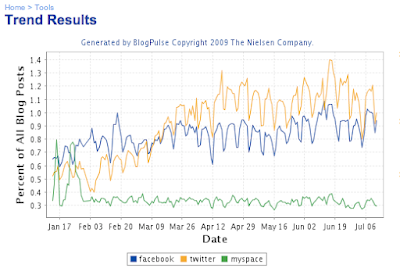
First, check out what's hot in the blogosphere. Nielsen data shows that Twitter is gaining mentions and MySpace is flatlining.
Graph of mentions Twitter Facebook MySpace. Twtitter trending up, Myspace flat and low, Facebook holding it's own[my apologies to the Tweep who sent me this way. I searched and couldn't find you. So an annon h/t. So sorry!]

Second trend, Nielsen Global Online Consumer Survey shows that personal recommendations and online opinions are the most influential.

Government is not listed in the mix, but depending on how you cut it, government sites are most like "brand" websites, which have a respectable 70% positive trust level.

The important piece for government, though, is to make content more sharable. If a friend sends an email, or shares a page on Facebook or tweets a link, 90% of the people will trust the information. Helping people to share government content looks like a big win.

Third, since Twitter is so hot, here are some numbers to give flavor to the "Twittershpere" via a report by Internet marketing company Hubspot. Among Twitter users
  • 55.50% are not following anyone
  • 54.88% have never tweeted
  • 52.71% have no followers
Looking closer at what this means, only 9% of the Twitter users meet all three criteria (less than 10 in each category). For example the State Department travel alerts follows only 15 but is followed by 6,215 and have updated with 175 alerts. And then there's Oprah, with her nearly 2 million followers, who only follows 14 people with a paltry 50 tweets.

People who have never tweeted may be using Twitter as a news aggregator, taking in information and choosing to share nothing. They are still involved by reading messages and are available. The people with few followers may follow many, follow a few people with whom they have a close exchange, or perhaps simply never got the Twitter bug. You can read the entire State of the Twittersphere (download PDF) report, here.

Jun 25, 2009

7 Listening Tools: Getting from Asking to Listening

2 comments
T-shirt that says, WARNING I am not listening P&G and Nielsen are trying to understand how learning gleaned from “listening” to online consumer conversations compares to survey-based findings (”asking”).
What we learned was surprising and important. Findings from “listening” and “asking” were largely consistent. Most importantly, in every case, “listening” added to our understanding in important ways, meaningfully enhancing insights, and sometimes suggesting a different course of action. For example, a survey on cloth diapering identified cost savings and sustainability as key reasons for using cloth diapers. Listening took this further, revealing the passion cloth-diapering moms have for “CD’ing,” and connecting it to core values around parenting. This led to a fundamentally different, more holistic understanding of cloth diapering than was available from survey results alone.

Listening consistently provided valuable depth and context … adding listening to the picture was a little like going from an X-ray to a CAT scan. Furthermore, listening revealed the level of consumer passion or intensity associated with a specific topic. Understanding “intensity” can be just as important to winning in the marketplace as understanding size or “magnitude,” suggesting the need to pursue survey-based and listening-based approaches (or hybrid methods) going forward.--More on the Nielsen Online Analyst Blog
It's clear that asking is important. But, information from listening added to information from surveys (asking) gives a more nuanced and more complete picture of what's going on.

For government, it means looking for ways to listen. Here are 7 easy--and available--listening tools.
  1. If you survey, be sure to leave space for free response. Yes, it's harder to quantify, but it's the best way to get to what your users/visitors really mean.
  2. Regularly review the emails sent to the generic webmaster address. You will learn what people are looking for, what makes them unhappy, and potential gaps in content or services.
  3. Review weblogs for search terms. These are the words and phrases that people are using to get to your site. Take the most popular terms and run the search yourself. What are the results? Is it what a user might expect?
  4. Review your internal search logs to find out what people are looking for once they're on your site. Quarterly, look at all the search terms and group them by "like." When you group them you might see a different trend. Also, your users will tell you what they call your content (you say "lawful permanent residence" and they say "green card").
  5. Check out what people are looking for on Google. There is a suite of free query tools that can give you insights into the people who may or may not visit your site. Start at What is the Google zeitgeist? and work your way through the search and comparison tools.
  6. Take the terms people relate to you (in 3 and 4) and use twitter search. You will get folks' raw opinion. Some good, some bad. Save the search as an RSS feed for regular access. Look for other twitter monitoring tools.
  7. Sign up for Google Alerts. Enter the terms to track and find out what bloggers, news sources and others are saying.
Got a good tool that you use? Put it in the comments and help a guy out.

BTW, Nielsen and P+G are doing a webinar to discuss their findings on Friday at 2 pm. You can register here.

Jun 23, 2009

It's Okay Not to Know-But How Will This Work?

0 comments
Empty goal, photo by henning via FlickrNextGov reports that would-be Recovery.gov designers face a moving target,
Web-design firms bidding on a contract to revamp the official stimulus-tracking site Recovery.gov face the challenge of building a prototype that must comply with unpredictable content requirements, according to procurement specialists and information access academics.

In October, agencies will be required to start transmitting reports from stimulus fund recipients to Recovery.gov, which is maintained by the Recovery Accountability and Transparency Board. But the details of what will go into those reports and the technologies that will dispatch information have not been finalized.--Read more on NextGov
It's great that the Board at Recovery.Gov is not creating a multi-volume set of requirements. In addition to lacking the time, the tortured requirements process is not a clear path to application success.

But what is the path to success?

A challenge in a project like this--especially when establishing a new work relationship--is to have client and vendor share the same expectations.

I hope that the RFP includes clear and specific goals for the site. I hope that it defines what success is--for the END USER. This definition will provide the touchstone to develop and evaluate features, to set appropriate phases of implementation, and to pull the plug on efforts going astray.

I hope that the project includes government program staff who are well-versed in the technology and who have the time to participate as partners, rather than observers. I hope, too, that their bosses trust them to do the work and make the decisions they need to make.

I hope that the people working on the effort spend most time coding, iterating, sharing, fixing and coding, iterating, sharing, fixing and fewer resources on updating project management software.

I hope that there is the courage to honestly say what's working and what's not, and to be able to say when a timeline is flawed or to jettison some one's pet feature in order to make the deadline.

And, I hope that the project goals are reviewed in every meeting to keep everyone aligned with the big picture.

Did I say goals were critical to success? This is especially key when there are so many unknowns.

Good luck!

Jun 14, 2009

The Revolution, et.al., Will Be Twittered

0 comments
Crisis Camp retweet Tweet globally, act locallyAndrew Sullivan blogging on Iranians using Twitter and social media as telephones and television communications were being shut down:
Mock not. As the regime shut down other forms of communication, Twitter survived. With some remarkable results. Those rooftop chants that were becoming deafening in Tehran? A few hours ago, this concept of resistance was spread by a twitter message.

That a new information technology could be improvised for this purpose so swiftly is a sign of the times. It reveals in Iran what the Obama campaign revealed in the United States. You cannot stop people any longer. You cannot control them any longer. They can bypass your established media; they can broadcast to one another; they can organize as never before.--Read the entire post at The Atlantic. 
While it's too early to say what will happen, it's clear that people are using whatever conduits they find to communicate, especially during a crisis.

At the same time the situation in Iran was unfolding, Crisis Camp was happening in Washington, D.C.

Directory of sessions for Crisis Camp, Flood, Earthquake, Pandemic, Twister, Dirty Bomb, Last Supper-ArmageddonCrisisCamp DC started with one idea, "How can technology help people around the world during times and places of crisis?" Over the weekend about a hundred people got together to talk about how technology is or can be used for humanitarian relief. Industry, NGOs, responders, academics, public health, geek, non-geek and a few government joined to usher in a movement. 

Where else can you find sessions like Flood, Earthquake, Pandemic, Twister, Dirty Bomb, Last Supper-Armageddon, or the use of zombies as an example to help people think in new ways?

Government limits were also in the mix. Government can be slow, not willing to trust citizens as adults, hobbled by privacy and potential corruption, and too top-down when crisis is definitely felt and fought from the ground up (see Camp tweets for fuller flavor). A big theme was emphasis on listening rather then telling, adapting rather than knowing, and sharing. 

There has been discussion about authoritative sources for crisis information, and government is at the beginnings of understanding our role. We know what we know, but unofficial sources--real people--know what they are experiencing. Bringing these views and experiences together, with the help of smart smart people and technology, will define success and failure in future crisis. And, as everyone at Crisis Camp was well aware, on the ground this is real--survival and pace of recovery.

See notes from some sessions here, and as your interest is piqued,  join like-minded innovators at the Ning network for Crisis Camp. The hope is for the movement to go viral, with camps around the world working and sharing to best use technology in times of crisis.

Jun 1, 2009

Social Networking and National Security

0 comments
A computer keyboard chained and locked.James Carafano, from the Heritage Foundation, writes that government's Web 2.0 efforts are lagging--especially regarding safeguarding and strengthening American society. 
While the White House as well as many federal agencies are experimenting with social networking tools, their efforts are unguided by sound research or clear and coherent policies that encourage innovation while protecting individual liberties and privacy. The hierarchical practices of traditional government are not keeping up; they are inadequate for exploiting the explosion of social networking systems.

Fundamental reforms will be required for conducting national security in a world driven by global listening. Washington cannot fully adopt and exploit social networking systems without profoundly changing the process of governance. Advocating such change, however, is premature. First, the government must understand and develop the means to interact in the new world in which it lives. The Administration should:
  • Restructure the government's means for conducting strategic communications;
  • Create human capital programs to prepare national security professionals and decision makers with new skills, knowledge, and attributes; and
  • Direct national security agencies to establish research and development programs focused on threats and competitive advantages of social networking tools.--(my emphasis) Read the entire backgrounder on heritage.org
Much of what I have been tracking about security and social media has been about cyber-security. Here, Carafano asks us to take a look at using social media to protect our country, rather than simply as a threat to our security. And to do so in a systematic, deliberate way. 

This approach--understanding the way networks develop, improving the knowledge and skills of employees and fundamentally changing how government communicates--has to be accomplished while government continues to use the new tools. This practical, if imperfect, experience is driving the policy and the research agenda. Waiting for research and policy would squander the opportunity to build experience (and perhaps expertise) of government innovators and innovation.

Both threads, deliberate change and raw experimentation, are needed to strengthen and protect our country as information creation and usage is being fundamentally restructured before our eyes.