Showing posts with label participation. Show all posts

Jan 2, 2011

Doing Gov 2.0 Backwards in High Heels

2 comments
Ginger Rogers dancing with Fred Astaire backwards and in high heelsI was reading the awesomely comprehensive 2010 roundup of Gov 2.0 by Alex Howard and stumbled into a little Twitter dust-up between Alex and one of his readers, Microsoft's public sector evangelist, Mark Drapeau.

The twit-for-tat was around Mark's criticism that Gov 2.0 activities were focused on "govies, policies, and techies, and little citizens, services, engagement." He's right. There continues to be a lot of foundation-level work going on--like writing policies, creating governance, training, upgrading systems, cleaning up and making available data, etc. It makes it hard to see how this is having an impact on citizens and the public.

Then, Alex referenced Gov 2.0 impact on citizens
As the new year beckons, there are more ways for the citizens of the United States to provide feedback to their federal government than perhaps there ever have been in its history. In 2011, the open question is whether "We the people" will use these new participatory platforms to help government work better. The evolution of these kinds of platforms aren't U.S.-centric, either. Ushahidi, for example, started in Africa and has been deployed worldwide. The crowd matters more now in every sense: crowdfunding, crowdsourcing, crowdmapping, collective intelligence, group translation, and human sensor networks--O'Reilly Radar
Alex is finding some Gov 2.0 activity that is actually touching people. A good start, but how does this play for my sister in Indiana?

But, as Mark went on,
twitter image from Drapeau, Well @digiphile, government exists to serve all its citizens. Thusfar Government 2.0 mainly exists to serve wonks and geeks.
he and I part ways.

The heady newness of the Open Government Directive and the first forays into social media are over. We look back wistfully, like on the faded blush of a new romance. That was fun! But now we are left to work in the trenches to realize the promise. Much less sexy, but critical to success.

This year has included some very important new guidance--for example on surveys (Paperwork Reduction Act), privacy (including cookies and participating in 3rd party networks), plain language and prize authority to name a few--that agencies are trying to apply. And there is increasing scrutiny, oversight, and evaluation from both within and outside of agencies.

It seems that nothing breeds slowdowns like success. The layer of people who like things "the way they are" are not excited about new ways of interaction. And some are pulling the many levers at their disposal to doubly ensure that all T's are crossed and I's dotted.

Then, there are many early evangelists who are practicing what they were preaching. Being change agents in their agencies mean that they are less available to take to the pulpits of conferences and blog posts to proselytize across agencies.

I am neither a wonk nor a geek. I am a citizen, though. I am a citizen who works in government. And I am a citizen who works in a government built on--and sustained by--a massive command and control bureaucracy from a pre-Internet and social networking era. I am a citizen who works in this slow-moving behemoth and trying to make change for my fellow citizens, not to serve wonks and geeks.

Folks working in the trenches welcome the thoughtful criticism of outsiders. We don't have all the answers and have plenty of blind spots. Keep our feet to the fire, help us make change, and keep caring! But, I gotta tell you, from an insider's perspective, this is harder than it looks.

Jan 3, 2010

7 Social Media Takeaways for Dot-gov

4 comments
Seven of hearts playing cardAs we traverse to a new decade, here are seven takeaways to help small, medium and large agencies use social media to be more transparent, participatory and collaborative. Take what you can use.
  1. Community without guilt. There are many "experts" will tell you that there is one right way to "do" social media. They are wrong. There are tons of ways to use new communications tools and channels. Want to engage with your fans, followers, friends? Great! Want to use social tools to rebroadcast your message? That's okay. Just want to see what people are saying about you? That's fine, too. Most important, make sure you have a strategy together before jumping in. You can always adjust later.
  2. Social media is "plumbing." Don't adopt tool angst. While you need to know how different tools work (blogs, Twitter, Facebook, Wikipedia, social voting), these tools are conduits to communicating and, hopefully, engaging with your audience. The key is to figure out what you are trying to accomplish (again!), and use the best tools to reach out and meet your goals.
  3. All you can eat doesn't mean that you don't HAVE to eat it all. People get overwhelmed with the variety and scope of engagement opportunities. It's better to choose fewer, strategic projects and do them well than to spread yourself too thin. I predict that there will be as many abandoned government Twitter and Facebook accounts as there will be new ones in 2010. Prove me wrong!
  4. Friction free. One of the reasons that Twitter is so popular is that it's friction free--in other words, EASY. It's super easy to sign up for Twitter, same with Facebook, LinkedIn, etc. This is the expectation that citizens now have for government services. Government needs to review our gateways to try and make it easier to use our services than to NOT use us.
  5. Listening is important. Don't overestimate the importance of re-broadcasting your same tired messages in new venues. The real value comes from listening--from finding out what people are saying about your agency, where you succeed as well as where you are failing. My favorite saying is "Everybody has a point," even when their delivery makes it hard to hear. If you are listening, though, you have the opportunity to learn, see trends, and improve.
  6. Communicate with economy and precision. One of the best things about Twitter is that it forces communications into 140 characters. This forces us to eliminate all the extra, flowery, self aggrandizing government language. It behooves us to do this not only when tweeting, but in our blogs, websites, manuals, letters, instructions, well, you get the picture.
  7. Wisdom of the crowds can be time and volume based. Twitter helps define what is important, according to Clay Shirky, by “algorithmic authority." The idea is that if "all kinds of people are pointing at the same thing at the same instant, it must be a pretty big deal." Looking at trends in Twitter, Google, and your own search terms on your site can give you insight about what people think is important, NOW. What can you feature on the homepage of your website? Can you tweet a link to a resource? Clear up a misconception?
Bottom line, it's the same formula: What are you trying to accomplish? Who is your audience? How do new media channels help you meet your goals? Measure all your efforts against these questions.

This post is inspired by David Carr's very good post in the NYTimes on Why Twitter Will Endure. Read that, too!

Dec 22, 2009

21st Century Snow Removal

1 comments
A nice boy shoveling his neighbors' walk.Snaps to the Mayor and to the terrific folks at D.C. Public Works. After 20 inches of snow fell for 26 hours through Saturday night, the street in front of my house--a side street no less--was plowed before 5 a.m. Sunday morning. (Maybe even earlier. No neighbors were awake to verify.)

This was very different from twenty inches of snow that fell on Washington in 1987. An absent Mayor and a bumbling snow removal process lives large in Washingtonians' memories as a symbol of political incompetence.

It's also a reminder that people care about things that affect them personally. As Tip O'Neill famously said, "all politics is local." This translates into helping people and providing services that have an immediate and personal impact. Sure, it's great if it helps "everyone," but what about ME?

Last week, the President announced the winner of the SAVE Award, Nancy Fichtner. Fichtner's idea was to allow patients discharged from VA hospitals to take home leftover medications, rather than throwing them out. Often, patients turned around to get the same prescription filled at the local pharmacy--the government paying twice. Fichtner's is a great suggestion, not only because it saves money, but because it also touches people directly.

Tucked into the President's remarks on the Save Award were other plans to make government more efficient, including information about a tech forum,
That’s why we’re holding a forum at the White House next month to seek more ideas from the private sector, specifically about how we can better use technology to reform our government for the 21st century.--President Obama
This is an opportunity to take another look at the services that government offers to citizens--especially the mundane transactions like filling out financial aid forms, paying taxes, getting passports, updating W-2 forms, signing up for health programs, disaster assistance, etc.--and making these transactions more efficient and friendly.

Treating people like valued customers--think Zappos or Amazon. Simplifying government transactions to save citizen time--think how easy it is to sign up for Netflix or build your network on Facebook. Helping people get to where they need to be--think Google.

Putting citizens first, making information easy to find, relevant, accurate and understandable; ensuring that common tasks can be easily completed online; being consistent across all channels, online and offline; opening up venues to receive and act on citizen feedback; and being accessible whether someone has a disability or isn't proficient in English--these are the opportunities to make technology work better. And, not just work better for government, but for the citizens, too. (These recommendations are from the Federal Web Managers white paper to the transition team from last year.)

Just a reminder to get down to brass tacks. We care about getting our snow removed. Like NOW!

Nov 1, 2009

Yellow Brick Roadmap: Five Examples of Getting Gov 2.0 Done

2 comments
The Ruby Slippers and Dorothy from Wizard of OzSince my post talking about the frustration in talking about making government more transparent, participatory, and collaborative, I had an epiphany. We are all Dorothy Gale.

Dorothy, from the Wizard of Oz, wore magical ruby slippers that empowered her to do what she most wanted--return home to Kansas. BUT she couldn't unleash their power until she believed that she could. Crazy, no?

How did our heroine get to believing? Via real life experiences. So, for Halloween I will be a Good Witch and provide guidance in the form of examples of real agencies solving the problems in becoming the government that we want to be. Call it the Yellow Brick Roadmap.

So, what are the barriers and what are solutions that agencies have found?

Privacy: The Department of Justice (DOJ) unveiled a new website and a set of social media tools at the end of September. They addressed privacy issues in 3rd party web tools--like Facebook, YouTube and Twitter--head on with a comprehensive Privacy Impact Assessment. DOJ writes that
[T]hese third-party websites are not a part of the Department’s internal information systems nor will they be operated by a contractor of the Department, the Department does not and will not collect information from individuals when individuals interact with the Department’s social web accounts. While it may appear that information posted by third parties on the Department’s accounts is the Department’s information, such third-party postings are technically and factually under the dominion of the third-party social websites.
DOJ's construct may be a good model for other agencies. Read the PDF of Justice's Privacy Impact Assessment.

Employee Use of Social Media: The Government Services Administration (GSA) is a Federal agency that provides services and support to other government agencies. They published a social media employee use policy in July. This policy addresses agency expectations,
As the technology evolves, this order and its accompanying handbook will evolve, but in general terms, this order defines guiding principles for use of these technologies by GSA employees. The use of social media technology follows the same standards of professional practice and conduct associated with everything else we do. Common sense and sound judgment help avoid the most vexing issues.
Read the PDF of the GSA Policy for Employee Use of Social Media.

Legal barriers in standard 3rd-party terms of service agreements: This was the original show-stopper for many agencies trying to use social networks. The federal government could not agree to some clauses in standard agreements with social media service providers.

Since this problem was identified a year ago, government-wide agreements have been negotiated with You Tube, Flickr, Facebook, MySpace, and more with additional agreements in the works. This has been a collaborative effort with many agencies contributing time and lawyers including EPA, Commerce, GSA, Library of Congress and the White House.

While each agency will decide when and how to implement social media and social networking tools based on their priorities and strategies, a basic legal hurdle for all government has been cleared. See more on the process for using standard terms of service agreements on Webcontent.gov.

Strategy and process: Frankly, another barrier has been, how do you get started? A terrific model for people to learn from is provided by The Smithsonian, the world's largest museum complex and research organization.
This Smithsonian Web and New Media Strategy was created through a fast and transparent process that directly involved, and continues to involve, hundreds of stakeholders inside and outside the Institution. This strategy will feed into the Smithsonian’s comprehensive strategic plan, currently under development.
I'll quick stipulate that the Smithsonian is not a typical government agency, yet their approach can be modified to fit the culture and needs of any agency. First, tie new media to the agency strategy. Second, appoint a leader with decision-making authority. Third, create a tactical road map. Fourth, create a funded unit that will implement the strategy.

Before people [you!] start to moan about how hard this is, nobody said it would be easy. The Smithsonian, however, is showing a way. See all the details at the Smithsonian Web and New Media Strategy Wiki.

Transparency & Open Government. While the long-awaited Open Government Directive is not yet published, the President's January 21st call for a more transparent, participatory and collaborative government has already made an impact.

The Department of Health and Human Services and Department of Homeland Security have undertaken dialogues with stakeholders to strengthen not only services but also strategy. The Open Government Directive development process itself has included public brainstorming and a wiki to help develop the policy. Each of these projects and tools are part of the learning process to make open government robust and meaningful. It's already happening.

This Yellow Brick Roadmap to real accomplishments is meant to help people [you!] believe that we are making progress opening up government. And, to show concrete examples that can be leveraged by people [you!] trying to make progress in your own agencies.

The path to success is recognizing that we [you!] are already on the path, that you have the tools/ruby slippers and it's up to you to make it happen. Got it?

Have more examples with enough resources for folks to replicate? Add to the comments below. Then, pick up your basket and your little dog, too, and follow the Yellow Brick Road!

Sep 1, 2009

4 Lessons for Dot-gov: What Makes a "Top" Website?

2 comments
The number 4Last week, Time published its Top 50 Websites for 2009, and there was nary a government site on the list.

The closest dot-gov came was #39, BabyNameWizard.com's NameVoyage, which uses Social Security Administration data to help parents find popular--and not so popular--names across the ages. But ssa.gov didn't make the list.

Looking at the sites that did "make it," Time's criteria for selecting Top Sites are clear. There are four main themes shared by Top Sites, and four lessons for government site owners who want to meet citizen and stakeholder needs.

1. Do something. Pretty much every Top Site had a task for people to complete. From searching for something on Google to selecting the best name for their baby to booking cheap travel on Kayak, Top Sites are where people go to accomplish something. Can people accomplish something on your site? Is your offer worth their time?

2. Focus. Most Top Sites have a clear single purpose. You use Netflix to find and rent movies. You go to OpenTable to make restaurant reservations. Fonolo helps you skip a corporate phone tree and get to a live person. Pretty direct. Many government sites, on the other hand, are multi-purpose. This makes search and navigation especially important to help people. How does your site help your visitors get someplace? Are you setting up a clear hierarchy with your users' top tasks up front?

3. Engage. This is a corollary to doing something. One of the somethings that Internet uses want to do is to participate. Many Top Sites, for example, Yelp and Amazon, let users have a say--rating movies, music, restaurants, services and products. Others, like Facebook and social networking sites, encourage friends to take silly polls and forward links. Once people have engaged, they are more likely to come back. Does your site allow feedback? Voting? Tagging? Can people see what others' have said? Do you make it easy for someone to send a link from your site? Do you talk back to them?

4. Share. Different from engaging, sharing lets site visitors collaborate in content creation. This can be Flickr (#1 on the List) which lets users upload photos for people to view, comment and reuse. Or Wikipedia, where you can share your expertise in a wildly popular public encyclopedia. Or buy joining a microfinance group via Kiva to invest in developing countries. Are you inviting people to share in their government? Are you inviting their creativity and smarts?

Whether you think Time's criteria is fair, the traffic behind many of these sites show that Internet users value them, too. Might be time to review what makes e-gov tick. Maybe we'll make the 2010 list.

Jul 17, 2009

What Is the Most Important Thing?

4 comments
My desk phone rang at 7:00 p.m. "Go Home!" said the caller.

Of course, he was glad to have caught me, and we had a quick confab about social media. And the arrows all pointed at the disruptive communications technologies that are social media.

The early days of ignorance and bliss are gone. The days when government staffers innocently clicked the button that said, "I agree," and opened up the Pandora's box of Facebook, YouTube, AddThis, Feedburner, MySpace, and Twitter.

Those few days when the Internet was free and open--a new, more transparent, collaborative and participatory way--for government to communicate and interact with her citizens. The days before the inevitable crush of rules and regulations, of some CFR thingie and the threat of potential hearings, made us grow up and take notice of what we had unleashed.

So today's discussion with my friend was about one of the regulatory tigers [link to pdf]. It doesn't matter which one because they are all important. Could be security. Could be privacy. Could be protecting the record of how a decision is made. Could be ethics. Could be cramming the Internet pipes of an agency with who knows what. Could be the sovereignty of the United States of America, for goodness' sake!

They are all important. And so is embracing the uncertainty and risk of this new more transparent, collaborative and participatory way for government to communicate and interact with her citizens.

Amazing photo of traffic circle by Nikolas R. Schiller, Los Angeles, Calif April 2008
We are now standing in the middle of an incredibly busy intersection of dozens of important interests. Working through the interests, it sometimes seems that these important interests don't know or recognize that they are all part of the same ecosystem. An ecosystem that is not yet in any balance. And, as each of the interests advocate vociferously for their needs, the shape of the discussion distorts.

My friend @bashley said, "We'll know #gov20 has come of age once it's cross-examined as if a defendant before a magistrate, awaiting sentence."

We are trying to build the perfect traffic circle. A circle in which all the interests enter into the traffic flow--the flow of this new more transparent, collaborative and participatory way for government to communicate and interact with her citizens--without colliding, without impeding the stream and without giving too much favor to any one interest.

Jul 12, 2009

Numbers and Darn Numbers

0 comments
A few quick resources to look at the state of the interwebs and to help you measure your own state of being.

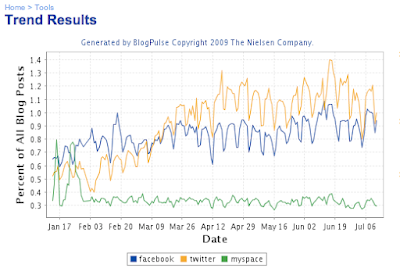
First, check out what's hot in the blogosphere. Nielsen data shows that Twitter is gaining mentions and MySpace is flatlining.
Graph of mentions Twitter Facebook MySpace. Twtitter trending up, Myspace flat and low, Facebook holding it's own[my apologies to the Tweep who sent me this way. I searched and couldn't find you. So an annon h/t. So sorry!]

Second trend, Nielsen Global Online Consumer Survey shows that personal recommendations and online opinions are the most influential.

Government is not listed in the mix, but depending on how you cut it, government sites are most like "brand" websites, which have a respectable 70% positive trust level.

The important piece for government, though, is to make content more sharable. If a friend sends an email, or shares a page on Facebook or tweets a link, 90% of the people will trust the information. Helping people to share government content looks like a big win.

Third, since Twitter is so hot, here are some numbers to give flavor to the "Twittershpere" via a report by Internet marketing company Hubspot. Among Twitter users
  • 55.50% are not following anyone
  • 54.88% have never tweeted
  • 52.71% have no followers
Looking closer at what this means, only 9% of the Twitter users meet all three criteria (less than 10 in each category). For example the State Department travel alerts follows only 15 but is followed by 6,215 and have updated with 175 alerts. And then there's Oprah, with her nearly 2 million followers, who only follows 14 people with a paltry 50 tweets.

People who have never tweeted may be using Twitter as a news aggregator, taking in information and choosing to share nothing. They are still involved by reading messages and are available. The people with few followers may follow many, follow a few people with whom they have a close exchange, or perhaps simply never got the Twitter bug. You can read the entire State of the Twittersphere (download PDF) report, here.

Jul 8, 2009

If Social Media is the New Punk, Who Are You?

2 comments

This is a fun video. And whether you do or don't like punk, you must admit that it influenced the music following. So, for fun, if gov-social media is to punk rock, where do you fit?

Ramones. Raw, stripped down and honest. Listen to Blitzkrieg Bop. Let's face it, not many in gov have the guts or the ability to be leaders in this space. But NGOs can.

Take a look at the innovative, crowd-sourced and brave efforts of the JumpStart Mapping Initiative. This program aims "to produce complete, free, and open public-domain street maps in developing countries." Volunteers are being trained in GIS surveying and cartography and walk the streets to produce a data set for a street map of the West Bank using web-based open source software to get to
  • better transparency in government planning for civil services
  • better relief and reporting for humanitarian efforts
  • better fluidity in private markets
  • the potential to generate job opportunities that enable businesses to enhance their services
See also the slides from Mikel Miron's program from Crisis Camp Ignite. This is one of the most amazing projects I have seen.

Another Ramone's era example is the useful, cool and edgy mashup created with official D.C. government data. Stumble Safely is a mobile application that helps people "find the best bars and a safe path to stumble home on." It uses uses data about D.C. crime, streets, liquor licenses, parks, and subway stations to build a safe route home as well as awareness information to let you know club hotspots. This is what happens when government takes the chance of opening up it's data stores-an application that gets people's attention and fills a niche need (or maybe desire). Watch the local government space for more Ramones-like applications.

The Clash: Punk from across the pond, The Clash took raw energy and politics and recognized that production values count with some added polish. Try Train in Vain. Still crazy innovative, they brought the in-your-face punk to a wider audience with the best LP of the 80's.

We are starting to see examples of Clash-level work, like the TSA Blog which brings a bite not normally seen in government discourse with an openness, and, yes, sometimes even in-your-face-ness that others have yet to emulate.

Another example, less edgy and more harmonic, is the Centers for Disease Control and Prevention (CDC) and their e-marketing social media efforts. Their steps into interaction in virtual worlds reaches new audiences (kids and their grandparents) to change people's behavior, like getting a flu vaccine. CDC is also using widgets to encourage people who care--not everyone--pass on public health information to their friends.

Much to come in this category.

U2: Still with a distinct sound, this Irish band has defined rock and roll for 25 years. From Two Hearts to Beautiful Day to a turn at the inauguration, they are definitely mainstream, but with an edge. They ask us to participate and to collaborate with them and with each other.

We are too soon for any U2-style examples as we're at the beginning of the trek (at this stage I see more examples like this).

We must continue to evolve, experiment and take risks. There would be no U2 without the Clash and no Clash without the Ramones. Punk evolves to mainstream, but a bit of the anarchy remains (did you hear what Bono said about int'l relations at the Inaugural concert?).

It's up to the folks who want more than a controlled, conservative approach to government "interaction" to step up to be dot-gov rockstars, the next Bono.

Hey, ho, let's GO!

Jul 6, 2009

Where You Are Matters: MySpace and Facebook

0 comments
Picture of a racially diverse group of VERY cute kidsHad an amazing time at the Personal Democracy Forum in NYC last week. More than once I felt my head exploding with new thoughts. In this program full of great thinking and new ideas, danah boyd's talk on "The Not-So-Hidden Politics of Class Online" was probably the most referenced, and one that struck a nerve.

boyd began with questioning the hype that Facebook was hot and that MySpace was not. Now that Facebook has caught up, traffic-wise, with rival MySpace, many think it's over for MySpace. But with 70 million visitors on MySpace, how does it not continue to be important?

She then discussed her research and the growing race, class and education divide between the two networks and what she calls a modern day, digital "white flight" from MySpace to Facebook.
All this said, people are already divided and we accept that people from different backgrounds inhabit different environments. We cannot expect technology to automatically integrate people and generate cultural harmony. Although most of you call these sites "social networking sites," there's almost no networking going on. People use these sites to connect to the people they know....

But here's the main issue with social divisions. We can accept when people choose to connect to people who are like them and not friend different others. But can we accept when institutions and services only support a portion of the network? When politicians only address half of their constituency? When educators and policy makers engage with people only through the tools of the privileged? When we start leveraging technology to meet specific goals, we may reinforce the divisions that we're trying to address.

boyd summarized her thinking and research about social networks and the impact of institutions selecting specific venues for outreach.
1) Social stratification is pervasive in American society (and around the globe). Social media does not magically eradicate inequality. Rather, it mirrors what is happening in everyday life and makes social divisions visible.

2) There is no universal public online. What we see as user "choice" in social media often has to do with structural forces like homophily in people's social networks. People connect to people who think like them and they think like the people with whom they are connected.

3) If you are trying to connect with the public, where you go online matters. The key to developing a social media strategy is to understand who you're reaching and who you're not and make certain that your perspective is accounting for said choices.

4) The Internet has enabled many new voices to enter the political fray, but not everyone is sitting at the table.--read the entire talk on danah.org [emphasis mine]
So, as government agencies develop a social network strategy--and even as they are dipping their toes into the social media waters--the decisions agencies are making about resources and resourcing need to be informed by facts and not hype.

If government wants to reach people where they are, it needs to understand not only where "people are," but also who uses which tools and how different audiences expect to interact and consume information.

My excerpts and overview do not give boyd's ideas their due. Please read more here and think about how you might use her analysis as you develop your social media strategy.

Jul 3, 2009

Smithsonian Seeding Staff New Media Innovation

2 comments
The Smithsonian Castle on the National Mall, Washington DCSmithsonian Secretary Wayne Clough announced a new project and fund to encourage staff at the world's largest museum complex and research organization to explore and launch ways to "use digital technology and new media" to advance the Smithsonian's work.

From Secretary Clough's announcement to staff
The Smithsonian 2.0 Fund offers internal grants to staff for varied and diverse attempts to use interactive web methods and digital technology in a creative way so as to engage members of the public or particular constituencies in the collections, research, exhibitions, or programs of the Smithsonian. Grant awards will typically be in the $10,000 to $30,000 range; they are intended to provide seed money for projects likely to turn into larger initiatives.

All Smithsonian staff and units are eligible to submit projects for funding. Proposed projects must be led by a Smithsonian staff person, though they may involve more than one SI unit as well as outside partners.

In light of our very successful Smithsonian 2.0 conference and subsequent debates and discussions, I am confident that we have a large number of good ideas for moving ahead in the digital arena. I fully expect numerous staff to submit fine proposals for the benefit of the Smithsonian, the public, and our various constituencies.--from email to staff
This project begins to answer one of the challenges raised in their debates:
Knowledge is increasing at such a rapid pace that keeping web-delivered content up to date is an extremely challenging and expensive task, perhaps too much so...If the pace of knowledge development is driven by the collaboration and sharing of expertise via the Internet, should we be looking at a similar model to get the word out about the breakthroughs and new developments we are part of?--see more on the Smithsonian 2.0 blog.
What a terrific effort to tap the collective knowledge and creativity of the people who directly know the collections and the audience, AND, to acknowledge that the knowledge and creativity of staff as a valued resource.

The effort is funded by gifts from the Smithsonian National Board. Great job putting your money where your mouth is, Smithsonian.

Jun 28, 2009

Phase III of Open Government Initiative Extended

0 comments
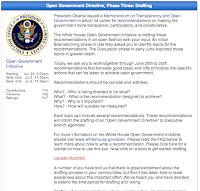
Open Government Initiative web sitePlease put on your to-do list and PARTICIPATE in this effort.

From the Open Government Blog at the White House
SAT, JUNE 27, 7:17 PM EST Extension of Phase III: Drafting of Open Government Recommendations
As of Friday, June 26th, there were well over 100 drafts of open government recommendations that you, the public, had written in Phase III of the public consultation process. The community of contributors grows by the hour, as word of this collaborative effort spreads.

A number of you have told us that there is great excitement about the drafting process in your communities, but that it has taken time to raise awareness about this important effort. We’ve heard you and have decided to extend the time period for drafting and voting.

Drafting of recommendations will now continue through 11:59pm Eastern Friday, July 3rd. Voting will stay open through the holiday weekend, until 11:59pm Eastern Monday, July 6th.

Spread the word and join the movement to help make government more transparent, participatory, and collaborative. Write, read, and rate recommendations at http://www.mixedink.com/opengov/ --Read the post on the White House blog.
The topics so far are
  • Transparency- including defining transparency, institutionalizing transparency, operations, more data online, improving access
  • Participation- including creating new opportunities to engage citizens, training people to participate, new media, agency e-rulemaking
  • Collaboration- including inter-governmental collaboration, public-private partnerships, online dispute resolution.
Don't see what you think is important? Jump in.

The White House is using a tool called Mixed Ink for the collaboration. It's a hybrid wiki that lets multiple authors update and comment, and also enables voting on changes for what they call "more consensual collaboration."

Don't be daunted by the tool. Poke around. Vote. Then go ahead and make some changes or add a section. Especially if this is what you have been asking for, and, let others know about this opportunity. This will be as good as we make it.

Now go! Do it!

Jun 25, 2009

7 Listening Tools: Getting from Asking to Listening

2 comments
T-shirt that says, WARNING I am not listening P&G and Nielsen are trying to understand how learning gleaned from “listening” to online consumer conversations compares to survey-based findings (”asking”).
What we learned was surprising and important. Findings from “listening” and “asking” were largely consistent. Most importantly, in every case, “listening” added to our understanding in important ways, meaningfully enhancing insights, and sometimes suggesting a different course of action. For example, a survey on cloth diapering identified cost savings and sustainability as key reasons for using cloth diapers. Listening took this further, revealing the passion cloth-diapering moms have for “CD’ing,” and connecting it to core values around parenting. This led to a fundamentally different, more holistic understanding of cloth diapering than was available from survey results alone.

Listening consistently provided valuable depth and context … adding listening to the picture was a little like going from an X-ray to a CAT scan. Furthermore, listening revealed the level of consumer passion or intensity associated with a specific topic. Understanding “intensity” can be just as important to winning in the marketplace as understanding size or “magnitude,” suggesting the need to pursue survey-based and listening-based approaches (or hybrid methods) going forward.--More on the Nielsen Online Analyst Blog
It's clear that asking is important. But, information from listening added to information from surveys (asking) gives a more nuanced and more complete picture of what's going on.

For government, it means looking for ways to listen. Here are 7 easy--and available--listening tools.
  1. If you survey, be sure to leave space for free response. Yes, it's harder to quantify, but it's the best way to get to what your users/visitors really mean.
  2. Regularly review the emails sent to the generic webmaster address. You will learn what people are looking for, what makes them unhappy, and potential gaps in content or services.
  3. Review weblogs for search terms. These are the words and phrases that people are using to get to your site. Take the most popular terms and run the search yourself. What are the results? Is it what a user might expect?
  4. Review your internal search logs to find out what people are looking for once they're on your site. Quarterly, look at all the search terms and group them by "like." When you group them you might see a different trend. Also, your users will tell you what they call your content (you say "lawful permanent residence" and they say "green card").
  5. Check out what people are looking for on Google. There is a suite of free query tools that can give you insights into the people who may or may not visit your site. Start at What is the Google zeitgeist? and work your way through the search and comparison tools.
  6. Take the terms people relate to you (in 3 and 4) and use twitter search. You will get folks' raw opinion. Some good, some bad. Save the search as an RSS feed for regular access. Look for other twitter monitoring tools.
  7. Sign up for Google Alerts. Enter the terms to track and find out what bloggers, news sources and others are saying.
Got a good tool that you use? Put it in the comments and help a guy out.

BTW, Nielsen and P+G are doing a webinar to discuss their findings on Friday at 2 pm. You can register here.

Jun 11, 2009

Gov 2.0 Around the World

0 comments
Check out this dot-gov video from down-under--Australia. Matthew Hodgson's video on Gov 2.0 shows that the challenges are trans-hemispheric [okay, I likely made that word up].

From PDF's and static pages created by the "experts" behind the green shades talking about themselves in arcane governtmentese to a landscape full of choice, relationships, trust, and community.


Making government personal, real and relevant. Coming soon to a continent near you!

Jun 4, 2009

Talkin' Bout My Generation

2 comments
Joe smiling. His senior picture.A colleague working at a big government agency tweeted,
I'd like to see a visualization of ages of federal employees. I'm worried we lost an entire generation. We need more young people!--annon
This weekend my son is graduating from high school. And, I can say--without bias--that he is a brilliant, talented, extraordinary young man. He sees the frustration of trying to do good work in government and asks, "Why do you do it, Mom?" 

But this isn't about me. It's about him, and making public service attractive to the best, the brightest, and the most talented--like him and his classmates. Not because government is a "secure" job, but because government is where good people go to do good work. Because government is where innovation is happening. Because government can help you change the world. Because public service is challenging and rewarding.

What will it take to for Joe and his classmates to bring the future into government? As was said, we need more young people. Discuss.

[I am going off the grid for the next few days to celebrate some family time. Be back next week.]

May 29, 2009

Shorts: Open Gov Dialogue, Smithsonian Future, SocMed Personalities

0 comments
White House Closes Down Phase I of Open Government Dialogue, Preps for Next Phase. After receiving 900 submissions and 33,000 votes on ideas ranging from strategies for making government data more accessible to legal and policy impediments to transparency, the White House closes the Open Government dialogue at opengov.ideascale.com (hosted by the National Academies of Public Administration). All materials will be reviewed along with comments received from government employees in March. The goal is to use ideas from the first phase to "inform deeper discussion." The White House wanted to clarify that while "the voting on the brainstorming submissions will be instructive, it will not determine which topics are discussed in the second phase." A little confusing, too, is that the brainstorming tool will remain open for the lively dialogue through June 19, it just won't inform the process (?). More on the next steps on WhiteHouse.Gov.

The Smithsonian Crowd-sources for It's Future. The grand museums(s) on the Mall is hosting a discussion on YouTube. They are "looking for a few friends and fans from around the world to help us form the future Smithsonian experience. A revolutionary Web and New Media Strategy project is underway, and we invite you to collaborate with us as we envision a rich new media future for the Institution." They are asking people to join their group on YouTube and submit a <1 class="Apple-style-span" style="color: rgb(192, 192, 192); ">More on Smithsonian's channel.  [A little funny because the "conflict" for Night at the Museum 2, filmed at Air and Space, includes a rant against the modernization of the museum experience.] 

What’s Your Government 2.0 Personality Type? Steve Radick creates a fun set of social media archetypes ranging from the Edgerider--an early-adopter of all things technology always looking for the latest and the greatest Internet meme, idea, and initiative--to the Skeptic who asks, “Why the hell are you spending so much time on Twitter and Facebook when you could be doing real work?" And a bunch in between. See if you can find yourself at Social Media Strategery.

May 23, 2009

5 Social Media Memes Changing Government

4 comments
Red Boy Scout patch with number 5Federal Computer Week, reporting on a government leadership summit [sorry, too lazy to find out more about another one of these meetings prolly sponsored by some publisher or something] talks about five social media elements that will change the way the government works.  

My [very] loose roundup of the new memes are

1.  Where, once, government was leading on technology requirements, it is now one among many (competing) consumer interests. 
What I think this means: I've been at plenty of meetings where folks say "we're the government, we are huge, they want our business, they will change to meet our needs." But if a company's entire business model is advertisement, and government doesn't drive enough traffic, where is their incentive to destroy their income stream? If government wants to use the tools, we need to figure out how we can adapt.

2. Public engagement reveals the law of unintended consequences. 
What this means: Forays into social tools need to be flexible, and program managers need to keep an eye on results. None of us knows what will happen when we try something out--servers may crash, agencies may be overwhelmed with comments, the only response will be the chirps of crickets, or you might be stuck naming your international space station after a satirical opinionator. Good news for NASA on this last one--they saw an opportunity rather than a disaster.

3. Stop the analysis paralysis and make data available. 
What this means: Here is a big cultural change, from the government churning data into tables and reports that is delivered tied up in a bow to a dynamic process of developers unleashing the data to tell all kinds of stories. See #2. Also, expect a clamoring to open up more data sources.

4. It's the content, stupid!
What this means: Government can embarrass itself jumping into social streams without having anything to say. It's a conversation. It's a message. It's not just having a Facebook page or Twtitter account. It's not the technology, but the way that it's used.  So, if you say, "What's a hashtag?" you have no business putting your government agency on Twitter. Leading to #5.

5. This is the new way of the world. 
What this means: Despite old-fashioned concerns about employees goofing around (what's the difference between that sudoku book and YouTube, as far as productivity goes?) and real, to-be-addressed concerns about privacy and security, people are working, learning, collaborating and living differently. It's happening. And, even as some of the tools fall to the wayside and new ones developed, expectations of citizens and employees are out of the bottle. They can't be put back in.

Welcome to the changing government.

Read the FCW article I jumped off from, here. 

May 11, 2009

7 Deadly Blindspots in Social Media

0 comments
Seven deadly social media blind spots are outlined in MarketingProfs Daily Fix by Mark Ivey,
1) Not thinking like social media marketers: Social media is all about sharing, opening up, being transparent, providing real value to our customers. It’s about long-term relationships, not short-term campaigns. We must give up control, take some risks and get out there. 

2) Not connecting social media programs with the larger corporate strategy and other programs: Social media programs are too often set up as separate silo programs. 

3) Not really listening to customers: Social media is about listening to our customers. What are their needs? What are they missing? How are they using your product/service? [U]nderstand what they would want from you.

4) Not listening to the market: How can you target your products/services if you don’t know your market?
Think about your goals—what are you trying to monitor/achieve? 

5) Not trusting the employees:
The old days where the company controlled employees’ content is long over—they’re conversing online whether companies condone it or not. Establish company guidelines but provide employees the tools and freedom to express themselves—and then step back. 

6) Not creating “social” content: Good content drives traffic, links, goodwill and much more. The
problem is much of our content is in corporate-speak and brochure-ware that we slap on the web. Your content needs to be fresh, interesting, engaging, relevant to your audience--and “share-able.” Forget your message a few minutes and focus on your customers. 

7) Not creating cool videos: See the trend?
Videos need to be about the customers’ needs, interests, not your latest product overview. -- [my emphasis added] Read the full story at MarketingProfs.
Even though the article focuses on marketing, dot-gov still has a take away: If you want to use social media to meet your goals, start with your customers first, and your customers again, last. It's in the creation of value for your customers (citizens, stakeholders) that you will be able to use new tools to achieve your mission.

May 4, 2009

Who Controls Language on the Interwebs?

1 comments
A rose by any new name may be unfindable.

Last week, official Washington began calling the artist formerly known as "swine flu" the "H1N1 flu," as did the World Health Organization. There are very good reasons for this--the virus isn't transmitted by eating pork products, it is hurting the economy, the relationship between pigs and the virus is debatable, it is more accurate to call it by it's scientific name and the government response is based on science, etc. 

That said, people are looking for information on "swine flu" and people are talking about "swine flu." From BlogPulse:

NielsenBlogPulse view of the terms swine flu vs. H1N1, swine is much more popular.The blue line is the trend for the use of the term "swine flu" in blogs, and the orange trends "H1N1." 

Looking at Google Trends, we see that the change in terminology from "swine flu" to H1N1 was picked up and acknowledged in the news (lower graph), but is not having much impact in general web searches (upper graph). This data is for U.S. searches only.


CDC has said that they were going to work on transitioning their online information to H1N1 from swine. That sounds like a good idea, since we wouldn't want a choice of words interrupting people's ability to find critical health information. 

Takeaway? Use data and trends to find out what people are looking for and build web sites and tools according to data. Help people learn the new terms, but remember that once a meme has legs, it's ingrained in the collective and will not be replaced easily.

In the meantime, wash your hands!, and see CDC for up-to-date information on the H1N1 (swine) flu. 

If you want to track what is happening in the blogosphere the Nielsen BlogPulse is a great resource. Book mark it! Also, Google Trends for what people are looking for. Great FREE sources.

Apr 26, 2009

Recovery Dialogue: IT Solutions

2 comments
recovery dot gov logoAnnounced on the Recovery.Gov Website:
Starting...April 27, The Recovery Accountability and Transparency Board and the Office of Management and Budget in partnership with the National Academy of Public Administration, will host a national online dialogue to engage leading information technology (IT) vendors, thinkers, and consumers in answering a key question:

What ideas, tools, and approaches can make Recovery.gov a place where all citizens can transparently monitor the expenditure and use of recovery funds?

Participants from across the IT community will be able to recommend, discuss, and vote on the best ideas, tools, and approaches. Your ideas can directly impact how Recovery.gov operates and ensure that our economic recovery is the most transparent and accountable in history. Mark your calendars and check back for the web link. Click here for more information.--See more on Recovery.GOV
This project is part of a partnership with the National Academy of Public Administration (NAPA). which sponsors the most excellent Collaboration Project. The Collaboration Project is creating a set of case studies on the best uses of collaborative technologies and new media in government. They also sponsored a national discussion on health information technology and privacy.

The Recovery Accountability and Transparency Board is asking for  help around five key areas
  • Website Design
  • Data Collection
  • Data Warehousing
  • Data Analysis and Visualization
  • Waste, Fraud, and Abuse Detection
  • Other topics that are key to achieving greater transparency and accountability
For starters, I have a minor suggestion:  stop asking visitors to click through to a PDF for more information. Information is much more accessible when it's not buried in a PDF. More transparent, if you will. 

Anyway, this is a great opportunity for a government agency to learn what people want, need and expect. I look forward to logging in this week--the project is open for seven days--and providing some substantive feedback. Hope you do, too!

Apr 18, 2009

Innovation Causes Failure

8 comments
The idea of opening up government to her citizens--allowing anyone in the country to ask the President a question or to comment on policy or to even set the policy agenda--seems to be a natural fit for technology, but continues to baffle.

Enter a really interesting interview on Federal Computer Week with Kim Patrick Kobza of Neighborhood America. Kobza takes a critical look at the Online Presidential Town Hall held last month. He notes some good elements, but
Fatal flaw: Where the application breaks down is the volume of solution possibilities – it is not credible. Think about it this way. Most choices in policy are essentially an “alternatives analysis” -- a choice between different but well defined solution possibilities. What is happening in whitehouse.gov is that the public is being asked to create and compare an almost infinite number of choices. Who could possibly read 53,808 questions? 53,808 alternatives? Most people understand that it just isn’t credible to think that that is possible. So the application creates an illusion of meritocracy when in fact the statistical significance of any one person’s participation is negligible. Put in a network context, it treats choices as a mechanical data management exercise, rather than as one that develops and advances logic to why choices might be made. There is no exchange that takes place between members within the network (citizens) and that limits the network value (intelligence) being generated.

Another thought on design. In my view, when building citizen participation, and more importantly, in discovering great ideas it is important that these types of sites build social attention. Social attention comes from novelty, uniqueness, and experiences that are fun and that promote learning. The design of this site again is not interesting. It might be argued it was interesting enough to gain 54,000 ideas. The other side of that argument is that many congressmen receive tens of thousands of emails a week. This application has not upped the standard or participation
. [my emphasis] --Read the entire interview here. 
Kozba has some specific recommendations for improving future forays, but finishes by saying:
I believe that this is not a good example of how social networking adds value to public processes. In fact, in some ways these methods hurt more than help because they set the wrong citizen expectations. They are not our best effort so to speak. So citizens will ultimately be discouraged because the application as used, will not achieve results. 
...Success depends upon much more than data management and mashing up technology features. We spend a lot of time studying what works and what doesn’t, and have had experiences to validate over 10 years. That has built an appreciation for how hard it is to get this right.

What we showcase at a Whitehouse.gov should be a shining example of our best efforts. It should be state of the art and based on our deepest knowledge and experience. It should not be, and does not have to be, based on experimentation. 
Wow, this is a harsh criticism, but quite on target. Sometimes, we in dot-gov are quick to give ourselves props because we tried. But this isn't U-5 soccer, this is the big leagues. We should be competing with the best and most sophisticated technology implementations.

Yes, this is definitely a resource issue. Many smart and creative people in government are using duct-tape, paper clips and super glue to build engagement tools. People turn to"free" tools like YouTube, Blogger, Google Docs, Flickr, because the barriers are low and something can actually be accomplished.  There are world class websites in government being hand coded--no database, no content management systems. 

This innovation and creativity does not serve government well. 

The reliance on the cheap and the intuitive rather than the quality and the researched supports the lack of a cohesive government-wide approach to using technology to improve government. It allows "progress to be made" despite the absence of empirical data to drive decisions, the proliferation of stale and inflexible development methods, and a process that does not include citizens and their actual needs. It does not challenge the stove-piped agency development and procurement of technology solutions. By making things work, we aren't forced to face the requirements and to build an actual 21st century government. 

I was talking to a colleague yesterday, and she said that government is the best place to work--that the very best and the very brightest technologists and innovators in the country should be clamoring to work at the White House and HHS and the Department of Education, etc.  Where else can you work on projects and programs that have such a huge impact?

It's time to reconcile this last thought with the rest of this post.