Showing posts with label technology. Show all posts

Nov 29, 2010

Schools Get an F: Our Kids and Tech

2 comments
While I am loathe to admit it, I danced on a lighted dance floor. I did The Hustle. I was quite underage to be going to clubs, but that's what we did. Those were the times I grew up in.*

Why the confession?

Because while I was a girl--disco dancing under a mirrored ball--I got a better computer education than high-schoolers get today.

At my working-class public high school, I took a "computer" class. We had to learn a language and write a program. We called the computer on the special phone, put the telephone receiver in suction cups and typed the commands to run the program. If the program didn't work, we had to figure out why. Line by line. And when it worked, we had accomplished something and did a happy dance.

I used  the C:\ prompt on my first computer (at work). Not because I am geeky, but because that was all there was. We had to imagine what was behind the dir command, because directories were opened one at a time. There was no tree, like in Windows, so you had to abstract and remember the directory structure.

The very, very basic programming and directory commands that I learned introduced me to using computers. I've been lucky enough to work with nice, smart, truly geeky people to help develop my technical knowledge. But I had something to build on, a basic computer literacy.

My kids go to pretty good schools. Their computer classes include how to use Excel and Powerpoint. Kids don't need to learn how to use productivity software. They just use it. "Programming," when offered, is usually HTML markup. They don't use logic. No IF...THEN...ELSE statements. The teachers don't use computers and are reluctant (don't know how?) to use them in class. The teachers who teach technology are hockey coaches. Kids get lessons in net-etiquette but not in three tier architecture.

We think that "born digital" kids know technology, but many of them can only put together a tacky, over-animated, under-researched slideshow. We have web "programmers" with a knowledge of HTML which they have parlayed into a visual programming language, but without any understanding of databases and data structures, systems analysis, or resource management. And, we have leaders who run programs based on technology, but who disengage whenever tech is mentioned.

Kids use technology and computers from sunup to sundown, but they don't know how it works. And they need to. Whether or not they are computer scientists or technologists, everyone needs a basic technical literacy. We teach the basics of reading, the building blocks of math, the structure of writing, but no fundamentals of technology. This is a huge mistake.

Government depends on the effective deployment of technology to solve problems. We need to recruit people who can write effective RFPs, navigate technology issues, oversee technology and technologists, as well as be geeks. But, that means we need people with the right knowledge and skills in the pipeline.

Kids do need to learn that The Cloud consists of physical servers, that data quality is critical to good output, that the semantic web can help machines make sense out of information on a web page so information structure counts, that information stored across multiple datasets and servers can be combined and mined, and all this is at least as important as whether a train leaving Boston for New York will beat an earlier, slower train from Providence.

Teachers, principals, schools, Secretary Duncan, let's get back to the future and do some meaningful updating of our technology curricula.

Technology is the fourth "R"--reading, (w)riting, 'rithmetic, and rechnology (that last one only works when spoken like Scooby-Doo another relic of my past).

[* here's how I was saved. Not quite fodder for On dot-gov.]

Jul 19, 2010

4 Lessons For Gov Via The @OldSpice Guy

2 comments
Should i start with a melodic, "Hellooo Ladies?"

Not one to let a hot meme slip by, and vacation prone to hearing the oceans in a shell and seeing signs in billowing clouds, here's my resounding YES to finding lessons for dot-gov in this past week's Internet phenom: that most awesome 180 videos in 3 days, multi-channel, rock-hard abs Old Spice campaign.

But I am not going to write about the brilliant social media campaign--others are doing that. Instead, I want to talk about four lessons we can take from @OldSpice Guy to better our dot-gov projects.

Number one: Speed
This is 2010, and if you haven't got it yet, we stopped waiting. The Old Spice team created video responses in real time. Someone--sometimes famous and sometimes not--would tweet and in minutes there was a response. And it was good. We hadn't seen this level of realtime before, but we like it.

Government needs to get with the program and escape from the time warps of never-ending requirements gathering, ad nauseam reporting, acquisition merry-go-rounds, and TAA (total risk aversion). I was on a panel a few weeks ago when someone asked how was it acceptable for government to take 3 months to implement open government initiatives. My response? that I would love for a project to come in under six. Sigh.

Our citizens expect immediate results. We need to make it so.

Number two: Planning
How do you make 180 videos, have them distributed across multiple networks and garner 11 million views in 3 days? Very carefully. This was a well-designed and executed plan. And, like any well-executed plan, it looked easy. But the handsome man already had a fan base, the social media team knew where to reach out, all the resources for the rapid research, writing, producing and editing were on site, and sign-offs were established.

I don't want to miss any chance to hammer home the strategy message. You, too, are building toward a goal. You have to lay the groundwork, do your research and pull together the team.  You also need to be open to opportunities.

For example, we learned that you can't put a new capability in place during a disaster (duh, you say, but there is an expectation that technology can solve problems "magically"). That's why it's important for people drill and for organizations to run simulations and exercises. That's why your IT and new media teams need to participate. Setting up a Twitter account days into a crisis is much less effective than building a follower base and expertise to broadcast information that scales.

Is having a web infrastructure that can easily output RSS something you will need? Don't have the infrastructure you want, but can begin collecting data for the next gen? Do it now. In 2006, we tested third party tools for a blog, because, even though we had no nibbles from the front office, we knew that we would keep pushing to blog. When the formerly reluctant boss hit "go," many months later, we were ready with tested technology and policy. We went from go to live in 5 weeks without breaking a sweat.

See where you want to be. Build toward that state.

Number three: Talent
No doubt that the Old Spicers had a corral full of talent. From the guy in front of camera to the professional broadcast quality output to the hysterically funny writers to the social media experts who brilliantly got it and executed on key to the crazy creatives that put the whole scheme in motion, this was high-quality work.

Who do you have in your stable? Is your organization built for mules who keep their heads down and plod along on the well-worn path? Or do you nurture thoroughbreds and give them room to run? Do you hire or contact with superstars only to to keep pulling up the reins and push them to follow that old path? Does your staff look at the Old Spice campaign and wish they could do something like that?

You want high quality output? Find and nurture the folks who can do that work. And give them the space.

Which leads to...

Number four: Trust
There would be no speed from this well-planned caper if there wasn't an extraordinary level of trust in the superstar team.  The ad company had worked with the client at length and pitched a process that skipped traditional sign-offs from legal, et.al. And the client agreed.

This is an interesting element. It's critical to understand that while trust is imperative, it's not automatic. Trust needs to be earned, every day. It's unreasonable--and dangerous--for executives to bet on a project or team simply because trust is a success factor. It's up to the folks in dot-gov to build the trust and to show the judgement necessary to take on risk. You create trust by building relationships, by showing success on smaller projects, by understanding the needs of the organization and developing programs to meet mission goals, by creating strong implementation and risk management plans, and by communicating clearly both up and down.

Trust, like Rome, isn't built in a day.

So that's it, speed, planning, talent and trust or SPTT! I think I need a vowel for that. Hey, look, a fish just fell in my arms. Then it turned into diamonds. I'm on a horse.

And, in case you missed it, here's my personal favorite of the Old Spice rapid ads--to the actor's daughter.


EAVB_OPOUDEQSUI

Jan 24, 2010

Three Privacy Tales

3 comments
Black t-shirt that reads, privacy is not a crimeA very smart, millennial new media colleague was talking online privacy over a beer. He said that he didn't really have an expectation of privacy and that he trusted Google to do right.

Last month, Google CEO Eric Schmidt ruffled more than a few privacy feathers.
In a recent interview [CEO Schmidt] suggested that people pushing for privacy are the one's at fault: "If you have something that you don't want anyone to know, maybe you shouldn't be doing it in the first place."

This sounds suspiciously like a reheated version of "if you've done nothing wrong, you've got nothing to worry about," that's trotted out by law enforcement types when pushing for stronger laws to violate individuals' privacy. It's an odd statement for someone like Schmidt to make, especially given the incredible level of scrutiny given to Google for the view it has into people's lives. To folks who are worried about such things, it sounds positively dismissive, which isn't the position that Google should be cultivating with those who are concerned right now." --
More on TechDirt
This month, another tech giant, Facebook founder Mark Zuckerberg, resurrected the controversy when he said that people don't expect privacy anymore.
Facebook founder Mark Zuckerberg told a live audience this weekend that the world has changed, that it's become more public and less private, and that the controversial new default and permanent settings reflect how the site would work if he were to create it today. Not everyone agrees with his move and its justification.

Has society become less private or is it Facebook that's pushing people in that direction? Is privacy online just an illusion anyway?--Read more on ReadWriteWeb
Facebook, with it's 350 million members has modified it's views on privacy as well as its policies. From a closed network in which only people that you have approved can see your profile, photos and other information to a fairly open network in which the default is "open to all" including search engine results.

My third privacy tale is from another direction--and continent. Europe has had pretty strong online privacy protections. In November, the European Union passed a law requiring Internet users' consent before cookies can be placed on their machines.
The amended directive will now state that national governments must "ensure that the storing of information, or the gaining of access to information already stored, in the terminal equipment of a subscriber or user is only allowed on condition that the subscriber or user concerned has given his/her consent, having been provided with clear and comprehensive information."

Cookies without user consent would only be allowed when they are "strictly necessary" to provide a service "explicitly requested" by the user such as storing shopping cart information on e-commerce sites, for example.--Read more at ClickZ
So, as big U.S. tech/new media moguls posit that privacy is becoming less important, to the Europeans, at least, it's critical to protect.

In the U.S., dot-gov has stronger privacy requirements than the private sector. There are some who think, though, that the EU controls will force a change in the commercial sector--especially to put more control in the hands of the consumer to be included in tracking and data gathering.

In the meantime, federal agencies will continue to face barriers in using commercial tools that use cookies to track users as these privacy tales play out.

Dec 22, 2009

21st Century Snow Removal

1 comments
A nice boy shoveling his neighbors' walk.Snaps to the Mayor and to the terrific folks at D.C. Public Works. After 20 inches of snow fell for 26 hours through Saturday night, the street in front of my house--a side street no less--was plowed before 5 a.m. Sunday morning. (Maybe even earlier. No neighbors were awake to verify.)

This was very different from twenty inches of snow that fell on Washington in 1987. An absent Mayor and a bumbling snow removal process lives large in Washingtonians' memories as a symbol of political incompetence.

It's also a reminder that people care about things that affect them personally. As Tip O'Neill famously said, "all politics is local." This translates into helping people and providing services that have an immediate and personal impact. Sure, it's great if it helps "everyone," but what about ME?

Last week, the President announced the winner of the SAVE Award, Nancy Fichtner. Fichtner's idea was to allow patients discharged from VA hospitals to take home leftover medications, rather than throwing them out. Often, patients turned around to get the same prescription filled at the local pharmacy--the government paying twice. Fichtner's is a great suggestion, not only because it saves money, but because it also touches people directly.

Tucked into the President's remarks on the Save Award were other plans to make government more efficient, including information about a tech forum,
That’s why we’re holding a forum at the White House next month to seek more ideas from the private sector, specifically about how we can better use technology to reform our government for the 21st century.--President Obama
This is an opportunity to take another look at the services that government offers to citizens--especially the mundane transactions like filling out financial aid forms, paying taxes, getting passports, updating W-2 forms, signing up for health programs, disaster assistance, etc.--and making these transactions more efficient and friendly.

Treating people like valued customers--think Zappos or Amazon. Simplifying government transactions to save citizen time--think how easy it is to sign up for Netflix or build your network on Facebook. Helping people get to where they need to be--think Google.

Putting citizens first, making information easy to find, relevant, accurate and understandable; ensuring that common tasks can be easily completed online; being consistent across all channels, online and offline; opening up venues to receive and act on citizen feedback; and being accessible whether someone has a disability or isn't proficient in English--these are the opportunities to make technology work better. And, not just work better for government, but for the citizens, too. (These recommendations are from the Federal Web Managers white paper to the transition team from last year.)

Just a reminder to get down to brass tacks. We care about getting our snow removed. Like NOW!

Nov 8, 2009

Ripe for Change: Compliance and Hiring

1 comments
Aircraft carrier USS John C. Stennis making a sharp clockwise U-turn on the deep blue ocean. Picture by Tina Lamb, USNGovernment 2.0 is more than social software. It's also updating processes that are barriers to a nimble, effective, collaborative government. Processes like hiring and compliance.

A hearing last week focused on yearly cybersecurity reporting and compliance versus protecting systems. NextGov reported on challenges with FISMA, the Federal Information Security Management Act, which requires agencies to identify and inventory their IT systems and determine how sensitive the information is that is stored on those systems.
"It seems like OMB thinks that a snapshot of agency preparedness every three years will defend our critical networks," said Sen. Thomas Carper, D-Del., during a hearing of the Senate Federal Financial Management Subcommittee, which he chairs. "But instead, billions of dollars are spent every year on ineffective and useless reports. Meanwhile, we continue to get attacked."
Efforts at more realtime, and effective, cybersecurity were cited at Department of State.
To supplement FISMA reporting requirements, State implemented a widely lauded risk-scoring program that scans every computer and server connected to the department's network no less than every 36 hours to identify security vulnerabilities and twice a month to check software configurations. The program assigns points on a scale of zero to 10, with 10 being the riskiest security threats. Points are deducted once issues are resolved. Since July, overall risk on the department's key unclassified network measured by the scoring program has been reduced by nearly 90 percent at overseas sites and 89 percent at domestic sites.

"These methods have allowed one critical piece of the department's information security program to move from the snapshot in time previously available under FISMA to a program that scans for weaknesses continuously, identifies weak configurations [every] 15 days, recalculates the most important problems to fix in priority order daily, and issues letter grades monthly to senior managers tracking progress for their organization," Streufert said.--
Read more in NextGov
On the hiring side, John Berry, Office of Personnel Management (OPM) boss, said that "cracks are showing" in the personnel system. According to Government Executive, he outlined a number of areas that might be ready for updating. Berry said that
Reformers must realign personnel systems to recognize, reward and promote merit within the federal workforce, while making the merit system principles a matter not simply of fairness but of job performance.
While not making specific policy edicts, he offered a few focus areas like
  • Expanding the eligibility for big bonuses--beyond the Senior Executive Service
  • Helping agencies pilot and incorporate telework
  • Working to better recognize and reward star performers
  • Focusing on training managers and workers to help adopt change
  • Reviewing the current 15 grade system for a more flexible and simplified promotion path
  • Creating "results-only" work environments, removing time and place from performance. Read more on GovExec.
Are these the "right" areas to focus on? I don't know. Frankly, the emphasis on big bonuses seems a caricature of the private sector. And, I would like to add changing the hiring process to allow more fluidity between the public and private sectors--the two systems are currently incompatible. But I do believe, like Berry says, "we can seize this moment to build something new."

It takes a while to turn around a large, complex vehicle like government. These efforts are helping to turn in the right direction.

Oct 26, 2009

Shorts: Twitter Grows, Report Cards, Drupal and Memos

1 comments
Twitter grows. Pew released some data last week about growth in Twitter use--from 11% of Internet users to 19% in just six-months. Other findings? Three groups of internet users are mainly responsible for driving the growth of this activity, social network users, people who are using mobile and folks under age 44. See more at the Pew Internet Project.

White Paper Report Card. Candi Harrison asks, "Web Manager Council’s White Paper – Is There Progress A Year Later?" In her post she recaps the goals of easily identifiable, relevant, accurate, and up-to-date information that is easy to understand, addresses citizen tasks, is consistent across channels, provides feedback channels and is accessible across reading, ability and language barriers. She gave government a mixed review. See more here.

White House goes Drupal. And TechPresident swoons as they announced that whitehouse.gov has moved to Open Source Software and dropped their proprietary system. I am not sure that this is a great advance for democracy--bottom line is that there will be a custom (read proprietary) system built on the open source platform. But it is good for open source. See more at TechPresident.

Finally, NextGov reports, no movement from White House on the issuing of the Open Government memo that the President announced January 21. See Next Gov.

Oct 18, 2009

Talk Talk vs. Do Do

11 comments
Hot air balloonJust what we need to move the policy discussion forward, another conference?

Back in March, Mark Drapeau from National Defense University wrote about the mid-life crisis of gov 2.0.
Government 2.0 has reached its midlife crisis. Despite some leadership from influential individuals on using social software in government, there is still in many cases a disconnect between authorities issuing directives and ground troops carrying them out...Resistant to change and adhering strictly to doctrine even when nonsensical, people in the clay layer can halt progress. Despite their intentions and being in a strategic position, they often stop the progress being called for.-- Read more on ReadWriteWeb
The solution? A conference. The wonderful Government 2.0 Camp in March attracted a huge number of government (federal, state and local as well as some international) and private sector attendees to talk about government 2.0 and learn from each other.

In July, Jaimie Maynard, a federal staffer, blogged about her post-conference low after the Open Government and Innovations Conference.
All web 2.0 conferences are all starting to look exactly the same. Many speakers come from agencies that are boldly using social media in a new and exciting ways, and many more "believers," who are not allowed to use those same technologies, come to hear about it. But the status quo remains the same...DoD, NASA, The White House are getting things done, but as a method to further collaboration and expand the use of social media, [the conference] failed. We need specifics: case studies, business case strategies that succeeded to support any/all of these tools, etc.
So, now it's October and there is another lament that Government 2.0 is failing or flailing. The Gov 2.0 conferences of the fall--O'Reilly's Expo and Summit--felt like just alot of talk by the same people about the same things.

Brian Drake from Deloitte blogs,
How we can get more people, enthusiasm, and get some tough issues on the table. The one group we continue to not hear from are the detractors or skeptics of social software...In addition to the slim number of public, cogent arguments against Government 2.0, our own discussions about failures are truncated. I’m noticing our Government 2.0 conferences either trumpet the achievements of the few or recast a failure as a success.--Read more on Brian's blog.
So the wrong people are coming to the conference. The solution? Another conference. This one to focus on the "Shortfalls of Gov 2.0" and attract people who aren't coming.

Steve Radick, from Booz Allen and a member of the "Goverati," offers a three part solution.
  1. Realize that not all is perfect in the land of Gov 2.0
  2. Identify the skeptics and open up a dialogue with them
  3. Hear the war stories of the people who have gone before us --Read more from Steve's blog.
And, a conference about Government 2.0 Shortfalls.

Underlying this most recent discussion is the idea that people are unaware of the barriers, arguments against, downsides to Government 2.0. I want to clarify that assumption.

People who actually work in government are well aware of the barriers and arguments against Government 2.0.

Yes, we already know. We don't need to talk about it at another conference. We need to fix it. The problems and issues have been defined and discussed since last year. A few quick examples,
  • In December 2008, the Federal Web Managers' Council published, "Social Media and the Federal Government: Perceived and Real Barriers and Potential Solutions" (pdf) This paper identified challenges with strategy, access, legal, privacy, advertising, ethics, accessibility, and the Paperwork Reduction Act. The paper also offered concrete recommendations to overcome these barriers.
  • In June, the Office of the Chief Privacy Officer at the Department of Homeland Security held a two-day workshop to explore best practices to implement the President’s January 2009, Transparency and Open Government Memorandum. In addition to Gov 2.0 advocates, panelists included a variety of viewpoints including privacy advocates, civil liberties organizations, security professionals, and differing legal opinions.
  • Last month, the Federal CIO Council security workgroup published Guidelines for Secure Use of Social Media by Federal Departments and Agencies identifying issues and recommendations to address security issues in social media.
While government 2.0 is bigger than social media much of the privacy, security, procurement, ethics, and laws and regulations issues are the same.

AND, many of us in government also know that there are some "successes" that have leap-frogged some hurdles and were implemented because leadership demanded that something be stood up. Agencies are playing catch up.

Gartner's Andrea DeMaio blogs very thoughtfully on government and technology changes. He recently said,
I am still amazed to see how little employee-centricity there is in today’s government 2.0 conferences, debates, positions and articles. It is as if employees were considered legacy, just part of an organization that will be transformed, and not the real fuel and soul of those organizations.

Until when their role will be given equal dignity as “citizens”, government 2.0 will remain an interesting subject for discussion, will marginally contribute to service improvement, but won’t realize a fraction of its potential.--More on Andrea's blog
I think that Brian and Steve make excellent points in their posts. I am not opposed to a conference to discuss the shortfalls of Government 2.0, but I am unsure about the payoff. What do we gain? How does it affect the policy? That's where the rubber meets the road. When will we have guidance on records? Can we make better sense out of the limits on advertising? Why does each agency need to do a privacy impact assessment on YouTube or FaceBook? Are the issues the same across government? How can we move the incentives (i.e. money) to reward cross-agency efforts? To gain efficiencies and reduce redundancies? To break down silos? To improve innovation?

Here's the challenge, because if we aren't getting to these solutions, it's just more hot air.

Oct 13, 2009

On the Side: Sidewiki and SideKick

0 comments
First, a side of Google. A few weeks back, Google introduced a new feature on it's Toolbar letting people comment on any web page. Called Sidewiki, people with Google accounts can comment on the entire content of a Web page or about specific portions of the page. They can also publish these comments to Twitter, Facebook and Blogger accounts.

Why is this important? Well, it's importance depends on it's popularity, but it frees comments from websites by opening all websites to comments--outside any comment, moderation or policy of a site.

People can have discussions around your site, rather than on it. Google wins by collecting information about pages and sites from humans rather than machines to grow their search algorithms. It's also another potential ad space--imagine an ad for Coke on the Pepsi homepage, Or ads from private sector employers in the same browser window as usajobs.gov.

For site owners, Google lets you claim your sites on Sidewiki. It's a good idea, too, since site owner comments appear first. You'll need a Google Webmaster Tools account. Many government sites are already using the Google Webmaster tools after the the Google Sitemaps push in dot-gov a few years back. Follow the steps here to claim your site. It took my team about ten minutes.

My second side is a side of the cloud you didn't want to see. People using T-Mobile's Sidekick smart phone lost all of their data supposedly safe "in the cloud."
A server meltdown over the weekend wiped out the master copies of personal data -- including address books, calendars, to-do lists and photos -- accumulated by users of T-Mobile's formerly popular Sidekick smartphone.

This computing calamity allows Sidekick owners only a faint hope of backing up the information currently on their devices, and none of recovering anything they'd trusted to online storage. And it leaves T-Mobile and the operator of the Sidekick's data service, a Microsoft subsidiary formerly known as Danger, Inc. -- oh, the irony! -- with some serious explaining to do.--Read more on WaPost.
Is this a setback for cloud computing? Well, it does put a damper on the cloud hype-machine. Importantly, the "cloud" in question was a single server--a single point of failure. To me, that doesn't sound like a cloud application but an application called "cloud computing."

For government, at the simplest it means to make sure you know what you are buying, understand redundancies and risks, and NEVER let your data get out of your control. A tough reminder, caveat emptor.

Sep 27, 2009

When You Wish Upon The Cloud

1 comments
In which Pooh decides to imitate a cloud in order to trick the bees into not realizing that he is after their honey.Government cloud computing is being touted as the next new thing. Promises of cheaper costs and a reduced carbon footprint, along with consumer experience with the ease of free e-mail and document sharing via "the cloud" makes it a no-brainer. And, bonus, instead of using out-dated government computing structures, the commercial cloud promises innovation and flexibility.

It's not necessarily easy, though.

First, a reminder that cloud computing is real. There are physical servers in physical server farms. It's important to remember that The Cloud is made up of data centers running 24/7/365. There are racks and racks of blades, power supplies, spare parts, monitoring tools and data center staff. These servers and computing capacity are shared by The Cloud tenants. The Cloud is excess computing capacity from the likes of Amazon and Google. The Cloud is not frozen water crystals or fluffy cotton puffs. It's not magic. The Cloud is physical. Learn more about The Cloud here.

This is important because issues with cloud computing are real, too. And real is the backbone of my wish list for government cloud computing. I wish for

Analysis of the risks. Some security experts are very concerned about the security of cloud computing. Casey Coleman, CIO of the General Services Administration, said, "Something like 45 percent of the IT portfolio is ranked at a FISMA certification level of low. What that means is that those applications and that data are candidates for running on some sort of commercial or hybrid cloud service." [Read more from Coleman in Federal Computer Week.] So, what can securely be run in a cloud environment? What can't be? And no cheating on the analysis because the idea of the cloud makes you nervous. Be real.

Analysis of the costs. It makes intuitive sense that money can be saved by sharing computing resources, but the devil is always in the details. Consumers think that software and storage is free--Facebook, Gmail, Google Docs--but they pay by viewing advertisements. Will some applications and storage be on a commercial cloud? Will government data centers shut down? Will they connect and share computing power to become a gov-cloud? Will government share applications with commercial and retail tenants? What would it cost? What about software licensing? Cloud-wide software licensing agreements? Money is real, too.

Useful cloud services. I want to improve accessibility of content by having captioning, live captioning, and translation services on demand. I want a government-wide blogging platform like Blogger for Government. The Department of Defense is already doing this in the dot-mil domain--DoD Live, Army Live, Air Force Live, Coast Guard Live--using a common Wordpress install. I want to be able to transfer large files securely from agency to agency using a cloud FTP server. I want a platform solution for posting multimedia and conducting surveys. I want easy access to website analytics--and, better yet, a way to compare the traffic data across agencies. I want government-wide options for search, dialogue, white pages, email, relationship management, instant messaging. And, I want the service whether it's available on the GSA schedule or via another purchasing option. No reason to be parochial in The Cloud.

What I want from the government cloud. Quicker--like "just in time"--purchase and implementation of tools that are being used in government. Removing roadblocks and silos that make government function like hundreds or even thousands of governments instead of one. Each of these mini-governments have their own ways to buy, their own ideas of security, their own interpretations of the Privacy Act of 1974, their own cookie policies, their own implementations of accessibility guidelines, and their individual risk tolerances. This makes sense for individual agencies who know their particular niches, but it makes no sense to the people--businesses, NGOs, staff, citizens--who need a simple answer and a single conduit to find it. Last, and not the least, I want citizens to control their own identities and to manage their relationship with government not on a per-agency basis but in a system that recognizes that they are whole people. This would make a real difference in the way government does business.

Now, keeping it real, what are YOUR wishes for the government cloud?

Sep 8, 2009

Shorts: Wiki Strategy Tool, NonProfits Blog, Cultural Divide

1 comments
Smithsonian sharing their social media strategy development via wiki. Check out the process and get some tips on developing your own new media plan on this wiki. The plans are to feed the web and new media strategy into the Smithsonian's comprehensive strategic plan. Look and learn on the wiki.

Nonprofits lead way in social media adoption. The Society of New Communications Research looked at the 200 largest U.S. charities and found nonprofits outpaced corporations and academic institutions in their adoption of social media. 57% of charities have blogs compared with 18% of the Fortune 500. See more on BizGtowthNews.

The great gov 2.0 cultural divide. On his GovFresh blog, Luke Fretwell uses this week's Gov 2.0 summit and events as a backdrop to smartly talk about bridging the gap between Washington and West Coast tech-entrepreneurs. He says "Washington, D.C., needs to understand Silicon Valley entrepreneurs are no different than GSA Schedule government contractors or corporate-funded trade associations, all seeking to profit on an industry that will never file for bankruptcy and can always print more money." Read more on GovFresh.

Aug 16, 2009

Too Much To Keep Up With? Don't Try

3 comments
Picture of Ballou and Keith at the beach. Not related to the post, but we had a nice vaycay."We must have a Twitter. And a Facebook. And a YouTube. And a private social network. And an island on Second Live. Oh, and a blog or two."

But, Alexandra Samuel writes:
You could spend half your life trying every technology that comes down the pike, and still be hopelessly at sea...So I'm here to let you off the hook. If a geek like me — a woman whose idea of a fantastically fun evening is to try out a dozen project management sites — can't keep up, what hope is there for folks who occasionally want to close their computers and pick up a book? There is no hope. You can't keep up.
Best of all, this is good news! Alexandra continues,
Keeping up is about following someone else's agenda: the bloggers and tweeters who trot out invitations to the latest beta. The marketers, publicists and journalists who blanket us with coverage about the latest hot tech phenomenon. And yes, the tech consultants who charge tens or hundreds of thousands to add new musts to your already long to-do list. The minute you stop trying to keep up, you open a far more exciting possibility: getting ahead with what matters to you, your team and your business.--Read more at the Harvard Business Blogs.
What to do instead?

1. Go back to what you are trying to accomplish mission-wise, and quit chasing the newest short skirt.

2. Ask the right questions. Not, how do I use XYZ technology, but how do I reach my audience? Where are they? Not, what kind of design do I need for my new website, but how do I help my audience accomplish their tasks?

3. Line up your quality content. Launching the blog is the easiest part, keeping it smart, topical and fresh is the daily drudge--and the holy grail. Spend more time on your current channels and less time launching new avenues.

4. Keep your fingers on the pulse. Subscribe to newsfeeds and keep up with blogs and articles about emerging technologies and how they're being used. You just don't have to use them all. At least not yet.

[I know the picture is not related to the post. But we were at the beach. And it was nice.]

Jul 30, 2009

Pulling the Plug on Underperforming IT Projects

2 comments
The Department of Veterans Affairs pulled the plug on 45 problem IT projects, pending further evaluation to see if they should continue.
In preparing data for the so-called IT Dashboard, a site that offers a window into the complex and costly process of procuring government IT services, VA officials discovered problems with some of the agency's IT projects. For example, while sifting through the data, VA Secretary Eric K. Shinseki and CIO Roger Baker learned that a scheduling project was running 17 months behind schedule, Kundra said.

Shinseki and Baker announced on Friday that they temporarily stopped development of 45 projects that are either behind schedule or over budget to determine if they should be canceled or salvaged.--Read more on NextGov.
The IT Dashboard allows users to learn more about information technology projects, like the VA's Health Data Repository, a $28 million project that is way behind schedule.


In addition to cost and schedule information, you can easily learn the purpose of the project and review other official documentation. And, very importantly, you can provide your thoughts to the CIO on specific projects.

This project is a tough one for agency CIO's. They are required to very publicly report and evaluate their projects. Many of them are responsible for projects that they didn't approve and in some cases went sour before their arrival. But it's important to begin to get an honest handle on IT projects and expenditures. And it's even more important to do something about them.<

Bravo to the VA, and bravo for this new transparency resource.

Jun 28, 2009

Phase III of Open Government Initiative Extended

0 comments
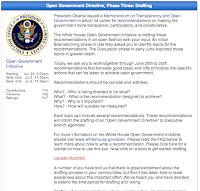
Open Government Initiative web sitePlease put on your to-do list and PARTICIPATE in this effort.

From the Open Government Blog at the White House
SAT, JUNE 27, 7:17 PM EST Extension of Phase III: Drafting of Open Government Recommendations
As of Friday, June 26th, there were well over 100 drafts of open government recommendations that you, the public, had written in Phase III of the public consultation process. The community of contributors grows by the hour, as word of this collaborative effort spreads.

A number of you have told us that there is great excitement about the drafting process in your communities, but that it has taken time to raise awareness about this important effort. We’ve heard you and have decided to extend the time period for drafting and voting.

Drafting of recommendations will now continue through 11:59pm Eastern Friday, July 3rd. Voting will stay open through the holiday weekend, until 11:59pm Eastern Monday, July 6th.

Spread the word and join the movement to help make government more transparent, participatory, and collaborative. Write, read, and rate recommendations at http://www.mixedink.com/opengov/ --Read the post on the White House blog.
The topics so far are
  • Transparency- including defining transparency, institutionalizing transparency, operations, more data online, improving access
  • Participation- including creating new opportunities to engage citizens, training people to participate, new media, agency e-rulemaking
  • Collaboration- including inter-governmental collaboration, public-private partnerships, online dispute resolution.
Don't see what you think is important? Jump in.

The White House is using a tool called Mixed Ink for the collaboration. It's a hybrid wiki that lets multiple authors update and comment, and also enables voting on changes for what they call "more consensual collaboration."

Don't be daunted by the tool. Poke around. Vote. Then go ahead and make some changes or add a section. Especially if this is what you have been asking for, and, let others know about this opportunity. This will be as good as we make it.

Now go! Do it!

Jun 23, 2009

It's Okay Not to Know-But How Will This Work?

0 comments
Empty goal, photo by henning via FlickrNextGov reports that would-be Recovery.gov designers face a moving target,
Web-design firms bidding on a contract to revamp the official stimulus-tracking site Recovery.gov face the challenge of building a prototype that must comply with unpredictable content requirements, according to procurement specialists and information access academics.

In October, agencies will be required to start transmitting reports from stimulus fund recipients to Recovery.gov, which is maintained by the Recovery Accountability and Transparency Board. But the details of what will go into those reports and the technologies that will dispatch information have not been finalized.--Read more on NextGov
It's great that the Board at Recovery.Gov is not creating a multi-volume set of requirements. In addition to lacking the time, the tortured requirements process is not a clear path to application success.

But what is the path to success?

A challenge in a project like this--especially when establishing a new work relationship--is to have client and vendor share the same expectations.

I hope that the RFP includes clear and specific goals for the site. I hope that it defines what success is--for the END USER. This definition will provide the touchstone to develop and evaluate features, to set appropriate phases of implementation, and to pull the plug on efforts going astray.

I hope that the project includes government program staff who are well-versed in the technology and who have the time to participate as partners, rather than observers. I hope, too, that their bosses trust them to do the work and make the decisions they need to make.

I hope that the people working on the effort spend most time coding, iterating, sharing, fixing and coding, iterating, sharing, fixing and fewer resources on updating project management software.

I hope that there is the courage to honestly say what's working and what's not, and to be able to say when a timeline is flawed or to jettison some one's pet feature in order to make the deadline.

And, I hope that the project goals are reviewed in every meeting to keep everyone aligned with the big picture.

Did I say goals were critical to success? This is especially key when there are so many unknowns.

Good luck!

Jun 18, 2009

New Utah Website Graded on Tasks

6 comments
The State of Utah launched a new, visually stunning web portal. Ari Herzog gives a great overview on his blog. 
Suffice to say, Utah and its portalized front page is at the forefront of the digital revolution among the 50 states. The new layout blows the other states out of the water.

From the press release on the new site, Utah CIO Steve Fletcher: "The new Utah.gov incorporates cutting edge technologies to enhance the user experience and the usability of the site. This site is ground-breaking in the effort to help citizens find information regardless of the level of government.”--Read and see more on AriWriter.

The sophisticated design offers a number of attractive animations that lead visitors down various navigation paths. Have a look.

screen shot of new Utah state website

Definitely sweet. So who wouldn't want to take it out on a test drive?

For my test, I decided to take it on a dot-gov tour to complete three tasks: get a new drivers license, find out what I needed to do to start a business in Utah, and find eldercare information, specifically I was looking for evaluations of senior living options.

New Drivers License. This is a common task so I figured it would be easy. I clicked the very nice top navigation item "Residents." It brilliantly and very usefully then exposed a series of options, "Citizens & Community" and right below that "Cars & Transportation." BINGO! 

Nope, had to hit the breaks hard. From here I could RENEW my drivers license, but not get a new one. Okay, to the search. It featured a smart search that provided options as I typed new drivers license.  Again, I got the option to renew, but not to get a new license. Back to the top navigation and I found the option "Moving to Utah." Here I could get a new drivers' license. Task was completed, but convoluted. I have a new driver and a new-driver-to-be in residence, so I would expect to find getting a new license as easy as renewing--but these are two different websites/applications.  Grade C-

Starting a new business in Utah. I imagined that I wanted to open a nail salon in Utah. I was in luck because prominently on the site, under "Popular Searches This Week" was a link to "start a business." Now here was the motherload of salient and helpful information. There was the "One Stop Business Registration"  which stepped me through the process. It was great because I could check it out without having to give up a lot of information about my "business." I easily found Government Requirements that led me to registration and licensing requirements. This was an easy to complete task. Grade A+

Finding eldercare resources. People with aging parents know the challenges of accessing eldercare services--especially across state lines. I pretended my mom lived in Utah and went through the exercise of finding senior assisted living options in the state and learning about consumer and regulatory ratings of facilities. I went back to the main navigation at the top and clicked on Residents. My first scans missed the option "Seniors.utah.gov." It would have been easier to find if it said simply "Seniors." It was the only option in URL-speak. Every other navigation option was a clear heading. 

I clicked on the Seniors.utah.gov page and turned to the Quick Links where I immediately saw "Housing & Living Arrangements."  At the top of that page is Licensed Utah Nursing and Assisted Living Facilities which includes NO resources for assisted living. So I backed out to the Housing Page and tried "Senior Community Housing," which led me to a page helping me understand "congregate housing," but that wasn't what I wanted. Back again to the Housing Page to "Guide for Retirement Communities." This, however, was not a Utah resource but a nationwide, commercial "finder." Of the eleven links on the housing page, only one went to a specific Utah resource. Either Utah does not have services for eldercare OR the state and local organizations that support seniors don't have web content. Grade D-

There is a reason that I don't like portals. They allow for silos and competing and overlapping content. There really is alot to like about the new Utah site, and I think it's a model for other state web sites. But, to be citizen-centric, it needs better integration and coordination of content.

Utah has been a leader in morphing services into dot-gov, and I expect that they will be at the forefront in helping to resolve the "problem of the portal." Because as challenging as the completion of these tasks were on utah-dot-gov, they are harder and even impossible on other state sites. It's clear that they are focusing on top tasks, just need more work under the hood. Good job Utah, help lead the way.

Jun 14, 2009

The Revolution, et.al., Will Be Twittered

0 comments
Crisis Camp retweet Tweet globally, act locallyAndrew Sullivan blogging on Iranians using Twitter and social media as telephones and television communications were being shut down:
Mock not. As the regime shut down other forms of communication, Twitter survived. With some remarkable results. Those rooftop chants that were becoming deafening in Tehran? A few hours ago, this concept of resistance was spread by a twitter message.

That a new information technology could be improvised for this purpose so swiftly is a sign of the times. It reveals in Iran what the Obama campaign revealed in the United States. You cannot stop people any longer. You cannot control them any longer. They can bypass your established media; they can broadcast to one another; they can organize as never before.--Read the entire post at The Atlantic. 
While it's too early to say what will happen, it's clear that people are using whatever conduits they find to communicate, especially during a crisis.

At the same time the situation in Iran was unfolding, Crisis Camp was happening in Washington, D.C.

Directory of sessions for Crisis Camp, Flood, Earthquake, Pandemic, Twister, Dirty Bomb, Last Supper-ArmageddonCrisisCamp DC started with one idea, "How can technology help people around the world during times and places of crisis?" Over the weekend about a hundred people got together to talk about how technology is or can be used for humanitarian relief. Industry, NGOs, responders, academics, public health, geek, non-geek and a few government joined to usher in a movement. 

Where else can you find sessions like Flood, Earthquake, Pandemic, Twister, Dirty Bomb, Last Supper-Armageddon, or the use of zombies as an example to help people think in new ways?

Government limits were also in the mix. Government can be slow, not willing to trust citizens as adults, hobbled by privacy and potential corruption, and too top-down when crisis is definitely felt and fought from the ground up (see Camp tweets for fuller flavor). A big theme was emphasis on listening rather then telling, adapting rather than knowing, and sharing. 

There has been discussion about authoritative sources for crisis information, and government is at the beginnings of understanding our role. We know what we know, but unofficial sources--real people--know what they are experiencing. Bringing these views and experiences together, with the help of smart smart people and technology, will define success and failure in future crisis. And, as everyone at Crisis Camp was well aware, on the ground this is real--survival and pace of recovery.

See notes from some sessions here, and as your interest is piqued,  join like-minded innovators at the Ning network for Crisis Camp. The hope is for the movement to go viral, with camps around the world working and sharing to best use technology in times of crisis.

Jun 11, 2009

Gov 2.0 Around the World

0 comments
Check out this dot-gov video from down-under--Australia. Matthew Hodgson's video on Gov 2.0 shows that the challenges are trans-hemispheric [okay, I likely made that word up].

From PDF's and static pages created by the "experts" behind the green shades talking about themselves in arcane governtmentese to a landscape full of choice, relationships, trust, and community.


Making government personal, real and relevant. Coming soon to a continent near you!

May 25, 2009

For Our Troops: VA Electronic Records and Thanks

1 comments
Flags at tombstones at Arlington National CemetaryToday is Memorial Day, a day to remember those who have sacrificed their lives because we have asked them to. There are no words to express both the awe for and the profound loss of these brave men and women.

Today also is a day to think about the many service men and women who have returned home. These vets are supported by the Veterans Health Administration and their award-winning electronic patient records system, VisitA. Yes, since 2006, the VA has model system of electronic health records which reduces costs and errors while increasing safety and efficiency. A few measures:
  • The cost of maintaining the system is $80 per patient per year, less than the cost of one unnecessarily repeated lab test.
  • The VA outperforms all other sectors of American health care across 294 measures of quality in disease prevention and treatment.
  • Patient waiting times have declined.
The VA's system is open source so it can be freely adapted and used by civilian hospitals. Currently, less than 2% of non-VA hospitals have a full-fledged electronic patient record. This is a great example of innovation in the government sector that can solve a universal problem. As health care reform heats up this summer, expect to see more on the VA's systems.

A bit off topic, two other links for Memorial Day. 

First, an incredible mashup using Google Earth called Map The Fallen-- a new online memorial to honor those service members who have fallen in Iraq and Afghanistan. You need Google Earth to see it, but please check out the video demo, it is truly amazing. 

Second, see www.tweettoremind.org for a small way to thank our troops. The campaign includes calls to tweet about your hero (@remind_org and #tweettoremind), share videos, and micro-fundraising. Five minutes and $5.25 isn't much to say, "Thanks!"

May 23, 2009

5 Social Media Memes Changing Government

4 comments
Red Boy Scout patch with number 5Federal Computer Week, reporting on a government leadership summit [sorry, too lazy to find out more about another one of these meetings prolly sponsored by some publisher or something] talks about five social media elements that will change the way the government works.  

My [very] loose roundup of the new memes are

1.  Where, once, government was leading on technology requirements, it is now one among many (competing) consumer interests. 
What I think this means: I've been at plenty of meetings where folks say "we're the government, we are huge, they want our business, they will change to meet our needs." But if a company's entire business model is advertisement, and government doesn't drive enough traffic, where is their incentive to destroy their income stream? If government wants to use the tools, we need to figure out how we can adapt.

2. Public engagement reveals the law of unintended consequences. 
What this means: Forays into social tools need to be flexible, and program managers need to keep an eye on results. None of us knows what will happen when we try something out--servers may crash, agencies may be overwhelmed with comments, the only response will be the chirps of crickets, or you might be stuck naming your international space station after a satirical opinionator. Good news for NASA on this last one--they saw an opportunity rather than a disaster.

3. Stop the analysis paralysis and make data available. 
What this means: Here is a big cultural change, from the government churning data into tables and reports that is delivered tied up in a bow to a dynamic process of developers unleashing the data to tell all kinds of stories. See #2. Also, expect a clamoring to open up more data sources.

4. It's the content, stupid!
What this means: Government can embarrass itself jumping into social streams without having anything to say. It's a conversation. It's a message. It's not just having a Facebook page or Twtitter account. It's not the technology, but the way that it's used.  So, if you say, "What's a hashtag?" you have no business putting your government agency on Twitter. Leading to #5.

5. This is the new way of the world. 
What this means: Despite old-fashioned concerns about employees goofing around (what's the difference between that sudoku book and YouTube, as far as productivity goes?) and real, to-be-addressed concerns about privacy and security, people are working, learning, collaborating and living differently. It's happening. And, even as some of the tools fall to the wayside and new ones developed, expectations of citizens and employees are out of the bottle. They can't be put back in.

Welcome to the changing government.

Read the FCW article I jumped off from, here. 

May 20, 2009

The Duty to Increase Technology Literacy

0 comments
Responsibility wristbandRobert Groves, President Obama's pick to lead the Census Bureau offered a new competency for leadership when he was before the Senate Committee on Homeland Security and Governmental Affairs.
Sen. Susan Collins, R-Maine, criticized the bureau's program to develop handheld computers..."It's really been appalling, after spending literally billions of dollars and much time, the Census Bureau scrapped its plans to use handheld technology for nonresponse follow-up due to significant performance problems and a loss of confidence in its contractors," Collins said.

[When Groves was] asked how he would correct problems associated with the handhelds. He said the IT issues stemmed partly from management issues and partly from an absence of research and development. Groves said he would ask the bureau's top leaders to become involved in all future IT projects.

"It seems clear in my part of the IT world, large-scale surveys, that successful hardware and software development has
the user involved at the beginning, middle and end," he said, adding the traditional model of developing a list of requirements and waiting for the product to be built no longer works. "Leadership at Census can't walk away from these contracts; they must be involved. This way you build a little piece, if it's not satisfactory, you throw it away." [my emphasis] --Read the entire article on NextGov.
At a time when all of our systems are running on technology, it's critical that leaders and managers have a basic competency in technology. This doesn't mean that program managers need to know how to code, bring up a server or reindex a database. 

It does mean that they need an understanding of the complexity of systems, the confidence to ask questions, and the knowledge to pull a plug or refocus efforts when necessary. It means they need to get beyond the promise of what can be to a cool-eyed assessment of timelines and requirements. It means that leaders need to develop trusted tech-counselors to help fill their technical gaps.

In 2009, leaders can't outsource or abdicate technology knowledge. They need to amass it. Amen, Mr. Groves.