Showing posts with label transparency. Show all posts

Jan 2, 2011

Doing Gov 2.0 Backwards in High Heels

2 comments
Ginger Rogers dancing with Fred Astaire backwards and in high heelsI was reading the awesomely comprehensive 2010 roundup of Gov 2.0 by Alex Howard and stumbled into a little Twitter dust-up between Alex and one of his readers, Microsoft's public sector evangelist, Mark Drapeau.

The twit-for-tat was around Mark's criticism that Gov 2.0 activities were focused on "govies, policies, and techies, and little citizens, services, engagement." He's right. There continues to be a lot of foundation-level work going on--like writing policies, creating governance, training, upgrading systems, cleaning up and making available data, etc. It makes it hard to see how this is having an impact on citizens and the public.

Then, Alex referenced Gov 2.0 impact on citizens
As the new year beckons, there are more ways for the citizens of the United States to provide feedback to their federal government than perhaps there ever have been in its history. In 2011, the open question is whether "We the people" will use these new participatory platforms to help government work better. The evolution of these kinds of platforms aren't U.S.-centric, either. Ushahidi, for example, started in Africa and has been deployed worldwide. The crowd matters more now in every sense: crowdfunding, crowdsourcing, crowdmapping, collective intelligence, group translation, and human sensor networks--O'Reilly Radar
Alex is finding some Gov 2.0 activity that is actually touching people. A good start, but how does this play for my sister in Indiana?

But, as Mark went on,
twitter image from Drapeau, Well @digiphile, government exists to serve all its citizens. Thusfar Government 2.0 mainly exists to serve wonks and geeks.
he and I part ways.

The heady newness of the Open Government Directive and the first forays into social media are over. We look back wistfully, like on the faded blush of a new romance. That was fun! But now we are left to work in the trenches to realize the promise. Much less sexy, but critical to success.

This year has included some very important new guidance--for example on surveys (Paperwork Reduction Act), privacy (including cookies and participating in 3rd party networks), plain language and prize authority to name a few--that agencies are trying to apply. And there is increasing scrutiny, oversight, and evaluation from both within and outside of agencies.

It seems that nothing breeds slowdowns like success. The layer of people who like things "the way they are" are not excited about new ways of interaction. And some are pulling the many levers at their disposal to doubly ensure that all T's are crossed and I's dotted.

Then, there are many early evangelists who are practicing what they were preaching. Being change agents in their agencies mean that they are less available to take to the pulpits of conferences and blog posts to proselytize across agencies.

I am neither a wonk nor a geek. I am a citizen, though. I am a citizen who works in government. And I am a citizen who works in a government built on--and sustained by--a massive command and control bureaucracy from a pre-Internet and social networking era. I am a citizen who works in this slow-moving behemoth and trying to make change for my fellow citizens, not to serve wonks and geeks.

Folks working in the trenches welcome the thoughtful criticism of outsiders. We don't have all the answers and have plenty of blind spots. Keep our feet to the fire, help us make change, and keep caring! But, I gotta tell you, from an insider's perspective, this is harder than it looks.

Nov 1, 2009

Yellow Brick Roadmap: Five Examples of Getting Gov 2.0 Done

2 comments
The Ruby Slippers and Dorothy from Wizard of OzSince my post talking about the frustration in talking about making government more transparent, participatory, and collaborative, I had an epiphany. We are all Dorothy Gale.

Dorothy, from the Wizard of Oz, wore magical ruby slippers that empowered her to do what she most wanted--return home to Kansas. BUT she couldn't unleash their power until she believed that she could. Crazy, no?

How did our heroine get to believing? Via real life experiences. So, for Halloween I will be a Good Witch and provide guidance in the form of examples of real agencies solving the problems in becoming the government that we want to be. Call it the Yellow Brick Roadmap.

So, what are the barriers and what are solutions that agencies have found?

Privacy: The Department of Justice (DOJ) unveiled a new website and a set of social media tools at the end of September. They addressed privacy issues in 3rd party web tools--like Facebook, YouTube and Twitter--head on with a comprehensive Privacy Impact Assessment. DOJ writes that
[T]hese third-party websites are not a part of the Department’s internal information systems nor will they be operated by a contractor of the Department, the Department does not and will not collect information from individuals when individuals interact with the Department’s social web accounts. While it may appear that information posted by third parties on the Department’s accounts is the Department’s information, such third-party postings are technically and factually under the dominion of the third-party social websites.
DOJ's construct may be a good model for other agencies. Read the PDF of Justice's Privacy Impact Assessment.

Employee Use of Social Media: The Government Services Administration (GSA) is a Federal agency that provides services and support to other government agencies. They published a social media employee use policy in July. This policy addresses agency expectations,
As the technology evolves, this order and its accompanying handbook will evolve, but in general terms, this order defines guiding principles for use of these technologies by GSA employees. The use of social media technology follows the same standards of professional practice and conduct associated with everything else we do. Common sense and sound judgment help avoid the most vexing issues.
Read the PDF of the GSA Policy for Employee Use of Social Media.

Legal barriers in standard 3rd-party terms of service agreements: This was the original show-stopper for many agencies trying to use social networks. The federal government could not agree to some clauses in standard agreements with social media service providers.

Since this problem was identified a year ago, government-wide agreements have been negotiated with You Tube, Flickr, Facebook, MySpace, and more with additional agreements in the works. This has been a collaborative effort with many agencies contributing time and lawyers including EPA, Commerce, GSA, Library of Congress and the White House.

While each agency will decide when and how to implement social media and social networking tools based on their priorities and strategies, a basic legal hurdle for all government has been cleared. See more on the process for using standard terms of service agreements on Webcontent.gov.

Strategy and process: Frankly, another barrier has been, how do you get started? A terrific model for people to learn from is provided by The Smithsonian, the world's largest museum complex and research organization.
This Smithsonian Web and New Media Strategy was created through a fast and transparent process that directly involved, and continues to involve, hundreds of stakeholders inside and outside the Institution. This strategy will feed into the Smithsonian’s comprehensive strategic plan, currently under development.
I'll quick stipulate that the Smithsonian is not a typical government agency, yet their approach can be modified to fit the culture and needs of any agency. First, tie new media to the agency strategy. Second, appoint a leader with decision-making authority. Third, create a tactical road map. Fourth, create a funded unit that will implement the strategy.

Before people [you!] start to moan about how hard this is, nobody said it would be easy. The Smithsonian, however, is showing a way. See all the details at the Smithsonian Web and New Media Strategy Wiki.

Transparency & Open Government. While the long-awaited Open Government Directive is not yet published, the President's January 21st call for a more transparent, participatory and collaborative government has already made an impact.

The Department of Health and Human Services and Department of Homeland Security have undertaken dialogues with stakeholders to strengthen not only services but also strategy. The Open Government Directive development process itself has included public brainstorming and a wiki to help develop the policy. Each of these projects and tools are part of the learning process to make open government robust and meaningful. It's already happening.

This Yellow Brick Roadmap to real accomplishments is meant to help people [you!] believe that we are making progress opening up government. And, to show concrete examples that can be leveraged by people [you!] trying to make progress in your own agencies.

The path to success is recognizing that we [you!] are already on the path, that you have the tools/ruby slippers and it's up to you to make it happen. Got it?

Have more examples with enough resources for folks to replicate? Add to the comments below. Then, pick up your basket and your little dog, too, and follow the Yellow Brick Road!

Oct 26, 2009

Shorts: Twitter Grows, Report Cards, Drupal and Memos

1 comments
Twitter grows. Pew released some data last week about growth in Twitter use--from 11% of Internet users to 19% in just six-months. Other findings? Three groups of internet users are mainly responsible for driving the growth of this activity, social network users, people who are using mobile and folks under age 44. See more at the Pew Internet Project.

White Paper Report Card. Candi Harrison asks, "Web Manager Council’s White Paper – Is There Progress A Year Later?" In her post she recaps the goals of easily identifiable, relevant, accurate, and up-to-date information that is easy to understand, addresses citizen tasks, is consistent across channels, provides feedback channels and is accessible across reading, ability and language barriers. She gave government a mixed review. See more here.

White House goes Drupal. And TechPresident swoons as they announced that whitehouse.gov has moved to Open Source Software and dropped their proprietary system. I am not sure that this is a great advance for democracy--bottom line is that there will be a custom (read proprietary) system built on the open source platform. But it is good for open source. See more at TechPresident.

Finally, NextGov reports, no movement from White House on the issuing of the Open Government memo that the President announced January 21. See Next Gov.

Oct 18, 2009

Talk Talk vs. Do Do

11 comments
Hot air balloonJust what we need to move the policy discussion forward, another conference?

Back in March, Mark Drapeau from National Defense University wrote about the mid-life crisis of gov 2.0.
Government 2.0 has reached its midlife crisis. Despite some leadership from influential individuals on using social software in government, there is still in many cases a disconnect between authorities issuing directives and ground troops carrying them out...Resistant to change and adhering strictly to doctrine even when nonsensical, people in the clay layer can halt progress. Despite their intentions and being in a strategic position, they often stop the progress being called for.-- Read more on ReadWriteWeb
The solution? A conference. The wonderful Government 2.0 Camp in March attracted a huge number of government (federal, state and local as well as some international) and private sector attendees to talk about government 2.0 and learn from each other.

In July, Jaimie Maynard, a federal staffer, blogged about her post-conference low after the Open Government and Innovations Conference.
All web 2.0 conferences are all starting to look exactly the same. Many speakers come from agencies that are boldly using social media in a new and exciting ways, and many more "believers," who are not allowed to use those same technologies, come to hear about it. But the status quo remains the same...DoD, NASA, The White House are getting things done, but as a method to further collaboration and expand the use of social media, [the conference] failed. We need specifics: case studies, business case strategies that succeeded to support any/all of these tools, etc.
So, now it's October and there is another lament that Government 2.0 is failing or flailing. The Gov 2.0 conferences of the fall--O'Reilly's Expo and Summit--felt like just alot of talk by the same people about the same things.

Brian Drake from Deloitte blogs,
How we can get more people, enthusiasm, and get some tough issues on the table. The one group we continue to not hear from are the detractors or skeptics of social software...In addition to the slim number of public, cogent arguments against Government 2.0, our own discussions about failures are truncated. I’m noticing our Government 2.0 conferences either trumpet the achievements of the few or recast a failure as a success.--Read more on Brian's blog.
So the wrong people are coming to the conference. The solution? Another conference. This one to focus on the "Shortfalls of Gov 2.0" and attract people who aren't coming.

Steve Radick, from Booz Allen and a member of the "Goverati," offers a three part solution.
  1. Realize that not all is perfect in the land of Gov 2.0
  2. Identify the skeptics and open up a dialogue with them
  3. Hear the war stories of the people who have gone before us --Read more from Steve's blog.
And, a conference about Government 2.0 Shortfalls.

Underlying this most recent discussion is the idea that people are unaware of the barriers, arguments against, downsides to Government 2.0. I want to clarify that assumption.

People who actually work in government are well aware of the barriers and arguments against Government 2.0.

Yes, we already know. We don't need to talk about it at another conference. We need to fix it. The problems and issues have been defined and discussed since last year. A few quick examples,
  • In December 2008, the Federal Web Managers' Council published, "Social Media and the Federal Government: Perceived and Real Barriers and Potential Solutions" (pdf) This paper identified challenges with strategy, access, legal, privacy, advertising, ethics, accessibility, and the Paperwork Reduction Act. The paper also offered concrete recommendations to overcome these barriers.
  • In June, the Office of the Chief Privacy Officer at the Department of Homeland Security held a two-day workshop to explore best practices to implement the President’s January 2009, Transparency and Open Government Memorandum. In addition to Gov 2.0 advocates, panelists included a variety of viewpoints including privacy advocates, civil liberties organizations, security professionals, and differing legal opinions.
  • Last month, the Federal CIO Council security workgroup published Guidelines for Secure Use of Social Media by Federal Departments and Agencies identifying issues and recommendations to address security issues in social media.
While government 2.0 is bigger than social media much of the privacy, security, procurement, ethics, and laws and regulations issues are the same.

AND, many of us in government also know that there are some "successes" that have leap-frogged some hurdles and were implemented because leadership demanded that something be stood up. Agencies are playing catch up.

Gartner's Andrea DeMaio blogs very thoughtfully on government and technology changes. He recently said,
I am still amazed to see how little employee-centricity there is in today’s government 2.0 conferences, debates, positions and articles. It is as if employees were considered legacy, just part of an organization that will be transformed, and not the real fuel and soul of those organizations.

Until when their role will be given equal dignity as “citizens”, government 2.0 will remain an interesting subject for discussion, will marginally contribute to service improvement, but won’t realize a fraction of its potential.--More on Andrea's blog
I think that Brian and Steve make excellent points in their posts. I am not opposed to a conference to discuss the shortfalls of Government 2.0, but I am unsure about the payoff. What do we gain? How does it affect the policy? That's where the rubber meets the road. When will we have guidance on records? Can we make better sense out of the limits on advertising? Why does each agency need to do a privacy impact assessment on YouTube or FaceBook? Are the issues the same across government? How can we move the incentives (i.e. money) to reward cross-agency efforts? To gain efficiencies and reduce redundancies? To break down silos? To improve innovation?

Here's the challenge, because if we aren't getting to these solutions, it's just more hot air.

Sep 27, 2009

When You Wish Upon The Cloud

1 comments
In which Pooh decides to imitate a cloud in order to trick the bees into not realizing that he is after their honey.Government cloud computing is being touted as the next new thing. Promises of cheaper costs and a reduced carbon footprint, along with consumer experience with the ease of free e-mail and document sharing via "the cloud" makes it a no-brainer. And, bonus, instead of using out-dated government computing structures, the commercial cloud promises innovation and flexibility.

It's not necessarily easy, though.

First, a reminder that cloud computing is real. There are physical servers in physical server farms. It's important to remember that The Cloud is made up of data centers running 24/7/365. There are racks and racks of blades, power supplies, spare parts, monitoring tools and data center staff. These servers and computing capacity are shared by The Cloud tenants. The Cloud is excess computing capacity from the likes of Amazon and Google. The Cloud is not frozen water crystals or fluffy cotton puffs. It's not magic. The Cloud is physical. Learn more about The Cloud here.

This is important because issues with cloud computing are real, too. And real is the backbone of my wish list for government cloud computing. I wish for

Analysis of the risks. Some security experts are very concerned about the security of cloud computing. Casey Coleman, CIO of the General Services Administration, said, "Something like 45 percent of the IT portfolio is ranked at a FISMA certification level of low. What that means is that those applications and that data are candidates for running on some sort of commercial or hybrid cloud service." [Read more from Coleman in Federal Computer Week.] So, what can securely be run in a cloud environment? What can't be? And no cheating on the analysis because the idea of the cloud makes you nervous. Be real.

Analysis of the costs. It makes intuitive sense that money can be saved by sharing computing resources, but the devil is always in the details. Consumers think that software and storage is free--Facebook, Gmail, Google Docs--but they pay by viewing advertisements. Will some applications and storage be on a commercial cloud? Will government data centers shut down? Will they connect and share computing power to become a gov-cloud? Will government share applications with commercial and retail tenants? What would it cost? What about software licensing? Cloud-wide software licensing agreements? Money is real, too.

Useful cloud services. I want to improve accessibility of content by having captioning, live captioning, and translation services on demand. I want a government-wide blogging platform like Blogger for Government. The Department of Defense is already doing this in the dot-mil domain--DoD Live, Army Live, Air Force Live, Coast Guard Live--using a common Wordpress install. I want to be able to transfer large files securely from agency to agency using a cloud FTP server. I want a platform solution for posting multimedia and conducting surveys. I want easy access to website analytics--and, better yet, a way to compare the traffic data across agencies. I want government-wide options for search, dialogue, white pages, email, relationship management, instant messaging. And, I want the service whether it's available on the GSA schedule or via another purchasing option. No reason to be parochial in The Cloud.

What I want from the government cloud. Quicker--like "just in time"--purchase and implementation of tools that are being used in government. Removing roadblocks and silos that make government function like hundreds or even thousands of governments instead of one. Each of these mini-governments have their own ways to buy, their own ideas of security, their own interpretations of the Privacy Act of 1974, their own cookie policies, their own implementations of accessibility guidelines, and their individual risk tolerances. This makes sense for individual agencies who know their particular niches, but it makes no sense to the people--businesses, NGOs, staff, citizens--who need a simple answer and a single conduit to find it. Last, and not the least, I want citizens to control their own identities and to manage their relationship with government not on a per-agency basis but in a system that recognizes that they are whole people. This would make a real difference in the way government does business.

Now, keeping it real, what are YOUR wishes for the government cloud?

Sep 17, 2009

Serving the Public Better, Together

3 comments
Bev Godwin, Director, USA.gov and Web Best Practices at U.S. General Services Administration, gave a warm shout out and outlined the incredible accomplishments of the government web manager community at the Gov 2.0 Summit.


During the Summit, when people were discussing barriers and success factors, time and again they repeated the mantra, it's not about the technology but about the people.

Did you know that 1,600 web managers participate in an open, collaborative, sharing community with the goal to make the best government websites in the world? Across local, state and federal agencies, school districts, departments? Breaking down silos and working with IT, legal, records, procurement, and program staff?

For more on how federal web managers collaborate and information on best practices and how to better serve citizens using the Web and new media see webcontent.gov.

As Bev said, "Let's stop this madness and get organized!"

[so's you know, I am a proud member of this community.]

Sep 13, 2009

Searching for My Inner Craig

1 comments
Topic One at the big Government 2.0 Summit here in Washington last week was "What is Gov 2.0, and how do we get there?"

This isn't a new question. Twenty-seven months after HHS launched the first Cabinet-level public discussion via a blog, we are still trying to define both the destination and the journey.

My own embrace of a new, open, transparent, participatory and collaborative era of government is shackled by the fact that I am an implementer. I don't get to sit on the sidelines and make smack-talk. I have to figure out how to make this work operationally, legally, and effectively for a federal agency. And, I would be a big, fat liar if I didn't admit that it is harder than it looks and more than a little scary [insert your favorite "not safe for work" link here].

This is where my unknowing mentor Craig comes in. Craig, the man who put the Craig in Craigslist, has been successfully herding cats--by not trying to herd them--on the humongous, world-wide online classified ad site and community he founded in 1995. He's also an active advocate of improving government services.

I've been studying Craig's zen-like approach to service and communities as a model to help me with Gov 2.0. In searching for my inner-Craig I've begun to identify some "truths" to help in actualizing open, transparent, participatory and collaborative government.

Truth 1 Trust. Craig says, "Most people are trustworthy and good and want to treat other people like they want to be treated." While this seems easy, in a bureaucratic, conservative command and control organization--like the government--it's easy to get stuck on the word "most." Since not everyone is a good guy, risk-averse organizations develop structures and policies to treat all comers as if they were "bad." Michele Weslander Quaid, CTO for the Office of the Director of National Intelligence, said that ODNI hired a risk manager to help make decisions based on risk/reward. By identifying potential risks and the chance the event will occur, government can develop policies that make sense. Working from fact, not fear, lets us trust people to do the right thing--even when it's something we didn't expect--and get out of their way.

Truth 2 Patience. Government social media and transparency efforts are in their infancy. We need to take the time to build out a process. It won't happen overnight. Craigslist grew organically in the Bay Area for years. There were trials and lessons learned to apply to new cities as it gradually expanded over a decade. This isn't to say that we need to slow down efforts, but that there will be successes and failures. We need to learn from both. It's like a three act play. After the heady first act of new blogs, video sharing and wikis, we are now in the long second act where the heroes are tested and do battle, make mistakes and learn how this works. We are still a ways from the climax and dénouement of Act III. We can't rush the story.

Truth 3 Customer service is public service. It's easier to have all the answers than to spend time listening to your audience. It's also not a successful strategy. For government, our audience--our customers--are the American people. We don't make government for the sake of government. We make government on behalf of, and in service of the people. So, its up to us to get out of our cubbies, our jargon, and our assumptions and get out of the way of the information and services people need. Behind Craigslist is the philosophy that people are basically good and their needs fairly simple (see trust above) so a minimal structure led by user needs will let people work things out by themselves. Government should not direct the user, the user directs the government to meet their needs.

Danielle Blumenthal is getting at this in her recent blog post.
Silence is not the answer. Jargon is not the answer. Long sentences and self promotion are not the answer. Let's stop talking to ourselves in a haze of groupthink and fear and start having real conversations about who the customer is (the public) what they want and need to hear (the truth) and how we need to say it so that they really get the message (any method of communication that works).--More from Branding and Social Media.
Knowing the truths is not the same as truly incorporating the truths. I am not all the way there, but I have a path. And I am working on it.

Thanks Master Craig, from Grasshopper Gwynne.

[For more on Craig, check out his blog or the recent Wired Magazine feature on him. ]

Aug 2, 2009

If You Build It, NOT: 4 Pointers for Search Optimization

5 comments
The field of dreams baseball players appearing out of the magic corn field walking on to the magic baseball fieldIt's a MYTH! A MYTH! A MYTH I TELL YOU!

Just because you build it, nobody will come. Sure, you announce to your friends and stakeholders, but then what? There will be no miles long trail of cars snaking through cornfields to experience your vision. It's a movie. And a myth.

Yes, viral is important, but you can't manufacture true viral. It just happens.

I have been calling out this myth for 12 years. And, in this time of fractured media and spliced attentions, it is critical to be level-headed and recognize that there is effort involved in driving traffic. Launching your website or application is not the end. You need to help folks find it.
Eighty percent of all online sessions begin with search. Google alone has a 63.7 percent share of all searches. Some quick math tells me that this means that just over half of the time someone starts an online session, they open to Google and begin to search. Bottom line: Most of the time people go online, they start with a search -- and don't type in your URL.

Instead of typing in your URL and ending up on your site, people are using search engines to find what they are looking for. The question is: Will they find you? You might not like the answer.

It turns out that the top three listings on a search engine results page account for approximately 63 percent of all clicks. That is, about two-thirds of the time, people look no further than the first three listings before clicking. So, clearly that's the place to be. --See
more from Jonathan Richman at I Media Connection
There are many books, blogs, websites and experts on helping people find you (also known as search engine optimization). My purpose today is to start you thinking about making your content more accessible to search engines. Here are four starting pointers.

1. Don't be cute. Search engines look for clues on your pages to let them know what the page is about. They usually think that titles and headings provide pointers to what is important. So, every time you create a cute name for your page and use teaser language for your headers instead of clearly telling and leading readers (and search engines) about your purpose, you are turning them away.

2. Use normal words. Speaking of not knowing, search engines can't translate your arcane, governmentese into something findable. Especially when you are using your own special language. You may love your acronyms, but the uninitiated will not have a clue. No clue means they can't find you.

3. Seek out resources. You can learn about words people use to describe your services. Your site search should report the words that people are searching on. If they are looking for "green card" and you only use the official name "LPR," you are turning them away. And away means to another source. Also, visit the Google Keyword Tool to learn related words and phrases. Incorporate these words into your pages.

4. Select some pages and make changes. Identify a few terms and their pages you want to drive people to. Update the page title, headers and copy with the normal words. Check your progress by searching on these terms on Google, Bing, YAHOO, Ask. The results are easy to see. Also see MarketLeap.com for quick keyword verification across multiple search engines.

Now go do some more research, you might want to start with Search Engine Watch. And feel free to share your own resources and tips in the comments below.

Jul 30, 2009

Pulling the Plug on Underperforming IT Projects

2 comments
The Department of Veterans Affairs pulled the plug on 45 problem IT projects, pending further evaluation to see if they should continue.
In preparing data for the so-called IT Dashboard, a site that offers a window into the complex and costly process of procuring government IT services, VA officials discovered problems with some of the agency's IT projects. For example, while sifting through the data, VA Secretary Eric K. Shinseki and CIO Roger Baker learned that a scheduling project was running 17 months behind schedule, Kundra said.

Shinseki and Baker announced on Friday that they temporarily stopped development of 45 projects that are either behind schedule or over budget to determine if they should be canceled or salvaged.--Read more on NextGov.
The IT Dashboard allows users to learn more about information technology projects, like the VA's Health Data Repository, a $28 million project that is way behind schedule.


In addition to cost and schedule information, you can easily learn the purpose of the project and review other official documentation. And, very importantly, you can provide your thoughts to the CIO on specific projects.

This project is a tough one for agency CIO's. They are required to very publicly report and evaluate their projects. Many of them are responsible for projects that they didn't approve and in some cases went sour before their arrival. But it's important to begin to get an honest handle on IT projects and expenditures. And it's even more important to do something about them.<

Bravo to the VA, and bravo for this new transparency resource.

Jul 17, 2009

What Is the Most Important Thing?

4 comments
My desk phone rang at 7:00 p.m. "Go Home!" said the caller.

Of course, he was glad to have caught me, and we had a quick confab about social media. And the arrows all pointed at the disruptive communications technologies that are social media.

The early days of ignorance and bliss are gone. The days when government staffers innocently clicked the button that said, "I agree," and opened up the Pandora's box of Facebook, YouTube, AddThis, Feedburner, MySpace, and Twitter.

Those few days when the Internet was free and open--a new, more transparent, collaborative and participatory way--for government to communicate and interact with her citizens. The days before the inevitable crush of rules and regulations, of some CFR thingie and the threat of potential hearings, made us grow up and take notice of what we had unleashed.

So today's discussion with my friend was about one of the regulatory tigers [link to pdf]. It doesn't matter which one because they are all important. Could be security. Could be privacy. Could be protecting the record of how a decision is made. Could be ethics. Could be cramming the Internet pipes of an agency with who knows what. Could be the sovereignty of the United States of America, for goodness' sake!

They are all important. And so is embracing the uncertainty and risk of this new more transparent, collaborative and participatory way for government to communicate and interact with her citizens.

Amazing photo of traffic circle by Nikolas R. Schiller, Los Angeles, Calif April 2008
We are now standing in the middle of an incredibly busy intersection of dozens of important interests. Working through the interests, it sometimes seems that these important interests don't know or recognize that they are all part of the same ecosystem. An ecosystem that is not yet in any balance. And, as each of the interests advocate vociferously for their needs, the shape of the discussion distorts.

My friend @bashley said, "We'll know #gov20 has come of age once it's cross-examined as if a defendant before a magistrate, awaiting sentence."

We are trying to build the perfect traffic circle. A circle in which all the interests enter into the traffic flow--the flow of this new more transparent, collaborative and participatory way for government to communicate and interact with her citizens--without colliding, without impeding the stream and without giving too much favor to any one interest.

Jun 28, 2009

Phase III of Open Government Initiative Extended

0 comments
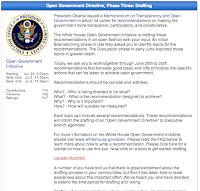
Open Government Initiative web sitePlease put on your to-do list and PARTICIPATE in this effort.

From the Open Government Blog at the White House
SAT, JUNE 27, 7:17 PM EST Extension of Phase III: Drafting of Open Government Recommendations
As of Friday, June 26th, there were well over 100 drafts of open government recommendations that you, the public, had written in Phase III of the public consultation process. The community of contributors grows by the hour, as word of this collaborative effort spreads.

A number of you have told us that there is great excitement about the drafting process in your communities, but that it has taken time to raise awareness about this important effort. We’ve heard you and have decided to extend the time period for drafting and voting.

Drafting of recommendations will now continue through 11:59pm Eastern Friday, July 3rd. Voting will stay open through the holiday weekend, until 11:59pm Eastern Monday, July 6th.

Spread the word and join the movement to help make government more transparent, participatory, and collaborative. Write, read, and rate recommendations at http://www.mixedink.com/opengov/ --Read the post on the White House blog.
The topics so far are
  • Transparency- including defining transparency, institutionalizing transparency, operations, more data online, improving access
  • Participation- including creating new opportunities to engage citizens, training people to participate, new media, agency e-rulemaking
  • Collaboration- including inter-governmental collaboration, public-private partnerships, online dispute resolution.
Don't see what you think is important? Jump in.

The White House is using a tool called Mixed Ink for the collaboration. It's a hybrid wiki that lets multiple authors update and comment, and also enables voting on changes for what they call "more consensual collaboration."

Don't be daunted by the tool. Poke around. Vote. Then go ahead and make some changes or add a section. Especially if this is what you have been asking for, and, let others know about this opportunity. This will be as good as we make it.

Now go! Do it!

May 29, 2009

Shorts: Open Gov Dialogue, Smithsonian Future, SocMed Personalities

0 comments
White House Closes Down Phase I of Open Government Dialogue, Preps for Next Phase. After receiving 900 submissions and 33,000 votes on ideas ranging from strategies for making government data more accessible to legal and policy impediments to transparency, the White House closes the Open Government dialogue at opengov.ideascale.com (hosted by the National Academies of Public Administration). All materials will be reviewed along with comments received from government employees in March. The goal is to use ideas from the first phase to "inform deeper discussion." The White House wanted to clarify that while "the voting on the brainstorming submissions will be instructive, it will not determine which topics are discussed in the second phase." A little confusing, too, is that the brainstorming tool will remain open for the lively dialogue through June 19, it just won't inform the process (?). More on the next steps on WhiteHouse.Gov.

The Smithsonian Crowd-sources for It's Future. The grand museums(s) on the Mall is hosting a discussion on YouTube. They are "looking for a few friends and fans from around the world to help us form the future Smithsonian experience. A revolutionary Web and New Media Strategy project is underway, and we invite you to collaborate with us as we envision a rich new media future for the Institution." They are asking people to join their group on YouTube and submit a <1 class="Apple-style-span" style="color: rgb(192, 192, 192); ">More on Smithsonian's channel.  [A little funny because the "conflict" for Night at the Museum 2, filmed at Air and Space, includes a rant against the modernization of the museum experience.] 

What’s Your Government 2.0 Personality Type? Steve Radick creates a fun set of social media archetypes ranging from the Edgerider--an early-adopter of all things technology always looking for the latest and the greatest Internet meme, idea, and initiative--to the Skeptic who asks, “Why the hell are you spending so much time on Twitter and Facebook when you could be doing real work?" And a bunch in between. See if you can find yourself at Social Media Strategery.

May 23, 2009

5 Social Media Memes Changing Government

4 comments
Red Boy Scout patch with number 5Federal Computer Week, reporting on a government leadership summit [sorry, too lazy to find out more about another one of these meetings prolly sponsored by some publisher or something] talks about five social media elements that will change the way the government works.  

My [very] loose roundup of the new memes are

1.  Where, once, government was leading on technology requirements, it is now one among many (competing) consumer interests. 
What I think this means: I've been at plenty of meetings where folks say "we're the government, we are huge, they want our business, they will change to meet our needs." But if a company's entire business model is advertisement, and government doesn't drive enough traffic, where is their incentive to destroy their income stream? If government wants to use the tools, we need to figure out how we can adapt.

2. Public engagement reveals the law of unintended consequences. 
What this means: Forays into social tools need to be flexible, and program managers need to keep an eye on results. None of us knows what will happen when we try something out--servers may crash, agencies may be overwhelmed with comments, the only response will be the chirps of crickets, or you might be stuck naming your international space station after a satirical opinionator. Good news for NASA on this last one--they saw an opportunity rather than a disaster.

3. Stop the analysis paralysis and make data available. 
What this means: Here is a big cultural change, from the government churning data into tables and reports that is delivered tied up in a bow to a dynamic process of developers unleashing the data to tell all kinds of stories. See #2. Also, expect a clamoring to open up more data sources.

4. It's the content, stupid!
What this means: Government can embarrass itself jumping into social streams without having anything to say. It's a conversation. It's a message. It's not just having a Facebook page or Twtitter account. It's not the technology, but the way that it's used.  So, if you say, "What's a hashtag?" you have no business putting your government agency on Twitter. Leading to #5.

5. This is the new way of the world. 
What this means: Despite old-fashioned concerns about employees goofing around (what's the difference between that sudoku book and YouTube, as far as productivity goes?) and real, to-be-addressed concerns about privacy and security, people are working, learning, collaborating and living differently. It's happening. And, even as some of the tools fall to the wayside and new ones developed, expectations of citizens and employees are out of the bottle. They can't be put back in.

Welcome to the changing government.

Read the FCW article I jumped off from, here. 

Apr 26, 2009

Recovery Dialogue: IT Solutions

2 comments
recovery dot gov logoAnnounced on the Recovery.Gov Website:
Starting...April 27, The Recovery Accountability and Transparency Board and the Office of Management and Budget in partnership with the National Academy of Public Administration, will host a national online dialogue to engage leading information technology (IT) vendors, thinkers, and consumers in answering a key question:

What ideas, tools, and approaches can make Recovery.gov a place where all citizens can transparently monitor the expenditure and use of recovery funds?

Participants from across the IT community will be able to recommend, discuss, and vote on the best ideas, tools, and approaches. Your ideas can directly impact how Recovery.gov operates and ensure that our economic recovery is the most transparent and accountable in history. Mark your calendars and check back for the web link. Click here for more information.--See more on Recovery.GOV
This project is part of a partnership with the National Academy of Public Administration (NAPA). which sponsors the most excellent Collaboration Project. The Collaboration Project is creating a set of case studies on the best uses of collaborative technologies and new media in government. They also sponsored a national discussion on health information technology and privacy.

The Recovery Accountability and Transparency Board is asking for  help around five key areas
  • Website Design
  • Data Collection
  • Data Warehousing
  • Data Analysis and Visualization
  • Waste, Fraud, and Abuse Detection
  • Other topics that are key to achieving greater transparency and accountability
For starters, I have a minor suggestion:  stop asking visitors to click through to a PDF for more information. Information is much more accessible when it's not buried in a PDF. More transparent, if you will. 

Anyway, this is a great opportunity for a government agency to learn what people want, need and expect. I look forward to logging in this week--the project is open for seven days--and providing some substantive feedback. Hope you do, too!

Mar 22, 2009

Open Data: Compare and Contrast

0 comments
Lock labeled Privacy. (Image Rpongsaj/Flickr)Soon after I posted on the very open and collaborative project at the U.S. Geological Survey, Wired had a post on the other side of the coin, Officials Hoard Valuable Databases Funded by Taxpayers
Government agencies across the country are sitting on gigabytes of valuable digital data that could be mashed, mixed and re-organized in crafty ways by Web 2.0 entrepreneurs and public interest groups engaged in everything from government oversight, to providing practical information to Americans.

Yet, despite federal and state public records laws designed to make the data accessible, many agencies are fighting more ferociously than ever to keep data created with public funds out of public hands. In their battles to withhold information, bureaucrats are citing everything from copyright and trade secret privileges to privacy and national security concerns. -Read more on Wired.
It's the clash of the titans. In one example from Wired, a nonprofit requested anonymous information about patient diagnoses, along with the physicians' identifying number, the procedures performed and amounts billed to Medicare to help match patients to experienced doctors for specific procedures and to determine if practitioners were over-billing Medicare or receiving government funds for high-risk procedures they didn't have the experience to perform. The nonprofit wanted to make this information available to consumers via their website. But the U.S. Department of Health and Human Services--parent of Medicare--denied the request on grounds that it violated doctor privacy by disclosing physician incomes.

And therein lies the rub for more than a few datasets: individual privacy and personally identifiable information (PII). Information that had been gathered painstakingly using paper and data cards and maps stored in City Hall are now much easier to put together and much easier to access. And data gathered for one purpose might be very useful for another, unrelated purpose. One that the data owner did not necessarily agree to. 

Government under the Privacy Act has an obligation to protect citizens' privacy. The Privacy Act states in part:
No agency shall disclose any record which is contained in a system of records by any means of communication to any person, or to another agency, except pursuant to a written request by, or with the prior written consent of, the individual to whom the record pertains... (See the Department of Justice for the Privacy Act of 1974).
We are experiencing a huge shift in data accessibility. 

Example of Big Shift #1: When we were buying our house in the early 1990's, I had to go downtown during "business hours" to research the amount of money that the current owners paid. [They were claiming that they were going to lose money on the transaction, and the data showed otherwise!] Now, anyone can go to WashingtonPost.com and see the price we paid. 

Example of Big Change #2: A few years ago, we used to call people to get directions to their houses. (Make a right at the second light there's a 7-11, then you'll drive by the house with the gnomes...) Now you give me a number and street, I can easily get specific directions--and even a picture--of your nearby Starbucks or your house. From my GPS enabled cellphone.

So what?, you say. Well, the Supreme Court, privacy advocates, and just plain people who don't want everyone to know how much money they make are concerned about making private information--or information that they consider private--easily available and combinable online. The barriers of time, location, and, even, expertise have fallen away. It changes the entire game.

In many, many cases, the PII can be scrubbed from the data set. But in some subset of cases, when data sets are combined, PII is exposed.  

This is the true clash of the titans--transparency versus privacy. The public versus the personal. Increasingly, it is government between these two giants, trying to balance and move forward (okay, and to be honest, sometimes playing one against the other to meet other, less pure objectives).

We live in interesting times. There are real problems to solve. We got some work cut out for us. 

Mar 16, 2009

Thinking the Unthinkable in Gov?

5 comments
Guttenberg Press, clipart courtesy of FCITClay Shirky's latest blog post, Newspapers and Thinking the Unthinkable, has got me thinking and thinking, some of it may be unthinkable for dotgov.
Revolutions create a curious inversion of perception. In ordinary times, people who do no more than describe the world around them are seen as pragmatists, while those who imagine fabulous alternative futures are viewed as radicals. The last couple of decades haven’t been ordinary, however...

When reality is labeled unthinkable, it creates a kind of sickness in an industry. Leadership becomes faith-based, while employees who have the temerity to suggest that what seems to be happening is in fact happening are herded into Innovation Departments, where they can be ignored en masse. This shunting aside of the realists in favor of the fabulists has different effects on different industries at different times. One of the effects on the newspapers is that many of their most passionate defenders are unable, even now, to plan for a world in which the industry they knew is visibly going away.

While Shirky is talking directly about the newspaper industry, he is also talking about our current world and all our communications and interactions. Including those interactions that kept people at arms' length from government--finding the legislator, writing a letter, addressing and mailing the letter; or making appointments to stand in line at the DMV; or even knowing that there was a regulation that affected your neighborhood or industry that you might find, read, and write or fax a comment about--are falling around us.

The printing press didn't just give us books, it gave us literacy.

That is what real revolutions are like. The old stuff gets broken faster than the new stuff is put in its place. The importance of any given experiment isn’t apparent at the moment it appears; big changes stall, small changes spread. Even the revolutionaries can’t predict what will happen. Agreements on all sides that core institutions must be protected are rendered meaningless by the very people doing the agreeing. (Luther and the Church both insisted, for years, that whatever else happened, no one was talking about a schism.) Ancient social bargains, once disrupted, can neither be mended nor quickly replaced, since any such bargain takes decades to solidify.

And so it is today. When someone demands to know how we are going to replace newspapers, they are really demanding to be told that we are not living through a revolution. They are demanding to be told that old systems won’t break before new systems are in place. They are demanding to be told that ancient social bargains aren’t in peril, that core institutions will be spared, that new methods of spreading information will improve previous practice rather than upending it. They are demanding to be lied to.

So when you ask me what this means, I can't tell you. We are living it. And it is happening all around us. And someday we will know the results. Right now, though, citizens are demanding services to be delivered with an immediacy they expect from Amazon or Craig's List or Netflix or Hulu or Limewire.

People will ask, why are you making a four color tri-fold brochure? I just want the information on my cell phone. Why can't I access my student loan information online from my own bank? Why do you have a paperwork reduction act and then make me fill out a form in triplicate, asking me for the same information I gave you before? Why can't I look at a bill 5 days before the President signs it? And more importantly, why can't it be written in English? Can't we get the clever bloggers to rewrite it?

And many people serving in government will be confused. Some will resist. Some will be the experimenters. But no matter what, we are living in a time of great change.

So, what are the unthinkable thinkings for our government?

Read Shirky's entire post here.

Mar 1, 2009

Transparency Camp Building a Path Forward

2 comments
Had the very good fortune today to attend Transparency Camp sponsored by the Sunlight Foundation.
This un-conference is about convening a trans-partisan tribe of open government advocates from all walks — government representatives, technologists, developers, NGOs, wonks and activists — to share knowledge on how to use new technologies to make our government transparent and meaningfully accessible to the public. --More on Transparency Camp
I haven't been to an "un-conference" before. Attendees put together the agenda on the fly, with sessions developing and held in available rooms. The real value is the convening of a great assemblage of geeks, consultants, practitioners from dot-gov both executive and leg branches, nonprofits and the private sector. Transparency has become a key touchstone since President Obama issued his oft-quoted Transparency Memo.

There was useful discussion about why transparency is important, the risks and costs of transparency and of not being transparent, privacy, recovery.gov, and crowd-sourcing (specifically the issue of the pot-people).

There was a lot of energy in the Camp (especially when geek superstars Tim O'Reilly and Craig Newmark were in sessions). Sessions ranged from technical to theoretical to how-to. During my sessions, people were talking about the importance of representative democracy as outlined in our Constitution and the hope that technologies will make government more responsive and more of the people, by the people, and for the people.

The folks in the room are the ones who will help to make it so.

You can get a feel for the Camp and see the twitterstream here.

Feb 24, 2009

What We Can Learn from dot-orgs

0 comments
Kurt Cagle writes on OpenCongress.org, a project of the Sunlight Foundation and Participatory Politics Foundation.

OpenCongress.org brings many of the tools of social networks - blogging, comments, syndication, interest rankings, tagging, and so forth - to the process of actually creating the laws themselves.

For instance, the web designers of OpenCongress.org used one particularly innovative extension of commenting systems to make it possible to post bills that had come out of committee, and to allow people to comment not just on the bill overall, but even on specific provisions within those bills. It is perhaps debatable whether the comments themselves make that much of a difference - though I did read a couple that made me see some sense in an alternative viewpoint - but the very fact that the commentary exists in the first place means that people are reading the bills, and beginning to understand a process that, for the most part, has usually been something that took place in the background. [emphasis mine] -- Read more at O'Reilly.

Although the OpenCongress site is not in dot-gov, it is definitely about dot-gov and really packs alot of citizen participation in one space.

People can easily find a bill, see what is popular (by views, blogged, press coverage and search terms!), and provide feedback. The site includes an A to Z issue index and a list of Congressional Committees and their relationships with links to additional committee information--like who is on the committee and what they are doing.

Yes, much of this information is available on House and Senate sites, but OpenCongress.org provides the relationships and context outside of the individual member or committee structure. You can even rate your Senator or Representative. Now that is interaction that you are not likely to see on an "official" Congressional site.

Why? It's hard for a site owner to be critical of themselves or to open themselves up for criticism (or insult). Every week there is an agency conversation that ends with, "Well, we can't take comments because someone might say something bad." We are just starting to see agencies taking this risk, like the TSA Checkpoint Blog*.

I think that the features on OpenCongress.org deserve a close look. There is much that government could model to invite participation and increase transparency--from the friendly interface that puts participation front and center to the variety of intuitive ways to get to the information you want to the ability to subscribe for updates in different ways.

[* Disclosure: I have a professional relationship with TSA. But I would still think that their efforts in blogging are brave and spot-on!]

Feb 20, 2009

And MORE on Transparency: To What End?

0 comments
Barbara Jordan gained national prominence for her role in the 1974 Watergate hearings as a member of the House Judiciary Committee when she delivered what many considered to be the most powerful speech of the hearings.Transparency in government is like mom and apple-pie. Who doesn't think it's good?

In the summer of 1974, when I was a really little girl, I watched the Watergate hearings. The seeds of my move to D.C., were planted by the incredible Barbara Jordan (D-TX). I was transfixed by the unraveling of the first "Gate" scandal. And was grateful for the efforts of the Committee, the Congress and especially the witnesses to make our government more transparent.

Dan Munz, in his blog post on transparency, correctly identifies transparency as a "procedural virtue." Transparency, in and of itself, doesn't make government any better.

So, how does more and more data showered on the American public make good policy? Dan suggests that making reams of data available allows those so inclined to customize information. This customization could make the info relevant to the actual lives of people, therefore improving public engagement.

I think that there is something to this. People want to know how the ga-zillions of recovery dollars are going to help their personal recoveries--whether in their own pocketbooks or within their towns, counties, states or industries. Numbers as high as a ga-zillion are too big for people to grasp. The data could be mashed up and localized to help people understand what government is doing and to provide context so citizens can meaningfully advocate on decisions that affect them directly.

Ultimately, the questions that people care about are ones like, Can I keep my house? What happens if I lose my job and health insurance? How do I get on the project to build the new bridge? The questions are very personal. The data is very general. Can the data be brought to a level that will make sense for individuals?

Dan's other reason for transparency is accountability. He is right again when he says that accountability is only meaningful when "government is willing to listen to what people say once they have the facts." Here again, the showers of data have no value unless they are shaped in a way that make them meaningful.

The goal of transparency is not transparency. Transparency efforts need to be measured by their effectiveness in facilitating accountability and citizen engagement.

Read Dan Munz's post "Where's The Data."

Feb 19, 2009

More on Transparency Relevancy

0 comments
Messy pile of colorful clothes. KandyJaxx on flickrTransparency continues to be among top topics--i.e. the launch of www.recovery.gov and the requirements to make information on spending an effectiveness available to all.

But as I discussed before, transparency is not just about open APIs and mashups.

Enter Lisa Welchman, one of my favorite thinkers on web governance.
Most recently US government Web growth is being made under the guise of “transparency” as communications-focused US government Web managers cling to easy-to-implement Web 2.0 technologies. I’m all for open communication and the transparency of government, but making new Web sites or layering bloated, poorly organized sites with a new face of Web 2.0 isn’t meeting the mission. Citizens and businesses need clear, easy access to information and services from governmental organizations on the Web. That must be the priority.

Of course, it’s easier to start up a new venture then to police and correct an overburdened, poorly-managed large Web site. I understand the temptation to flee to the brave new world of Web 2.0 and abandon or ignore the low quality Web 1.0 sites. But that’s the easy way out, and the way that leaves citizens and businesses short-changed. There is a lot of valuable information on those sites. There is Information that citizens need in order to make decisions related to their family's health and education, and information that businesses need to operate legally. Transparency includes providing easy access to these deep repositories of information as well as the more interactive capabilities of the currently popular Web 2.0 technologies. [emphasis mine]-- Read the whole post here.

Lisa adds an important facet to the transparency discussion. In a way, she is asking, how transparent is a rats' nest? [or the floor of my teenager's bedroom for that matter?] So, before we get all crazy about making NEW stuff available, what about making sense of what we already have? [it really does sound like I am talking to my kid!]