Showing posts with label lists. Show all posts

Jan 3, 2010

7 Social Media Takeaways for Dot-gov

4 comments
Seven of hearts playing cardAs we traverse to a new decade, here are seven takeaways to help small, medium and large agencies use social media to be more transparent, participatory and collaborative. Take what you can use.
  1. Community without guilt. There are many "experts" will tell you that there is one right way to "do" social media. They are wrong. There are tons of ways to use new communications tools and channels. Want to engage with your fans, followers, friends? Great! Want to use social tools to rebroadcast your message? That's okay. Just want to see what people are saying about you? That's fine, too. Most important, make sure you have a strategy together before jumping in. You can always adjust later.
  2. Social media is "plumbing." Don't adopt tool angst. While you need to know how different tools work (blogs, Twitter, Facebook, Wikipedia, social voting), these tools are conduits to communicating and, hopefully, engaging with your audience. The key is to figure out what you are trying to accomplish (again!), and use the best tools to reach out and meet your goals.
  3. All you can eat doesn't mean that you don't HAVE to eat it all. People get overwhelmed with the variety and scope of engagement opportunities. It's better to choose fewer, strategic projects and do them well than to spread yourself too thin. I predict that there will be as many abandoned government Twitter and Facebook accounts as there will be new ones in 2010. Prove me wrong!
  4. Friction free. One of the reasons that Twitter is so popular is that it's friction free--in other words, EASY. It's super easy to sign up for Twitter, same with Facebook, LinkedIn, etc. This is the expectation that citizens now have for government services. Government needs to review our gateways to try and make it easier to use our services than to NOT use us.
  5. Listening is important. Don't overestimate the importance of re-broadcasting your same tired messages in new venues. The real value comes from listening--from finding out what people are saying about your agency, where you succeed as well as where you are failing. My favorite saying is "Everybody has a point," even when their delivery makes it hard to hear. If you are listening, though, you have the opportunity to learn, see trends, and improve.
  6. Communicate with economy and precision. One of the best things about Twitter is that it forces communications into 140 characters. This forces us to eliminate all the extra, flowery, self aggrandizing government language. It behooves us to do this not only when tweeting, but in our blogs, websites, manuals, letters, instructions, well, you get the picture.
  7. Wisdom of the crowds can be time and volume based. Twitter helps define what is important, according to Clay Shirky, by “algorithmic authority." The idea is that if "all kinds of people are pointing at the same thing at the same instant, it must be a pretty big deal." Looking at trends in Twitter, Google, and your own search terms on your site can give you insight about what people think is important, NOW. What can you feature on the homepage of your website? Can you tweet a link to a resource? Clear up a misconception?
Bottom line, it's the same formula: What are you trying to accomplish? Who is your audience? How do new media channels help you meet your goals? Measure all your efforts against these questions.

This post is inspired by David Carr's very good post in the NYTimes on Why Twitter Will Endure. Read that, too!

Dec 29, 2009

Round Up for 2009

0 comments
Here are some of articles, papers, and videos that shaped my thinking this year.
  • Putting Government Data Online Tim Berners-Lee most excellent article challenging us to take the risk and be open before we know the results. My #1.
  • Newspapers and Thinking the Unthinkable Clay Shirky's view of journalism is an insight into the disruptive change we are living.
  • "The Not-So-Hidden Politics of Class Online" danah boyd's speech at June's Personal Democracy Forum forcing folks to sit up and think about how we use and think about online social networks.
  • Web Squared: Web 2.0 Five Years On (PDF) Tim O’Reilly and John Battelle's discussion on how the Web is learning, and maybe solving some of our data issues.
  • Is Twitter a Complex Adaptive System? Vanessa Miemis laces a number of disciplines together to build on structure and development of online social systems (not just Twitter).
  • Cultural Change is Free In this video, John Seddon talks about "systems thinking", as opposed to the top-down "management thinking" or "Command and Control" thinking. Or, the manifesto to letting it go. Watch the entire video, it's worth it.
What else should I be reading? I want to learn more--put your favs in the comments.

Next, here are the ten most popular posts from this blog in 2009.
  1. What Is the Most Important Thing?
  2. Transparency Requires Plain Language
  3. Yellow Brick Roadmap: Five Examples of Getting Gov 2.0 Done
  4. 5 Social Media Memes Changing Government
  5. Hey dot-gov! Don't Believe Your Hype
  6. Innovation Causes Failure
  7. New Utah Website Graded on Tasks
  8. Talk Talk vs. Do Do
  9. 7 Listening Tools: Getting from Asking to Listening
  10. Social Networking and National Security
Thanks for reading and egging me on.

And, last, here's to an exciting New Year! Can't wait to see what's next.

Dec 6, 2009

Facebook: What's The Point?

2 comments
Three cute little kids playing soccerIt's time for end of year rankings. This week the top fifty brands on Facebook were identified.
...a ranking of the brands that are currently making the best use of Facebook. Various metrics—including fan numbers, page growth, frequency of updates, creativity as determined by a panel of judges, and fan engagement—were factored into each page’s score and ultimate rank on the list.--More from The Big Money.
The list included beverage companies Dr. Pepper, Coke and Mountain Dew to food companies Crispy Creme, Ben & Jerry's and Taco Bell to lifestyle brands like Louis Vuitton, Audi and Victoria's Secret.

These companies made the list--with very few exceptions--for the lamest of reasons. And without a discernible formula for success.
  • Two companies with millions of fans have "impressive fan base even though it rarely updates its page." Does this mean that you shouldn't interact with your fans?
  • One company was cited as a success because it posts frequently for fan engagement. Another was successful because it posts infrequently--their fans don't like to hear from them. Some companies post fan pictures or videos on their corporate pages. Does this mean you should interact with your fans? Or not?
  • A number of companies proved that buying ads on Facebook led to more fans. Well, duh! But what happens after the ad buy? What do these fans do? How does having fans help reach organizational goals?
  • A few other organizations found out that when they gave things away--hamburgers or danishes--people become fans. Again, after the promo was over, fan growth rate slowed. And it's unclear what the fans will do--buy another danish?
  • And, to great fanfare, a few media companies get "many" people to "like" their Facebook entries. How many of these fans who "like" a post actually click through and read the entire article? Is there a small core of people who click "like"? Do they share the link? Do their friends click through, increasing traffic? Why is "liking" important to an organization?
I am not saying that growing a fan list on Facebook is unimportant. I am wondering, however, why these companies are doing it. The raw number measures are not very meaningful. I would like to know
  • Do more people use free danish coupons in the Sunday paper? How do those customers compare with Facebook "fans?" Are they the same?
  • What does it mean if someone "likes" a page? Are people who "like" pages more likely to partake in another valued activity?
  • How do you find out how many fans are blocking your organization from their news feeds--basically hiding your messages? What is the percentage? Is there a natural falloff?
  • There are 350 million people on Facebook. What's the big win if 8,000 (2%) of your fans--a grossly insignificant number of Facebook users--vote in your contest? How do you grow that into something? What would success look like?
One bright light, Audi is using it's Facebook fan page to ask people to fill out a survey to tell the car company how they would like to interact. Not so lame.

Bottom line, it's not U-6 soccer, where everyone gets a trophy for showing up. It's past time where showing up is good enough.

A while back, I reminded government to be careful in believing its own hype. It all comes down to measures that mean something. Let's show that we take engagement seriously and create goals and measures for social media--otherwise we will not know if it's "working."

It's time for the big leagues, with stats collected and analyzed for each game, pubic win/loss records and accountability.

Nov 1, 2009

Yellow Brick Roadmap: Five Examples of Getting Gov 2.0 Done

2 comments
The Ruby Slippers and Dorothy from Wizard of OzSince my post talking about the frustration in talking about making government more transparent, participatory, and collaborative, I had an epiphany. We are all Dorothy Gale.

Dorothy, from the Wizard of Oz, wore magical ruby slippers that empowered her to do what she most wanted--return home to Kansas. BUT she couldn't unleash their power until she believed that she could. Crazy, no?

How did our heroine get to believing? Via real life experiences. So, for Halloween I will be a Good Witch and provide guidance in the form of examples of real agencies solving the problems in becoming the government that we want to be. Call it the Yellow Brick Roadmap.

So, what are the barriers and what are solutions that agencies have found?

Privacy: The Department of Justice (DOJ) unveiled a new website and a set of social media tools at the end of September. They addressed privacy issues in 3rd party web tools--like Facebook, YouTube and Twitter--head on with a comprehensive Privacy Impact Assessment. DOJ writes that
[T]hese third-party websites are not a part of the Department’s internal information systems nor will they be operated by a contractor of the Department, the Department does not and will not collect information from individuals when individuals interact with the Department’s social web accounts. While it may appear that information posted by third parties on the Department’s accounts is the Department’s information, such third-party postings are technically and factually under the dominion of the third-party social websites.
DOJ's construct may be a good model for other agencies. Read the PDF of Justice's Privacy Impact Assessment.

Employee Use of Social Media: The Government Services Administration (GSA) is a Federal agency that provides services and support to other government agencies. They published a social media employee use policy in July. This policy addresses agency expectations,
As the technology evolves, this order and its accompanying handbook will evolve, but in general terms, this order defines guiding principles for use of these technologies by GSA employees. The use of social media technology follows the same standards of professional practice and conduct associated with everything else we do. Common sense and sound judgment help avoid the most vexing issues.
Read the PDF of the GSA Policy for Employee Use of Social Media.

Legal barriers in standard 3rd-party terms of service agreements: This was the original show-stopper for many agencies trying to use social networks. The federal government could not agree to some clauses in standard agreements with social media service providers.

Since this problem was identified a year ago, government-wide agreements have been negotiated with You Tube, Flickr, Facebook, MySpace, and more with additional agreements in the works. This has been a collaborative effort with many agencies contributing time and lawyers including EPA, Commerce, GSA, Library of Congress and the White House.

While each agency will decide when and how to implement social media and social networking tools based on their priorities and strategies, a basic legal hurdle for all government has been cleared. See more on the process for using standard terms of service agreements on Webcontent.gov.

Strategy and process: Frankly, another barrier has been, how do you get started? A terrific model for people to learn from is provided by The Smithsonian, the world's largest museum complex and research organization.
This Smithsonian Web and New Media Strategy was created through a fast and transparent process that directly involved, and continues to involve, hundreds of stakeholders inside and outside the Institution. This strategy will feed into the Smithsonian’s comprehensive strategic plan, currently under development.
I'll quick stipulate that the Smithsonian is not a typical government agency, yet their approach can be modified to fit the culture and needs of any agency. First, tie new media to the agency strategy. Second, appoint a leader with decision-making authority. Third, create a tactical road map. Fourth, create a funded unit that will implement the strategy.

Before people [you!] start to moan about how hard this is, nobody said it would be easy. The Smithsonian, however, is showing a way. See all the details at the Smithsonian Web and New Media Strategy Wiki.

Transparency & Open Government. While the long-awaited Open Government Directive is not yet published, the President's January 21st call for a more transparent, participatory and collaborative government has already made an impact.

The Department of Health and Human Services and Department of Homeland Security have undertaken dialogues with stakeholders to strengthen not only services but also strategy. The Open Government Directive development process itself has included public brainstorming and a wiki to help develop the policy. Each of these projects and tools are part of the learning process to make open government robust and meaningful. It's already happening.

This Yellow Brick Roadmap to real accomplishments is meant to help people [you!] believe that we are making progress opening up government. And, to show concrete examples that can be leveraged by people [you!] trying to make progress in your own agencies.

The path to success is recognizing that we [you!] are already on the path, that you have the tools/ruby slippers and it's up to you to make it happen. Got it?

Have more examples with enough resources for folks to replicate? Add to the comments below. Then, pick up your basket and your little dog, too, and follow the Yellow Brick Road!

Oct 4, 2009

Hey dot-gov! Don't Believe Your Hype

5 comments
Pink Floyd's Dark Side of the Moon album cover.Success! Popularity! Fans! Page views! I win! Seems everybody wants to be Internet-important. Not to bust anybody's bubble, but government success and engagement numbers benefit from some perspective.

For starters, Federal Computer Week listed the "Top Ten Agencies with The Most Facebook Fans." Tops is White House's Facebook page with (now) 375,000 fans. That's a respectable number that continues to grow. But for comparison, the Facebook page for Nutella--that chocolate hazelnut spread--has 3.3 million fans. Plus there are two other Nutella fan pages with 977,000 and 750,000 fans each.

NASA, government's popular space agency, is pulling closer to 10,000 fans of it's Facebook page. Pink Floyd--a band that released it's last album the day that Netscape was founded and who created one of the best rock albums of all time Dark Side of the Moon (released in 1973 the same year that NASA's space station Skylab was launched)--has 1.6 million fans. [See also Mark Drapeau's post on this topic.]

Second, there are the arguments I hear about the important power of government content and presence on the Internet. Overall, this is true. According to comScore data* all dot-gov traffic combined puts government among the top 10 online properties.

Top websites by unique visitors, Google, Yahoo!, Microsoft, AOL, Facebook. ALL of Dot-Gov, Fox Interactive, Ask Network, Ebay, AmazonLooking closer at the numbers is more sobering. Because government sites are fragmented they are less trafficked than the aggregated numbers show.

For example, the online classified site craigslist.org has three-fifths (60%) the traffic of the entire government. Comparing the State Department--despite high traffic for passport and travel information, the sports-entertainment site ESPN has ten times more visitors. Commerce.gov--whose data includes hurricane and storm tracking from noaa.gov, weather.gov, time.gov--has less than one-sixth the traffic of the popular Weather Channel. And, the transaction heavy Social Security Administration has 10% of the visitors that Wal-Mart does.


Government websites and social media efforts exist in a broader ecosystem. Yes, let's celebrate success, but let's first define and refine what that means. The tough news? Looking at numbers without context can lead to believing that you are more important than you really are. The good news? The fact that you are less important than you think doesn't mean that you aren't important at all.

* The comScore data on government sites July 09 and regarding other media sites Aug 09.

Sep 1, 2009

4 Lessons for Dot-gov: What Makes a "Top" Website?

2 comments
The number 4Last week, Time published its Top 50 Websites for 2009, and there was nary a government site on the list.

The closest dot-gov came was #39, BabyNameWizard.com's NameVoyage, which uses Social Security Administration data to help parents find popular--and not so popular--names across the ages. But ssa.gov didn't make the list.

Looking at the sites that did "make it," Time's criteria for selecting Top Sites are clear. There are four main themes shared by Top Sites, and four lessons for government site owners who want to meet citizen and stakeholder needs.

1. Do something. Pretty much every Top Site had a task for people to complete. From searching for something on Google to selecting the best name for their baby to booking cheap travel on Kayak, Top Sites are where people go to accomplish something. Can people accomplish something on your site? Is your offer worth their time?

2. Focus. Most Top Sites have a clear single purpose. You use Netflix to find and rent movies. You go to OpenTable to make restaurant reservations. Fonolo helps you skip a corporate phone tree and get to a live person. Pretty direct. Many government sites, on the other hand, are multi-purpose. This makes search and navigation especially important to help people. How does your site help your visitors get someplace? Are you setting up a clear hierarchy with your users' top tasks up front?

3. Engage. This is a corollary to doing something. One of the somethings that Internet uses want to do is to participate. Many Top Sites, for example, Yelp and Amazon, let users have a say--rating movies, music, restaurants, services and products. Others, like Facebook and social networking sites, encourage friends to take silly polls and forward links. Once people have engaged, they are more likely to come back. Does your site allow feedback? Voting? Tagging? Can people see what others' have said? Do you make it easy for someone to send a link from your site? Do you talk back to them?

4. Share. Different from engaging, sharing lets site visitors collaborate in content creation. This can be Flickr (#1 on the List) which lets users upload photos for people to view, comment and reuse. Or Wikipedia, where you can share your expertise in a wildly popular public encyclopedia. Or buy joining a microfinance group via Kiva to invest in developing countries. Are you inviting people to share in their government? Are you inviting their creativity and smarts?

Whether you think Time's criteria is fair, the traffic behind many of these sites show that Internet users value them, too. Might be time to review what makes e-gov tick. Maybe we'll make the 2010 list.

Jun 25, 2009

7 Listening Tools: Getting from Asking to Listening

2 comments
T-shirt that says, WARNING I am not listening P&G and Nielsen are trying to understand how learning gleaned from “listening” to online consumer conversations compares to survey-based findings (”asking”).
What we learned was surprising and important. Findings from “listening” and “asking” were largely consistent. Most importantly, in every case, “listening” added to our understanding in important ways, meaningfully enhancing insights, and sometimes suggesting a different course of action. For example, a survey on cloth diapering identified cost savings and sustainability as key reasons for using cloth diapers. Listening took this further, revealing the passion cloth-diapering moms have for “CD’ing,” and connecting it to core values around parenting. This led to a fundamentally different, more holistic understanding of cloth diapering than was available from survey results alone.

Listening consistently provided valuable depth and context … adding listening to the picture was a little like going from an X-ray to a CAT scan. Furthermore, listening revealed the level of consumer passion or intensity associated with a specific topic. Understanding “intensity” can be just as important to winning in the marketplace as understanding size or “magnitude,” suggesting the need to pursue survey-based and listening-based approaches (or hybrid methods) going forward.--More on the Nielsen Online Analyst Blog
It's clear that asking is important. But, information from listening added to information from surveys (asking) gives a more nuanced and more complete picture of what's going on.

For government, it means looking for ways to listen. Here are 7 easy--and available--listening tools.
  1. If you survey, be sure to leave space for free response. Yes, it's harder to quantify, but it's the best way to get to what your users/visitors really mean.
  2. Regularly review the emails sent to the generic webmaster address. You will learn what people are looking for, what makes them unhappy, and potential gaps in content or services.
  3. Review weblogs for search terms. These are the words and phrases that people are using to get to your site. Take the most popular terms and run the search yourself. What are the results? Is it what a user might expect?
  4. Review your internal search logs to find out what people are looking for once they're on your site. Quarterly, look at all the search terms and group them by "like." When you group them you might see a different trend. Also, your users will tell you what they call your content (you say "lawful permanent residence" and they say "green card").
  5. Check out what people are looking for on Google. There is a suite of free query tools that can give you insights into the people who may or may not visit your site. Start at What is the Google zeitgeist? and work your way through the search and comparison tools.
  6. Take the terms people relate to you (in 3 and 4) and use twitter search. You will get folks' raw opinion. Some good, some bad. Save the search as an RSS feed for regular access. Look for other twitter monitoring tools.
  7. Sign up for Google Alerts. Enter the terms to track and find out what bloggers, news sources and others are saying.
Got a good tool that you use? Put it in the comments and help a guy out.

BTW, Nielsen and P+G are doing a webinar to discuss their findings on Friday at 2 pm. You can register here.

May 11, 2009

7 Deadly Blindspots in Social Media

0 comments
Seven deadly social media blind spots are outlined in MarketingProfs Daily Fix by Mark Ivey,
1) Not thinking like social media marketers: Social media is all about sharing, opening up, being transparent, providing real value to our customers. It’s about long-term relationships, not short-term campaigns. We must give up control, take some risks and get out there. 

2) Not connecting social media programs with the larger corporate strategy and other programs: Social media programs are too often set up as separate silo programs. 

3) Not really listening to customers: Social media is about listening to our customers. What are their needs? What are they missing? How are they using your product/service? [U]nderstand what they would want from you.

4) Not listening to the market: How can you target your products/services if you don’t know your market?
Think about your goals—what are you trying to monitor/achieve? 

5) Not trusting the employees:
The old days where the company controlled employees’ content is long over—they’re conversing online whether companies condone it or not. Establish company guidelines but provide employees the tools and freedom to express themselves—and then step back. 

6) Not creating “social” content: Good content drives traffic, links, goodwill and much more. The
problem is much of our content is in corporate-speak and brochure-ware that we slap on the web. Your content needs to be fresh, interesting, engaging, relevant to your audience--and “share-able.” Forget your message a few minutes and focus on your customers. 

7) Not creating cool videos: See the trend?
Videos need to be about the customers’ needs, interests, not your latest product overview. -- [my emphasis added] Read the full story at MarketingProfs.
Even though the article focuses on marketing, dot-gov still has a take away: If you want to use social media to meet your goals, start with your customers first, and your customers again, last. It's in the creation of value for your customers (citizens, stakeholders) that you will be able to use new tools to achieve your mission.

Apr 4, 2009

Shorts: Tools not Gov20 Ready, Catch-22 and URL Shorteners

0 comments
Khaki women's walking shorts.Twitter, Facebook not ready for Government 2.0? Bill Schrier, CIO for the City of Seattle and a creative adopter of technology, writes, "Amazingly enough, social networking tools may not be of much use to local government, unless there are significant improvements or new applications. How do social media companies and local governments need to change to really bring social networking "to the people"? " Schrier calls out issues with identity and relationships to government, challenges with volume and true one-one communications with officials, and the digital divide as issues that need to be thought through and addressed. Read his post.

Government 2.0 Meets Catch 22. NY Times blogger Saul Hansell writes, “Do I need to P.I.A. Facebook?” said the perplexed bureaucrat squished into a narrow basement hotel conference room in Washington DC. P.I.A. stands for Privacy Impact Assessment, a procedure that federal agencies must go through every time they create a new computer system. It was one of many questions about how the government can use the tools of Web 2.0 raised in a session of a privacy conference last week. Organizations of all sorts have been trying to figure out how they can adapt social networks, blogs, wiki’s and other Web tools to their traditional operating methods in order to connect to customers and partners." Really, who woulda thunk that a PIA would be mentioned in a NYT blog? Also, for the record the Dept of Homeland Security doesn't have a Facebook page per some misinformed "official" quoted in the blog. Read the entire post.

Analysis: Which URL Shortening Service Should You Use? Search Engine Land has a great primer and comparison for URL shorteners. "URL shortening services are experiencing a renaissance in the age of Twitter. When every character counts, these services reduce long URLs to tiny forms. But which is the best to use, when so many are offered and new ones seem to appear each day? Below, issues to consider and a breakdown of popular services, including recommendations and services to avoid (the new DiggBar being one of these)." Very practical read.

Mar 5, 2009

Making a Case for Social Media

0 comments
Bunch of logos from social media sites including Facebook, YouTube, Flickr, MySpace, deliciousWhile not all dot-gov is about social media--despite heavy news and buzz coverage--it certainly is growing in importance.

Social media includes blogs, social networking sites like Facebook and MySpace, microblogging platforms like Twitter, social bookmarking like delicious, collaborative tools like Wikipedia, and more. These tools provide new avenues to deliver government services and communicate--two way!--with citizens.

Even as the policy issues in using social media in government are being worked out, it's not too early to understand and figure out how to use these tools in your own agency.

An absolutely terrific resource is the extensive webliography (bibliography of web sources) from Robin Broitman, How to Sell Social Media to Cynics, Skeptics & Luddites. A few highlights
  • Ten Common Objections to Social Media Adoption and How You Can Respond: From Read Write Web: An excellent article that list each of the top 10 common objections to new online tools and provides advice on what you can say in response to each of them. From I to I don’t have the time to contribute and moderate.
  • Top 10 Reasons Brands should Listen to Social Media: From Power Shift - Social Media Blog: There are a multitude of reasons for paying attention to what’s being said in social media. This article lists the top ten which include uncovering complaints so you can remedy them and identifying customers who praise your products so you can use these as testimonials.
  • 21 Ways to Share the Social Media Love From Altitude Branding: The first step in convincing someone about social media is making sure they understand it. This article reviews 21 things to do share what you know about social media with others — business or individual. If you want to increase your own confidence in social media try our post 100+ Resources to Boost Your Social Media Savvy
Take a look at these even if you are not ready to convince your boss. You might be the one who needs convincing, and the time to research is now. If you liked the examples above, see more here.

Feb 26, 2009

Social Media Science: A Periodic Table

0 comments
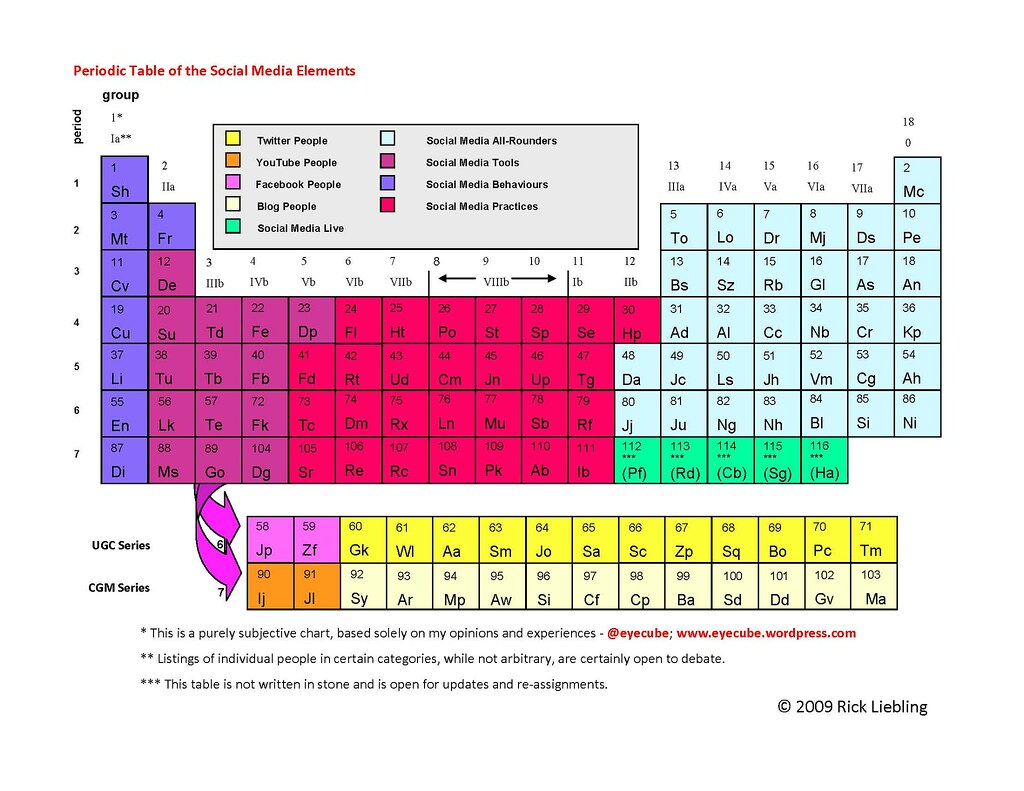
Rick Liebling put together a Periodic Table of Social Media Elements.
Periodic Table of Social Media
[click pic to enlarge]

This chart is interesting as much for the legend as the table itself. It's a road map to today's social media landscape with lists of influential bloggers, twitterers and experts; lists of terminology (we have all felt like we didn't know the secret handshake, this is so helpful); and a key to practices in social media (follow, hashtag, poke, status update).

I especially like the behaviors--what do people do within the social media space?
Social Media Behaviours: (These are the positive things you choose to do)
Sh = Share
Mt = Monitor
Fr = Friend
Cv = Converse
Cu = Customize
Li = Listen
En = Engage
Di = Dialogue
The idea is to mix up the different elements. I am not sure how that works, but this chart/legend is a great primer for people learning about social media and a great checklist for people who want to fill gaps in their social medial strategy.

Read Rick's post here.

Jan 13, 2009

Analytics Toolbox: 50+ More Ways to Track Website Traffic

0 comments
You can't manage what you don't measure. Really, you can't. And for folks managing web content and web applications, there is a growing --and many times free--cadre of tools to help you learn about what people are doing on your site, what they are interested in, and what they don't like.

See Mashable for 50 tools to help track traffic. You might want to check out
  • Google Analytics, for the price (free) you can't beat it. It does require persistent cookies, so is not right for dotgov without a waiver.
  • StatCounter for smaller sites, includes a nice set of reports for general website reporting.
  • Sitevolume you can track keyword volume on popular social media sites. You can see which words and phrases resonate and compare terms.
Look carefully under the hood of these tools to make sure that they meet the regulations for dotgov sites.

Jan 10, 2009

Social Media: Lists, Lists and More Lists

0 comments
Cheating isn't frowned upon in the work-world, and we are always looking for case-studies and examples that we can modify and use. Not to mention looking for examples to bolster our business cases, "well so-and-so is blogging!" [Note to Joe and John: cheating IS frowned upon in school!!!]

See "Social Media Case Studies SUPERLIST- 18 Extensive Lists of Organizations Using Social Media." Lists include corporate Twitterers, directory of Fortune 500 blogs, and nominees and award winners in various recognition programs with their case studies.

In addition to Robin's fab list, here are some lists from government.

The Collaboration Project from the National Academies of Public Administration for a terrific set of case studies of social media/collaboration in federal, state and local goverments.

Also, see USA.GOV for a number of directories like:
Finally, a (looong) list of government tweeters on Twitter is available at Twitter Fan Wiki.

Don't see your agency's efforts on these lists? Speak up and tell them you are missing. These resources are updated regularly.